╔
Porti, città e territori: il Documento di Pianificazione Strategica del Sistema Portuale della Sicilia Occidentale
Per lungo tempo i porti sono stati interpretati prevalentemente come infrastrutture tecniche dedicate al trasporto e alla movimentazione delle merci. I processi di globalizzazione, la trasformazione delle economie marittime e la crescente attenzione ai temi della sostenibilità hanno progressivamente modificato questa interpretazione. Oggi il porto è riconosciuto come un dispositivo territoriale complesso, capace di produrre effetti economici, urbani, sociali e ambientali che si estendono ben oltre il perimetro amministrativo delle aree portuali. In questa prospettiva, il porto non rappresenta più soltanto un’infrastruttura destinata alla logistica e ai trasporti, ma una piattaforma territoriale capace di attivare economie, costruire relazioni tra reti globali e sistemi locali e promuovere processi di trasformazione urbana.
For a long time, ports were primarily understood as technical infrastructures dedicated to transport and cargo handling. Processes of globalization, the transformation of maritime economies, and the growing emphasis on sustainability have progressively reshaped this interpretation. Today, the port is recognized as a complex territorial system capable of generating economic, urban, social, and environmental effects that extend well beyond the administrative boundaries of port areas. From this perspective, the port is no longer viewed merely as an infrastructure serving logistics and transport, but rather as a territorial platform capable of stimulating economic development, fostering relationships between global networks and local systems, and promoting processes of urban transformation.

Il network delle Autorità Portuali in Italia (aggiornamento 2022). Si tenga presente che ad oggi il network è stato esteso con l’ingresso in numerose Autorità di nuovi scali. A titolo esemplificativo, l’AdSP del Mare di Sicilia Occidentale oggi annovera anche Gela, Licata e Sciacca, tutti sul versante del Canale di Sicilia. (Elaborazione da “DPSS dell’Autorità di Sistema Portuale del Mare di Sicilia Occidentale”, 2022).
The network of Italian Port System Authorities (updated to 2022). It should be noted that the network has since been expanded through the inclusion of additional ports within several Port System Authorities. For example, the Port System Authority of the Western Sicilian Sea now also includes the ports of Gela, Licata, and Sciacca, all located along the Strait of Sicily. (Adapted from Strategic System Planning Document of the Port System Authority of the Western Sicilian Sea [DPSS], 2022).
Questa interpretazione si collega al paradigma della città liquida, sviluppato nell’ambito degli studi sui waterfront mediterranei (Carta, Ronsivalle, 2015; Carta et al., 2025), secondo il quale le città portuali contemporanee sono chiamate a superare la storica separazione tra aree operative e tessuti urbani, costruendo nuove forme di integrazione tra funzioni economiche, spazi pubblici e paesaggi costieri, ogniqualvolta le condizioni territoriali e funzionali lo consentano. Il porto diventa così un’infrastruttura relazionale, capace di connettere sistemi produttivi, dinamiche urbane e reti territoriali a differenti scale.
In questo quadro si inserisce il Documento di Programmazione Strategica di Sistema (DPSS), introdotto dalla normativa italiana (art. 5 della Legge 28 gennaio 1994, n. 84, come modificato dalla Legge n. 156/2021 e ss.mm.ii.). Il DPSS rappresenta uno degli strumenti più innovativi della pianificazione portuale nazionale, poiché propone una visione integrata dello sviluppo dei porti e dei territori che li ospitano. Nel caso dell’Autorità di Sistema Portuale del Mare di Sicilia Occidentale, il documento assume il ruolo di quadro strategico di riferimento attraverso il quale coordinare lo sviluppo portuale, la rigenerazione urbana e la valorizzazione territoriale lungo un esteso arco costiero che dal Tirreno occidentale percorre la costa occidentale e sud-occidentale della Sicilia fino a Gela e al Canale di Sicilia.
L’elemento di maggiore innovazione del DPSS consiste proprio nell’assumere il porto, insieme al suo retroterra economico e infrastrutturale, come interfaccia tra mare e terra, tra reti globali e sistemi territoriali locali. La pianificazione strategica supera così una concezione esclusivamente infrastrutturale dello scalo portuale per attribuirgli un ruolo di nodo territoriale, capace di integrare sviluppo economico, qualità urbana e sostenibilità ambientale.
L’Autorità di Sistema Portuale del Mare di Sicilia Occidentale costituisce un caso di studio particolarmente significativo per comprendere l’applicazione di questo approccio. Il sistema portuale comprende infatti Palermo, Termini Imerese, Trapani e Porto Empedocle e, più recentemente, anche Gela, Licata e Sciacca. Si tratta di realtà differenti per dimensioni, specializzazioni funzionali e rapporti con i territori di riferimento.
This interpretation is closely aligned with the Liquid City paradigm developed in studies on Mediterranean waterfronts (Carta & Ronsivalle, 2015; Carta et al., 2025). According to this perspective, contemporary port cities are called upon to overcome the historical separation between operational port areas and the urban fabric by developing new forms of integration among economic functions, public spaces, and coastal landscapes, whenever territorial and functional conditions permit. The port thus becomes a relational infrastructure, capable of connecting productive systems, urban dynamics, and territorial networks across multiple spatial scales.
Within this framework, the Strategic System Planning Document (Documento di Programmazione Strategica di Sistema, DPSS), introduced by Italian legislation (Article 5 of Law No. 84 of 28 January 1994, as amended by Law No. 156/2021 and subsequent amendments), represents one of the most innovative instruments in the national port planning system. The DPSS promotes an integrated vision of the development of ports and the territories in which they are embedded. In the case of the Port System Authority of the Western Sicilian Sea, the document serves as the overarching strategic framework for coordinating port development, urban regeneration, and territorial enhancement along an extensive coastal corridor extending from the western Tyrrhenian coast, along the western and south-western shores of Sicily, to Gela and the Strait of Sicily.
The most innovative aspect of the DPSS lies precisely in its recognition of the port, together with its economic and infrastructural hinterland, as an interface between sea and land, and between global networks and local territorial systems. Strategic planning thus moves beyond a purely infrastructural conception of the port, assigning it the role of a territorial node capable of integrating economic development, urban quality, and environmental sustainability.
The Port System Authority of the Western Sicilian Sea provides a particularly significant case study for understanding the application of this approach. Its port system currently includes Palermo, Termini Imerese, Trapani, and Porto Empedocle, as well as, more recently, Gela, Licata, and Sciacca. These ports differ considerably in terms of size, functional specialization, and their relationships with the surrounding territories.
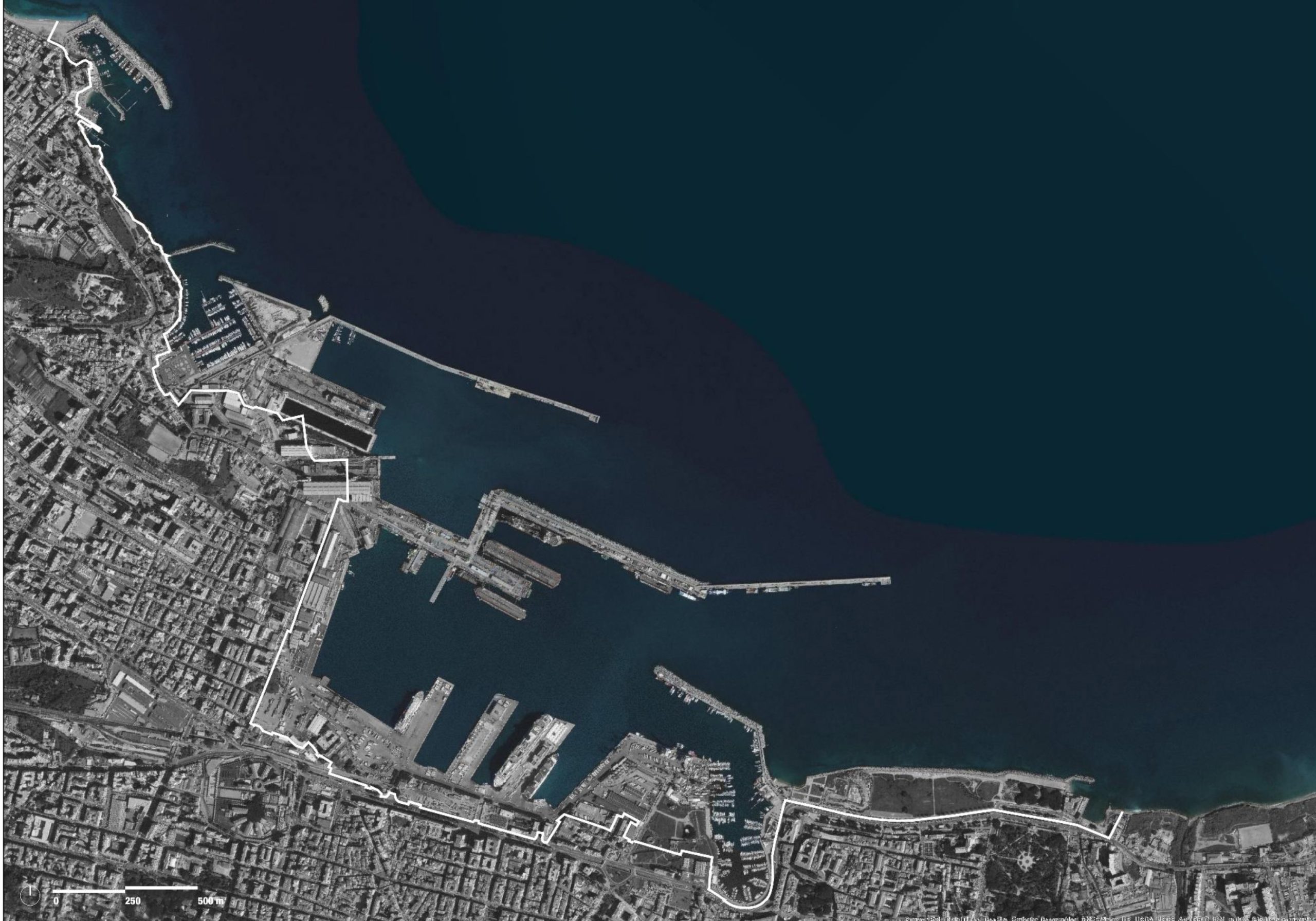
Palermo e il suo distretto portuale. (Elaborazione da “DPSS dell’Autorità di Sistema Portuale del Mare di Sicilia Occidentale”, 2022).
Palermo and its port district. (Adapted from Strategic System Planning Document of the Port System Authority of the Western Sicilian Sea [DPSS], 2022).
Palermo rappresenta il principale nodo del sistema, caratterizzato da traffico passeggeri, crocieristico e merci. Termini Imerese svolge una funzione strategica nel traffico ro-ro e nelle attività industriali. Trapani consolida il proprio ruolo nei collegamenti con le isole minori e nel settore della cantieristica e si apre al crocierismo. Porto Empedocle mantiene una vocazione legata alle merci e ai collegamenti con le Pelagie, proponendosi come porto crocieristico per Agrigento.
Gela – dal 2022 parte dell’Autorità – ha avviato un percorso strutturato di rilancio, orientato a restituire piena funzionalità e sicurezza alla navigazione, puntando sul superamento strutturale del problema dell’insabbiamento e sul miglioramento delle condizioni operative del Porto Rifugio. Licata – dal 2023 parte dell’Autorità – è soggetto a una riqualificazione complessiva che mira a rafforzarne il ruolo operativo e, insieme, a valorizzarne il significato urbano, culturale e sociale, in dialogo con le altre realtà costiere del network. Sciacca – recentemente entrata nel sistema – vedrà la realizzazione di interventi mirati ad accogliere grandi yacht e navi da crociera, integrando queste nuove funzioni con l’attività peschereccia. L’approccio combina funzionalità, sostenibilità e attenzione al paesaggio, con l’obiettivo di trasformare il porto in uno spazio vissuto, aperto e attrattivo.
Palermo is the principal hub of the system, handling passenger, cruise, and freight traffic. Termini Imerese performs a strategic role in roll-on/roll-off (Ro-Ro) services and industrial activities. Trapani has strengthened its position in connections with the smaller islands and in the shipbuilding sector, while also expanding its cruise operations. Porto Empedocle continues to specialize in freight traffic and ferry services to the Pelagie Islands, while positioning itself as the cruise gateway to Agrigento.
Gela – which became part of the Port System Authority in 2022 – has embarked on a structured redevelopment programme aimed at restoring the port’s full operational capacity and navigational safety by addressing the long-standing problem of sedimentation and improving the operational conditions of the Porto Rifugio (Harbour of Refuge). Licata – incorporated into the Authority in 2023 – is undergoing a comprehensive redevelopment process designed both to strengthen its operational role and to enhance its urban, cultural, and social significance in dialogue with the other coastal ports within the network. Sciacca – the most recent addition to the system – is expected to undergo targeted interventions to accommodate large yachts and cruise ships while integrating these new functions with its traditional fishing activities. This approach combines operational efficiency, environmental sustainability, and sensitivity to the coastal landscape, with the objective of transforming the port into a vibrant, accessible, and attractive urban space.
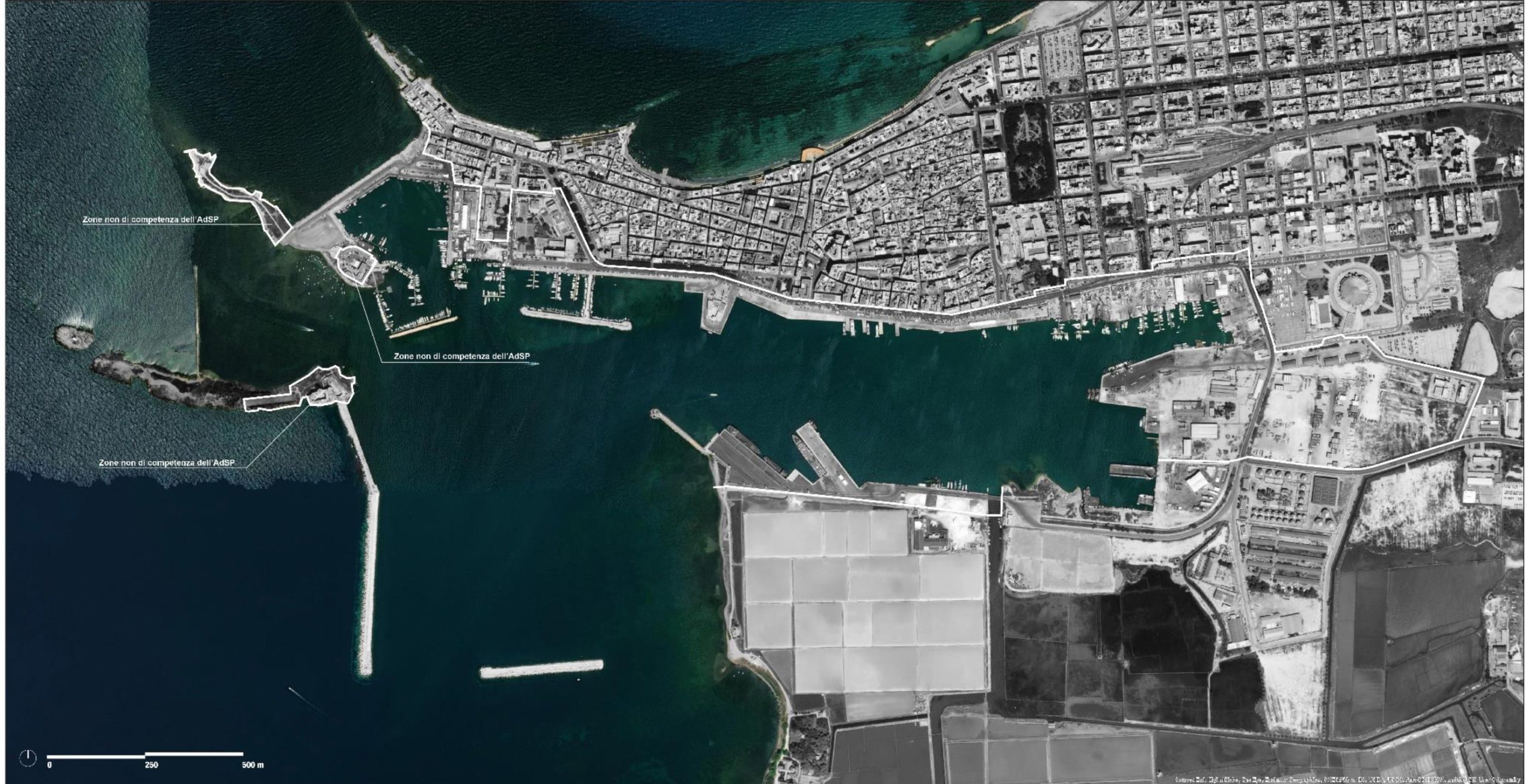
Trapani e il suo distretto portuale. (Elaborazione da “DPSS dell’Autorità di Sistema Portuale del Mare di Sicilia Occidentale”, 2022).
Trapani and its port district. (Adapted from Strategic System Planning Document of the Port System Authority of the Western Sicilian Sea [DPSS], 2022).
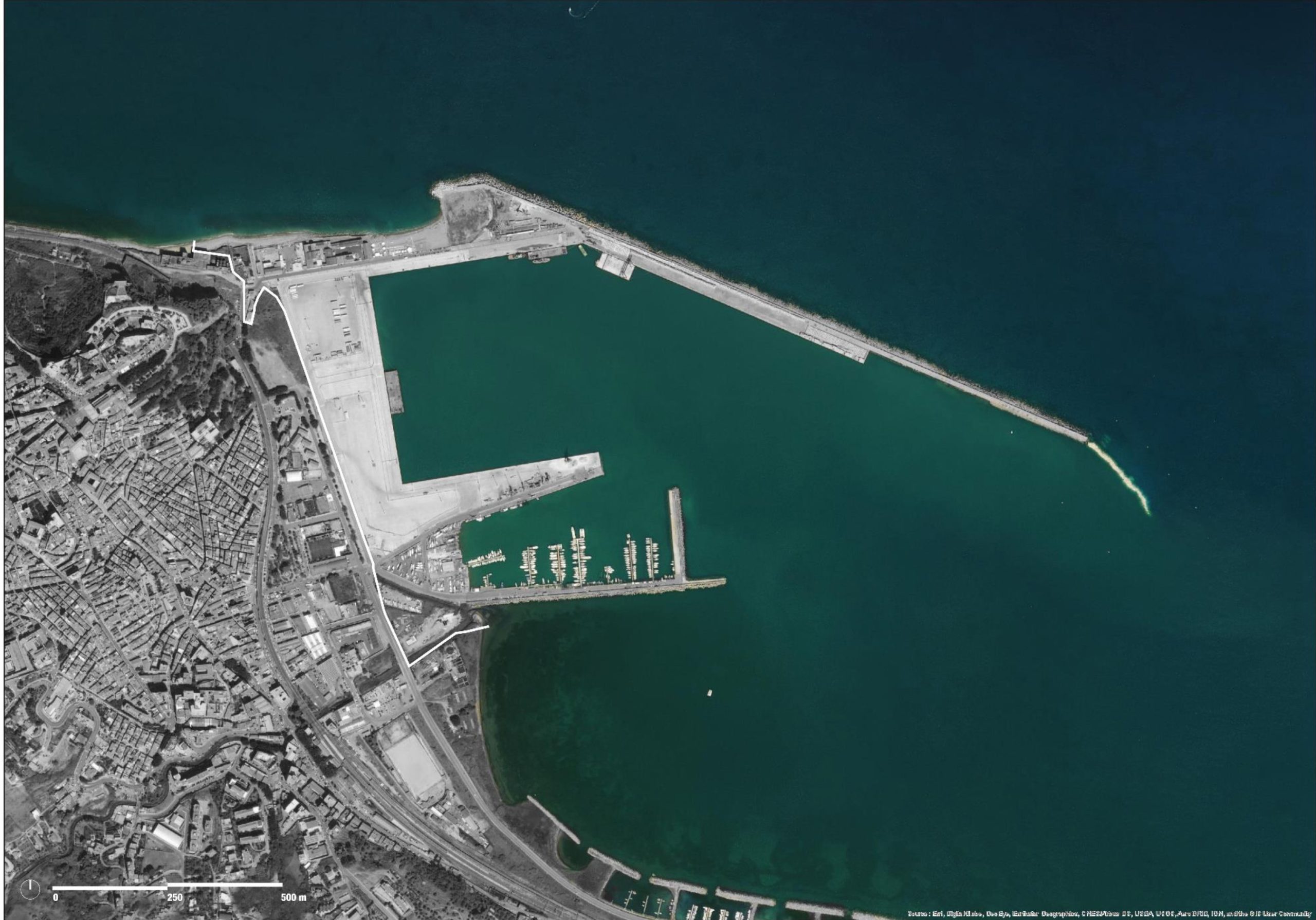
Termini Imerese e il suo distretto portuale. (Elaborazione da “DPSS dell’Autorità di Sistema Portuale del Mare di Sicilia Occidentale”, 2022).
Termini Imerese and its port district. (Adapted from Strategic System Planning Document of the Port System Authority of the Western Sicilian Sea [DPSS], 2022).

Porto Empedocle e il suo distretto portuale. (Elaborazione da “DPSS dell’Autorità di Sistema Portuale del Mare di Sicilia Occidentale”, 2022).
Porto Empedocle and its port district. (Adapted from Strategic System Planning Document of the Port System Authority of the Western Sicilian Sea [DPSS], 2022).
Va precisato che il DPSS vigente non riguarda ancora gli scali di Gela, Licata e Sciacca. Tuttavia, come si illustrerà successivamente, una caratteristica strutturale del documento approvato dal Ministero delle Infrastrutture e dei Trasporti consiste proprio nella predisposizione di studi e strategie capaci di accompagnare l’estensione del network, garantendo continuità e coerenza all’evoluzione del sistema.
It should be noted that the current DPSS does not yet cover the ports of Gela, Licata, and Sciacca. Nevertheless, as will be discussed in the following sections, one of the defining features of the document approved by the Italian Ministry of Infrastructure and Transport is its provision of studies and strategic guidelines capable of supporting the future expansion of the port network, thereby ensuring continuity and coherence in the long-term evolution of the system.
Gli obiettivi di sviluppo del DPSS
The Strategic Development Objectives of the DPSS
Il Documento di Programmazione Strategica di Sistema (DPSS) individua quattro grandi obiettivi strategici che delineano la visione di sviluppo dell’Autorità di Sistema Portuale del Mare di Sicilia Occidentale. Il primo riguarda l’adeguamento delle infrastrutture portuali alle nuove condizioni economiche, climatiche e tecnologiche. Il secondo è orientato al rafforzamento della competitività delle attività portuali attraverso una maggiore specializzazione funzionale. Il terzo è dedicato all’integrazione città-porto. Il quarto mira alla costruzione di economie di rete capaci di estendere i benefici dello sviluppo portuale all’intero territorio regionale.
Particolare rilievo assume il tema del rapporto città-porto. In numerosi contesti europei, la crescita delle attività logistiche ha determinato una progressiva separazione tra porto e città. Recinzioni, misure di sicurezza, specializzazione funzionale e incremento dei traffici hanno spesso trasformato lo scalo portuale in uno spazio percepito come estraneo alla vita urbana. Il DPSS del Mare di Sicilia Occidentale propone, invece, una strategia orientata alla ricostruzione delle relazioni fisiche, economiche e culturali tra porto e città, con l’obiettivo di superare tale frattura e rafforzare l’integrazione tra l’infrastruttura portuale e il contesto urbano.
In questa prospettiva, le aree di interazione città-porto rappresentano il principale strumento operativo della strategia. Si tratta di spazi nei quali sviluppare funzioni compatibili con le attività portuali e, al tempo stesso, capaci di generare benefici condivisi per cittadini, operatori economici e visitatori. Tali ambiti assumono il ruolo di luoghi di mediazione tra esigenze operative e qualità urbana, favorendo processi di integrazione funzionale e di valorizzazione degli spazi di transizione tra città e mare, divenendo nei fatti quel dispositivo connettivo, spazio-funzionale, di sviluppo e rigenerazione urbano-portuale.
La sostenibilità costituisce un ulteriore asse centrale del documento. Il DPSS si inserisce pienamente nel quadro delle politiche europee per la transizione ecologica, promuovendo interventi orientati all’efficientamento energetico, alla riduzione delle emissioni, all’economia circolare e all’innovazione tecnologica. I porti sono chiamati a svolgere un ruolo attivo nel raggiungimento degli obiettivi climatici europei, assumendo una funzione strategica nei processi di decarbonizzazione e di adattamento ai cambiamenti ambientali.
Nel caso della Sicilia occidentale, la sostenibilità assume un valore ancora più rilevante in ragione della presenza di importanti risorse ambientali e paesaggistiche strettamente interconnesse con l’intero sistema portuale. Le Saline di Trapani e Paceco, Monte Pellegrino, il sistema delle Madonie, i paesaggi costieri dell’agrigentino e numerose aree protette costituiscono elementi fondamentali del capitale territoriale regionale. Il DPSS interpreta tali risorse non come vincoli allo sviluppo, bensì come componenti strutturali di una strategia integrata, nella quale lo sviluppo portuale è chiamato a dialogare con la tutela ambientale e con la valorizzazione del patrimonio culturale.
The Strategic System Planning Document (DPSS) identifies four overarching strategic objectives that define the development vision of the Port System Authority of the Western Sicilian Sea. The first concerns the adaptation of port infrastructure to evolving economic, climatic, and technological conditions. The second aims to strengthen the competitiveness of port activities through greater functional specialization. The third focuses on city-port integration. The fourth seeks to foster network economies capable of extending the benefits of port development across the wider regional territory.
Particular emphasis is placed on the city-port relationship. In many European contexts, the expansion of logistics activities has led to a progressive separation between ports and cities. Security measures, physical barriers, functional specialization, and increasing freight volumes have often transformed ports into spaces perceived as disconnected from urban life. In contrast, the DPSS for the Western Sicilian Sea proposes a strategy aimed at rebuilding the physical, economic, and cultural relationships between port and city, with the objective of overcoming this divide and strengthening the integration of port infrastructure within the surrounding urban context.
Within this perspective, city-port interaction areas constitute the principal operational instrument of the strategy. These are spaces intended to accommodate functions that are compatible with port operations while simultaneously generating shared benefits for residents, economic stakeholders, and visitors. Such areas serve as mediating environments between operational requirements and urban quality, fostering functional integration and enhancing the transitional spaces between the city and the sea. In doing so, they effectively become connective spatial and functional devices for urban-port development and regeneration.
Sustainability represents another central pillar of the document. The DPSS is fully aligned with European policies for the ecological transition, promoting initiatives aimed at improving energy efficiency, reducing emissions, advancing the circular economy, and fostering technological innovation. Ports are therefore expected to play an active role in achieving the European Union’s climate objectives, assuming a strategic function in both decarbonization and climate adaptation processes.
In Western Sicily, sustainability acquires even greater significance because of the presence of outstanding environmental and landscape assets that are closely interconnected with the entire port system. The Trapani and Paceco Salt Pans, Monte Pellegrino, the Madonie mountain system, the coastal landscapes of the Agrigento area, and numerous protected areas constitute essential components of the region’s territorial capital. The DPSS interprets these resources not as constraints on development, but as structural elements of an integrated strategy in which port development is conceived in continuous dialogue with environmental protection and the enhancement of cultural heritage.

La dimensione euromediterranea in cui si inserisce il sistema portuale del Mare di Sicilia Occidentale. (Elaborazione da “DPSS dell’Autorità di Sistema Portuale del Mare di Sicilia Occidentale”, 2022).
The Euro-Mediterranean dimension of the Port System of the Western Sicilian Sea. (Adapted from Strategic System Planning Document of the Port System Authority of the Western Sicilian Sea [DPSS], 2022).
La dimensione euro-mediterranea rappresenta un ulteriore elemento strategico. La posizione geografica della Sicilia colloca l’isola al centro delle principali rotte che collegano Europa, Africa e Medio Oriente. In questo quadro, le reti TEN-T e il Corridoio Scandinavo-Mediterraneo offrono opportunità significative per rafforzare il ruolo dei porti siciliani all’interno delle catene logistiche internazionali, consolidandone la funzione di nodi strategici di connessione tra sistemi regionali e reti globali.
Alla luce di queste componenti chiave, il DPSS propone una visione articolata su due orizzonti temporali, non affrontando le questioni in modo statico e finalizzato esclusivamente alla definizione di aspetti localizzativi e normativi. Il primo orizzonte, di medio periodo, riguarda il completamento degli interventi già programmati e il miglioramento dell’efficienza operativa del sistema portuale. Il secondo, di lungo periodo, è orientato alla costruzione di un nuovo modello di sviluppo territoriale – e non esclusivamente portuale – fondato sull’integrazione tra logistica, innovazione, turismo, cultura e sostenibilità.
In questa prospettiva, l’Autorità di Sistema Portuale assume un ruolo profondamente rinnovato rispetto al passato. Essa non è più soltanto l’ente di gestione delle infrastrutture, ma si configura come attore della governance territoriale, chiamato a costruire visioni condivise e a promuovere processi di sviluppo integrato tra attori istituzionali, economici e territoriali.
The Euro-Mediterranean dimension constitutes another key strategic element of the DPSS. Sicily’s geographical location places the island at the crossroads of the principal maritime routes linking Europe, Africa, and the Middle East. Within this framework, the Trans-European Transport Network (TEN-T) and the Scandinavian–Mediterranean Corridor provide significant opportunities to strengthen the role of Sicilian ports within international logistics chains, consolidating their function as strategic nodes connecting regional systems with global networks.
In light of these key components, the DPSS advances a vision articulated across two complementary time horizons, rather than addressing planning issues through a static approach focused solely on land-use designations and regulatory provisions. The first, a medium-term horizon, concerns the completion of already planned interventions and the improvement of the operational efficiency of the port system. The second, a long-term horizon, is directed towards the construction of a new model of territorial development – not limited to port development alone –based on the integration of logistics, innovation, tourism, culture, and sustainability.
From this perspective, the Port System Authority assumes a substantially renewed role compared with the past. It is no longer merely the body responsible for managing port infrastructure; rather, it emerges as a key actor in territorial governance, entrusted with fostering shared strategic visions and promoting integrated development processes involving institutional, economic, and territorial stakeholders.

Il network infrastrutturale della AdSP MSO. (Elaborazione da “DPSS dell’Autorità di Sistema Portuale del Mare di Sicilia Occidentale”, 2022).
The infrastructure network of the AdSP-WSS. (Adapted from Strategic System Planning Document of the Port System Authority of the Western Sicilian Sea [DPSS], 2022).
In base a quanto descritto sopra, gli obiettivi strategici sono definiti in un quadro articolato su due orizzonti temporali: il medio periodo (6 anni) e il lungo periodo (15 anni). Tale impostazione consente di coordinare interventi di immediata attuazione con una prospettiva di sviluppo più ampia, nella quale alcune azioni strategiche contribuiscono alla visione “espansiva” di crescita di lungo termine, pur risultando indispensabili per il consolidamento degli obiettivi del medio periodo. Ne deriva una visione unitaria, declinata sui due orizzonti temporali, che consente di sviluppare un processo di pianificazione nel quale le opportunità già attive possono essere attuate e ulteriormente valorizzate attraverso i successivi Piani Regolatori Portuali da redigere per ciascuno degli scali portuali.
Il DPSS assume una chiara dimensione strategica integrando le azioni dell’Autorità di Sistema Portuale (AdSP) con quelle degli altri soggetti istituzionali coinvolti (Comuni, Città Metropolitana di Palermo, Liberi Consorzi Comunali di Trapani e Agrigento, Regione Siciliana, operatori economici ed enti statali per le rispettive competenze). Il documento svolge inoltre un ruolo proattivo di rilievo nell’individuazione di politiche e interventi anche in aree esterne ai perimetri di competenza portuale, ma in grado di sostenere e valorizzare le funzioni dei porti, considerate fattori trainanti per l’economia della Sicilia centro-occidentale. Completa questo quadro la definizione delle necessarie azioni regolative finalizzate a garantire l’efficienza e la funzionalità complessiva del sistema portuale.
Nell’ambito di questa triplice missione, gli obiettivi strategici sono i seguenti.
Obiettivo 1 – Adeguare le infrastrutture portuali per rispondere all’aumento previsto e programmato della domanda, realizzare gli opportuni adeguamenti funzionali e contribuire alla mitigazione degli effetti del cambiamento climatico. Lo stato attuale e le tendenze in atto richiederanno una serie di interventi in tutti i porti del sistema per garantire l’operatività anche in condizioni meteorologiche e marine sempre più avverse e improvvise, determinate dai cambiamenti climatici, dalle modificazioni geomorfologiche della costa e dall’innovazione tecnologica.
Obiettivo 2 – Gestire le merci in modo efficace e competitivo, rispondendo alla funzione primaria del porto quale luogo di trasporto e movimentazione. Tale obiettivo sarà perseguito attraverso nuove zonizzazioni o la ridefinizione delle aree operative nei singoli scali. Lo scenario di medio periodo mira a soddisfare pienamente ed efficientemente l’attuale andamento della domanda, mentre quello di lungo periodo punta a stimolarne la crescita attraverso l’offerta di servizi di trasporto e movimentazione in previsione dell’espansione dei mercati verso il Mediterraneo meridionale e verso nuove aree di produzione e consumo.
Obiettivo 3 – Integrare città e porto, estendendo e rafforzando le relazioni tra le funzioni portuali più permeabili e le attività urbane connesse al mare. Questo obiettivo si articola in due dimensioni:
- Sul piano urbanistico-funzionale, sono previsti interventi finalizzati alla creazione di funzioni nelle quali la comunità urbana possa beneficiare degli spazi portuali e, viceversa, attraverso specifici accordi, l’AdSP possa mettere a disposizione competenze tecniche e progettuali per la realizzazione di spazi e funzioni legati al mare anche al di fuori della giurisdizione portuale.
- Sul piano operativo, gli interventi mirano ad attivare processi di scambio economico tra città e porto, con particolare attenzione all’ottimizzazione e alla realizzazione di strutture dedicate alla gestione dei passeggeri nei diversi scali.
Obiettivo 4 – Sviluppare economie di rete, individuando infrastrutture e spazi, anche esterni alle aree di competenza portuale, idonei ad accogliere funzioni e politiche necessarie allo sviluppo delle filiere economiche. In una prima fase, l’azione si concentrerà sul rafforzamento delle strutture esistenti nel medio periodo; successivamente verranno programmate nuove linee di intervento di lungo termine, finalizzate a contribuire allo scenario di sviluppo delineato. Tra le azioni riconducibili a questo obiettivo rientrano i progetti di miglioramento dell’accessibilità dell’ultimo miglio alle infrastrutture portuali, poiché consentono di ridurre i tempi di percorrenza e di accesso, ampliando significativamente i territori raggiungibili dai porti entro 60 e 90 minuti, soglie particolarmente rilevanti per i quattro scali del sistema. Tali interventi costituiranno le condizioni di base per l’estensione del Sistema Portuale ad altri porti del Mediterraneo.
Based on the framework outlined above, the strategic objectives are defined across two planning horizons: the medium term (6 years) and the long term (15 years). This approach makes it possible to coordinate actions that can be implemented immediately with a broader development perspective, in which certain strategic initiatives contribute to the long-term growth vision while also proving essential to achieving the medium-term objectives. The result is a unified planning framework articulated across these two-time horizons, enabling a planning process in which existing opportunities can be implemented and further enhanced through the subsequent Port Master Plans to be prepared for each port within the system.
The DPSS adopts a clearly strategic perspective by integrating the actions of the Port System Authority (AdSP) with those of the other institutional stakeholders involved, including municipalities, the Metropolitan City of Palermo, the Free Municipal Consortia of Trapani and Agrigento, the Sicilian Regional Government, economic operators, and the competent national authorities. The document also plays a proactive role in identifying policies and interventions in areas beyond the boundaries of the port jurisdiction whenever these are capable of supporting and enhancing port functions, which are regarded as key drivers of economic development in central and western Sicily. This strategic framework is complemented by the definition of the regulatory measures required to ensure the overall efficiency and functionality of the port system.
Within this threefold mission, the strategic objectives are as follows.
Objective 1 – Adapting port infrastructure. Port infrastructure must be upgraded to accommodate the projected increase in demand, implement the necessary functional improvements, and contribute to mitigating the effects of climate change. Current conditions and emerging trends require a range of interventions across all ports within the system to ensure operational continuity under increasingly severe and unpredictable weather and sea conditions resulting from climate change, coastal geomorphological dynamics, and technological innovation.
Objective 2 – Enhancing the efficiency and competitiveness of freight operations. This objective addresses the port’s primary function as a hub for transport and cargo handling. It will be pursued through new functional zoning schemes or the reorganization of operational areas within individual ports. The medium-term scenario seeks to meet existing demand efficiently and comprehensively, while the long-term scenario aims to stimulate further growth by expanding transport and cargo-handling services in anticipation of the expansion of markets towards the Southern Mediterranean and other emerging production and consumption regions.
Objective 3 – Integrating the city and the port. This objective seeks to strengthen and expand the relationships between those port functions that are most compatible with urban activities and the broader range of sea-related urban functions. It is articulated through two complementary dimensions.
- Urban and functional dimension. Interventions are designed to create functions through which the urban community can benefit from port spaces while, conversely, the Port System Authority, through dedicated cooperation agreements, can provide technical and planning expertise for the development of maritime-related spaces and facilities beyond the limits of port jurisdiction.
- Operational dimension. Actions are intended to stimulate economic exchange between the city and the port, with particular emphasis on optimizing and developing passenger facilities across the different ports within the system.
Objective 4 – Developing network economies. This objective focuses on identifying infrastructure and spaces – including areas outside the Port System Authority’s jurisdiction – that are suitable for accommodating the functions and policies required to support the development of regional economic value chains. During the initial phase, efforts will concentrate on strengthening existing infrastructure over the medium term. This will be followed by the implementation of new long-term initiatives designed to contribute to the broader development scenario outlined in the DPSS. Actions associated with this objective include projects to improve last-mile accessibility to port infrastructure, reducing travel and access times while significantly expanding the areas that can be reached from the ports within 60 and 90 minutes – thresholds that are particularly relevant for the four core ports of the system. These interventions will establish the fundamental conditions for the future extension of the port system to additional Mediterranean ports.
Alcune considerazioni sul quadro strategico del DPSS dell’Autorità di Sistema Portuale del Mare di Sicilia Occidentale
Reflections on the Strategic Framework of the DPSS of the Port System Authority of the Western Sicilian Sea
L’esperienza dell’Autorità di Sistema Portuale del Mare di Sicilia Occidentale mostra come la pianificazione strategica possa contribuire a ridefinire il ruolo dei porti nel XXI secolo, superando una concezione prevalentemente infrastrutturale e settoriale delle politiche portuali. Le trasformazioni dell’economia globale, la transizione ecologica, l’evoluzione delle catene logistiche e la crescente competizione tra territori richiedono infatti strumenti di governo capaci di integrare scale, competenze, politiche e dimensioni differenti. In questo quadro, il Documento di Programmazione Strategica di Sistema rappresenta una risposta a questa esigenza, ponendosi come un dispositivo di pianificazione innovativo, in grado di costruire una visione nella quale infrastrutture, città, territori e reti di mobilità concorrono alla definizione di un progetto unitario di sviluppo.
L’elemento di maggiore interesse che emerge dalla progressiva implementazione del DPSS – e dal necessario processo di aggiornamento attualmente in corso di redazione da parte dell’Autorità per accompagnare l’estensione del sistema portuale e le nuove esigenze di pianificazione – risiede nella capacità di costruire relazioni: tra mare e terra, tra città e porto, tra economia e ambiente, tra patrimonio territoriale e innovazione, tra dimensione locale e reti globali. Il porto viene così interpretato non più come semplice punto di accesso alle reti del trasporto marittimo, ma un motore di innovazione territoriale, una piattaforma territoriale capace di attivare processi di integrazione, di generare nuove economie e di promuovere trasformazioni urbane e territoriali.
Le strategie delineate dal documento mostrano come il rafforzamento della competitività del sistema portuale possa essere perseguita parallelamente alla qualità dello spazio urbano, alla tutela delle risorse ambientali e paesaggistiche e alla valorizzazione del patrimonio culturale. La competitività non viene quindi perseguita come obiettivo autonomo, ma come esito di una strategia integrata nella quale sviluppo economico, sostenibilità e qualità urbana si rafforzano reciprocamente. In questo senso, l’approccio del DPSS supera una concezione settoriale della pianificazione portuale e promuove forme più avanzate di governance territoriale, proponendo un modello fondato sul coordinamento tra istituzioni, territori e soggetti economici.
Sotto questo profilo, le città portuali della Sicilia occidentale rappresentano un laboratorio di sperimentazione particolarmente significativo per il contesto mediterraneo. La pluralità degli scali, la diversità delle rispettive specializzazioni funzionali e la varietà dei contesti territoriali nei quali essi si inseriscono rendono questo sistema un caso di studio significativo per sperimentare modelli di pianificazione multi-scalare capaci di coniugare competitività, coesione territoriale e sostenibilità. Le soluzioni proposte dal DPSS possono pertanto offrire indicazioni utili anche ad altri sistemi portuali chiamati a confrontarsi con sfide analoghe, avendo dimostrato come non sia soltanto uno strumento di programmazione di opere e investimenti, ma soprattutto uno strumento per costruire una visione territoriale capace di orientare le trasformazioni future.
Nel suo complesso, il caso della Sicilia occidentale evidenzia come i porti possano tornare ad assumere un ruolo centrale nei processi di sviluppo delle città e dei territori. La prospettiva delineata dal DPSS suggerisce infatti un cambiamento di paradigma: il porto non è più soltanto un’infrastruttura funzionale ai traffici marittimi, ma un nodo strategico di un sistema territoriale complesso, nel quale convergono funzioni logistiche, urbane, ambientali, culturali e relazionali. Attraverso una pianificazione strategica integrata e una governance orientata alla cooperazione istituzionale, il sistema portuale può contribuire alla costruzione di modelli di sviluppo più sostenibili, inclusivi e competitivi, rafforzando al contempo il ruolo della Sicilia e del Mediterraneo quali spazi di connessione tra economie, culture e paesaggi.
The experience of the Port System Authority of the Western Sicilian Sea demonstrates how strategic planning can contribute to redefining the role of ports in the twenty-first century by moving beyond a predominantly infrastructural and sector-specific approach to port policy. The transformation of the global economy, the ecological transition, the evolution of logistics chains, and the growing competition among territories require governance instruments capable of integrating multiple spatial scales, institutional competences, policy domains, and planning dimensions. Within this context, the Strategic System Planning Document (DPSS) represents an innovative planning instrument that responds to these challenges by articulating a comprehensive vision in which infrastructure, cities, territories, and mobility networks collectively contribute to a unified development strategy.
The most significant aspect emerging from the progressive implementation of the DPSS – and from the ongoing revision currently being prepared by the Port System Authority to support the expansion of the port system and address emerging planning needs – is its capacity to build relationships: between sea and land, between city and port, between economy and environment, between territorial heritage and innovation, and between local contexts and global networks. Within this framework, the port is no longer conceived merely as a gateway to maritime transport networks, but as a driver of territorial innovation – a territorial platform capable of fostering processes of integration, generating new economic opportunities, and promoting urban and regional transformation.
The strategies outlined in the document demonstrate that strengthening the competitiveness of the port system can be pursued in parallel with improving urban quality, protecting environmental and landscape resources, and enhancing cultural heritage. Competitiveness is therefore not treated as an isolated objective but rather as the outcome of an integrated strategy in which economic development, sustainability, and urban quality mutually reinforce one another. In this respect, the DPSS moves beyond a sectoral approach to port planning and promotes more advanced forms of territorial governance based on coordination among institutions, territories, and economic stakeholders.
From this perspective, the port cities of Western Sicily constitute a particularly significant laboratory for experimentation within the Mediterranean context. The diversity of the ports, their different functional specializations, and the variety of territorial settings in which they are embedded make this system a valuable case study for testing multi-scalar planning models capable of reconciling competitiveness, territorial cohesion, and sustainability. The solutions proposed by the DPSS may therefore provide useful insights for other port systems facing similar challenges, demonstrating that the document is not merely a framework for programming infrastructure and investment but, above all, a strategic instrument for constructing a territorial vision capable of guiding future transformations.
Taken as a whole, the case of Western Sicily illustrates how ports can once again assume a central role in the development of cities and territories. The perspective advanced by the DPSS points to a genuine paradigm shift: the port is no longer simply an infrastructure serving maritime transport but a strategic node within a complex territorial system where logistical, urban, environmental, cultural, and relational functions converge. Through integrated strategic planning and governance founded on institutional cooperation, the port system can contribute to the construction of development models that are more sustainable, inclusive, and competitive, while simultaneously reinforcing the role of Sicily and the Mediterranean as spaces of connection among economies, cultures, and landscapes.
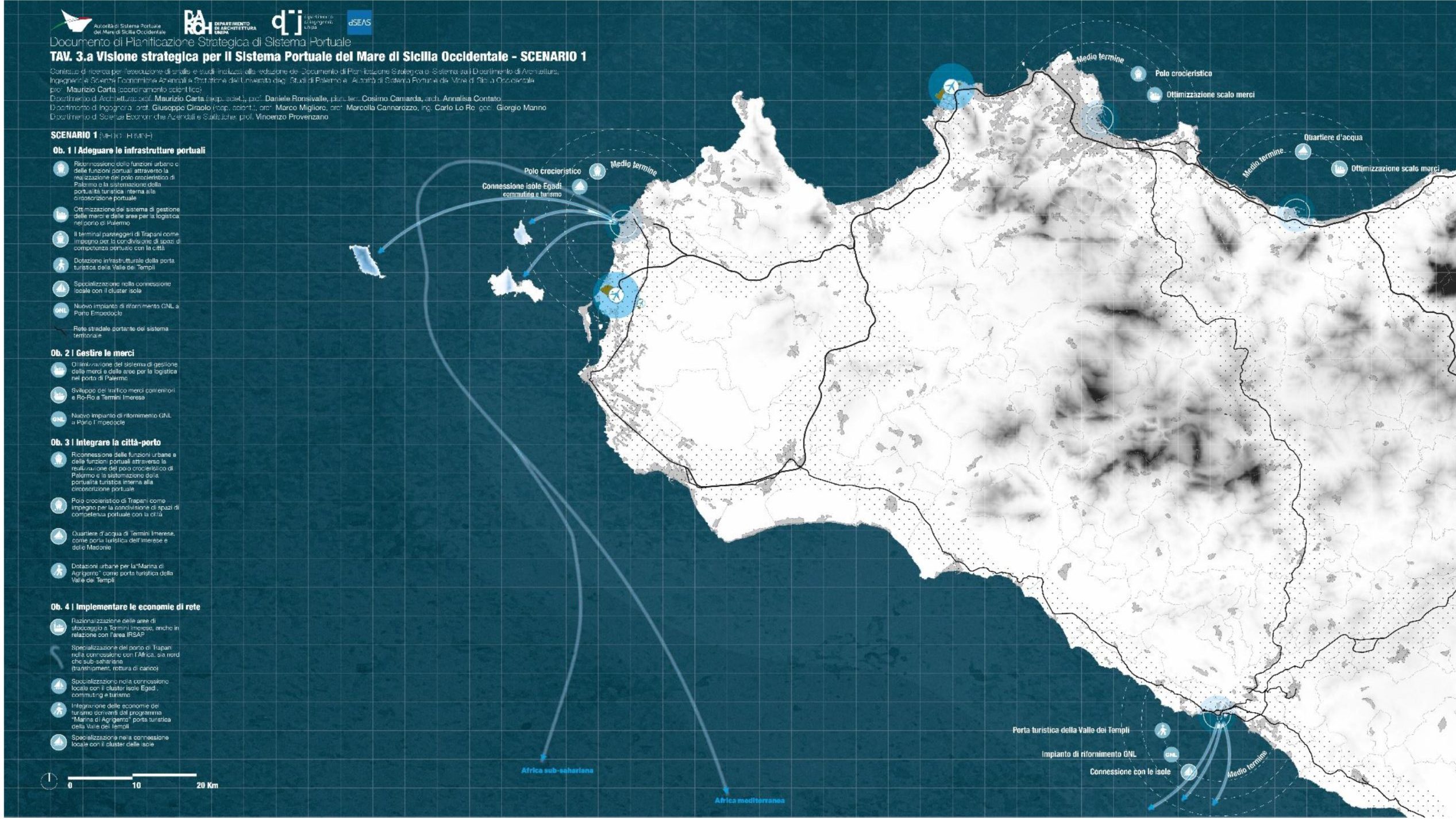
DPSS della AdSP MSO. Lo scenario 1 di potenziamento e rafforzamento infrastrutturale portuale. (Fonte: DPSS dell’Autorità di Sistema Portuale del Mare di Sicilia Occidentale”, 2022).
DPSS of the Port System Authority of the Western Sicilian Sea. Scenario 1: Port Infrastructure Enhancement and Upgrading. (Source: Strategic System Planning Document of the Port System Authority of the Western Sicilian Sea [DPSS], 2022).
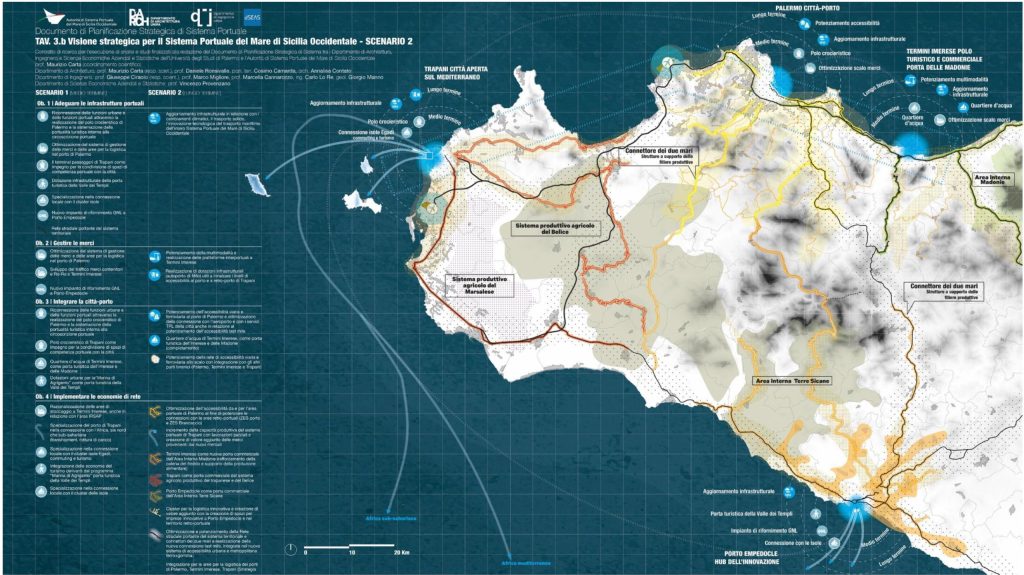
DPSS della AdSP MSO. Lo scenario 2 di crescita territoriale del sistema portuale. (Fonte: DPSS dell’Autorità di Sistema Portuale del Mare di Sicilia Occidentale”, 2022).
DPSS of the Port System Authority of the Western Sicilian Sea. Scenario 2: Territorial Growth of the Port System. (Source: Strategic System Planning Document of the Port System Authority of the Western Sicilian Sea [DPSS], 2022).
IMMAGINE INIZIALE | Veduta del porto di Palermo dal mare. (© Daniele Ronsivalle, 2021).
HEAD IMAGE | View of the Port of Palermo from the Sea. (© Daniele Ronsivalle, 2021).
╝
RIFERIMENTI
REFERENCES
Carta, M., La Greca, P., Ronsivalle, D., Lino, B. (2025), Planning Complex Waterfront Interfaces. Reshaping Port City Regeneration for Sustainable Urban Futures, Springer Nature, Cham.
Carta, M., Ronsivalle, D., Lino, B. (2020), The Good Practice Framework for European Sustainable Urbanisation through port city Regeneration. An operative guide, Espon publisher, Luxembourg.
Carta M., Ronsivalle D. (eds., 2016), The fluid city paradigm. Waterfront regeneration as an urban renewal strategy, Springer International Publishing, Cham.
Carta M. (2013), Waterfront atlas. Vision, paradigms, policies and integrated projects for the Sicilian and Maltese waterfronts, Dipartimento Città e Territorio, Palermo.
Ministero delle Infrastrutture e dei Trasporti (2007), Reti e territori al futuro. Materiali per una visione, Ministero delle Infrastrutture e dei Trasporti, Roma.
RONSIVALLE, Daniele and Annalisa CONTATO. “Ports, Cities and Territories: The Port System Strategic Planning Document of Western Sicily”. PORTUS | Port-City Relationship and Urban Waterfront Redevelopment, 51 (August 2026). RETE Publisher, Venice. ISSN 2282-5789. URL: https://portusonline.org/ports-cities-and-territories-the-port-system-strategic-planning-document-of-western-sicily/