╔
The affirmation of a competitive and sustainable regional economy depends on the existence of infrastructures capable of responding to the demands of the present and, at the same time, anticipating the challenges of the future. It is in this context that the Port of Aveiro is positioned as a strategic asset for the development of the region and the country.
In a scenario of growing global competition, the role of ports goes far beyond the movement of goods. They are now complex logistics platforms, which influence the competitiveness of companies, the attractiveness of territories and the resilience of supply chains. The Port of Aveiro has been assuming this role clearly, reinforcing its response capacity and its integration into the economic fabric of the Central region and Iberian space.
Its privileged location in the Center of Portugal and on the Ria de Aveiro, combined with a strong connection to a strong industrial hinterland, allows it to function as a relevant logistics node, capable of articulating different modes of transport and offering more efficient and integrated solutions. The focus on intermodality, in particular in strengthening rail connections, has been decisive in improving the efficiency of the logistics system, reducing road constraints and increasing the overall competitiveness of the region.
This positioning has been accompanied by a consistent evolution of port activity. In 2025, the Port of Aveiro reached its best performance ever, with 5.85 million tons handled, reflecting not only growth, but also greater operational efficiency, evidenced by the increase in the average cargo per ship. To keep up this dynamic, the Port of Aveiro has ongoing structuring investments, such as the new Intermodal Terminal, which will allow more efficient rail operations. A new project to improve maritime accessibility is also underway, which will strengthen the capacity to receive larger ships and allow the Port to finally receive Panamax-class Ships.
This performance and investments are only possible due to the strong performance of the companies in our hinterland and the great relationships with our nearby cities of Gafanha da Nazaré, Ílhavo and Aveiro. This close relationship is hallmarked in the Port Community Association, where all stakeholders (from the Port Administration to city representatives and companies like Navigator, Ferpinta and others) are able to provide their feedback on Port efficiency, bottlenecks, and potential improvements. A good port-city-company relationship is essential for our Port, to ensure we provide the best service and performance to all stakeholders involved and ensure overall competitiveness of our region vis-à-vis other European regions.
But competitiveness is also built through innovation. The focus on digital transformation is, therefore, a central axis of the Port of Aveiro’s strategy. The integration in initiatives such as the Technological Free Zone, in partnership with the University of Aveiro and other entities, has allowed the testing and development of technological solutions applied to the port context.
In parallel, participation in European projects such as 6G-VERSUS strengthens the link to cutting-edge innovation, exploiting the potential of next-generation networks to make operations smarter, safer and more efficient. This involvement does not end here. Also noteworthy is the participation in projects such as A-AAGORA, focused on the restoration of marine and coastal ecosystems and the strengthening of climate resilience, or Climate Adapt, which aims to eliminate barriers to access climate data and promote its integration into operational systems.
In terms of operational efficiency, we have been investing in digitization and process integration. Like the other national ports, we work with the Logistics Single Window and, in the future, we will integrate the European Maritime Single Window, a European digital platform that will allow entities involved in maritime transport to send, exchange and receive information through a single portal.
Soon, the Single Port Card will also be implemented, reinforcing the modernization of access to the terminals of the Port of Aveiro and decreasing the number of paper documents and bureaucracy to safely access Port infrastructure. This advance is also the result of the recent reformulation of the ordinances, which are now more digital, efficient and secure.
We also invested in modernizing critical systems such as the VTS (Vessel Traffic Service), which will increase the effectiveness of maritime traffic monitoring and improve the safety and efficiency of ship entry and exit maneuvers. All these initiatives intersect areas such as security, mobility and intelligent port management.
To these axes is added an increasingly relevant dimension: data. The valorization of the Blue Economy increasingly depends on the ability to collect, process and share information in a structured way. European initiatives promoting principles such as FAIR data, as well as platforms such as EOSC or EMODnet, are examples of this evolution. The latter, for example, brings together marine data from various European sources in a harmonized way.
Sustainability is another structuring axis of the port strategy. The energy transition, resource efficiency and the reduction of environmental impact are not parallel objectives, but an integral part of the way the port develops and projects itself into the future. This is also added by the fact that the Port of Aveiro is located in the Ria de Aveiro, a unique ecosystem harboring dozens of jobs, wildlife and a gateway to the Atlantic Ocean. Preserving this unique and brilliant ecosystem is also part of our sustainability strategy, combining our relations with our neighboring cities to create feasible strategies for preservation and promotion.
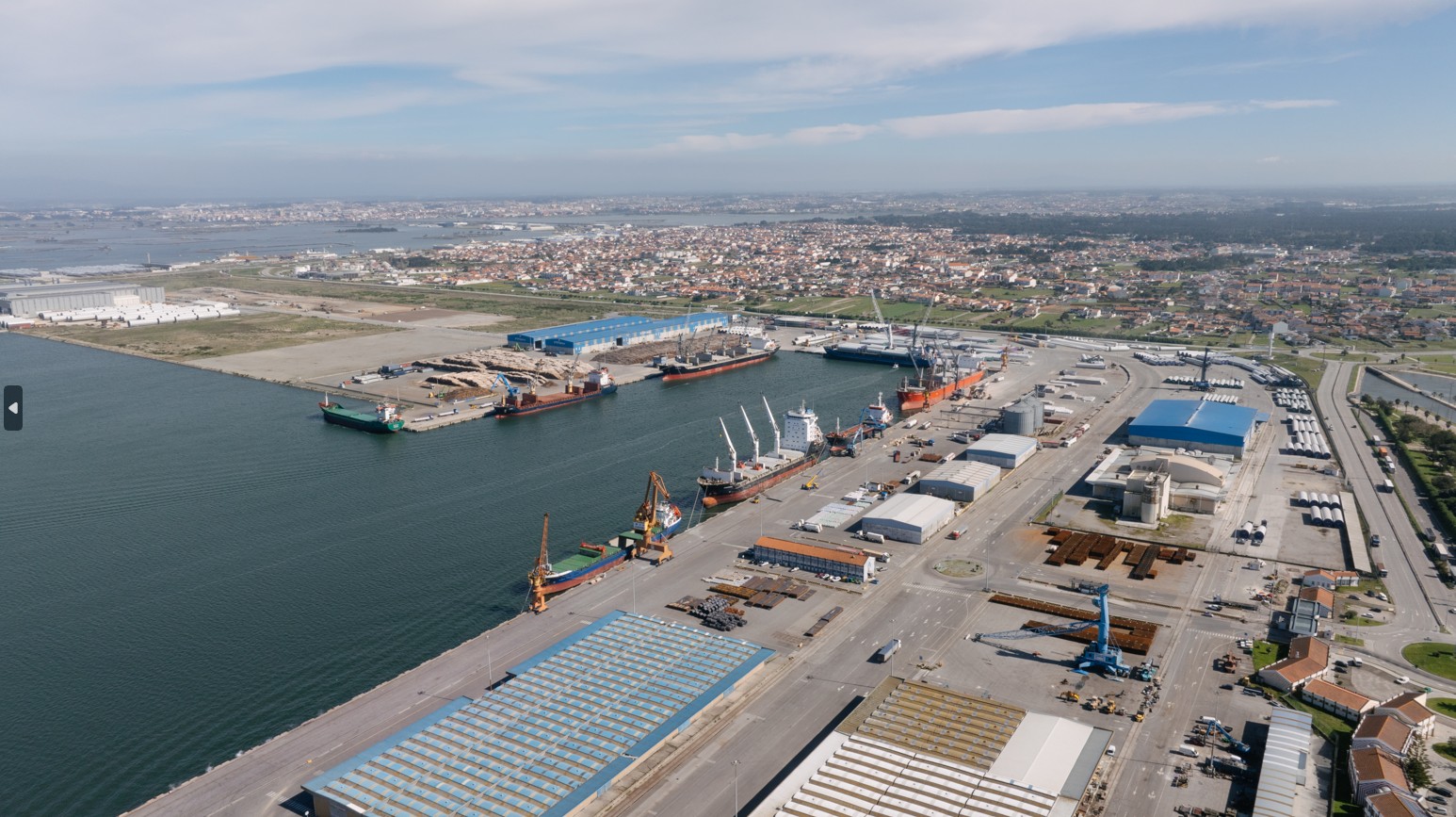
Aerial view of the Port odf Aveiro, with the cargo ships docked along the piers and industrial warehouses. (Source: Administration of the Port of Aveiro).
In this context, the Port of Aveiro assumed, in 2024, a formal commitment to the European mission “Restore Our Ocean and Waters by 2030”, aligning itself with one of the main challenges of the European Union: the protection and regeneration of marine and aquatic ecosystems. This commitment translates into concrete actions in the areas of decarbonization, ecosystem restoration and the promotion of biodiversity, involving the entire port community and society.
By 2030, significant investments in sustainability are planned. We are talking about concrete measures such as strengthening energy infrastructure based on renewable sources, implementing electricity supply systems for moored ships, developing decarbonized mobility plans, testing locally produced biofuels and adopting nature-based solutions to increase coastal resilience and promote biodiversity.
In a context in constant transformation, the Port of Aveiro asserts itself as an infrastructure at the service of regional competitiveness, innovation and the sustainable transition of the economy. A port that connects territory, companies and knowledge and that seeks to respond to challenges with concrete and consistent solutions.
The future requires more integration, more efficiency, and more collaboration. And it is on this path that the Port of Aveiro wants to continue to assert itself.
HEAD IMAGE | Terminal North of the Port of Aveiro. (Source: Administration of the Port of Aveiro).