╔
Muelle Ciudad: Cádiz convierte su frente portuario en un nuevo espacio público
En 2019, en estas mismas páginas de PORTUS, Teófila Martínez resumía con una idea muy sencilla uno de los grandes retos urbanos de Cádiz: «Integrar es fusionar». Siete años después, aquel planteamiento está dejando de ser una aspiración para convertirse en un espacio físico. Las obras de ordenación del Muelle Ciudad, en pleno frente portuario del casco histórico, avanzan ya en su fase de pavimentación y hacen visible una transformación largamente esperada: la recuperación para el uso ciudadano de una franja estratégica entre la Plaza de Sevilla, la Plaza de San Juan de Dios y los atraques de cruceros [1] [12].
In 2019, in these same pages of PORTUS, Teófila Martínez summed up one of Cádiz’s major urban challenges with a very simple idea: “Integration means fusion”. Seven years later, that concept is moving from aspiration to physical reality. The redevelopment of Muelle Ciudad, on the port waterfront directly facing the historic centre, has already entered the paving stage and is making a long-awaited transformation visible: the recovery for public use of a strategic strip between Plaza de Sevilla, Plaza de San Juan de Dios and the cruise berths [1] [12].
Vista actual de las obras y el pavimento en Muelle Ciudad. (Source: Autoridad Portuaria del la Bahía de Cádiz).
Current view of the works and paving at Muelle Ciudad. (Source: Port Authority of Cadiz Bay).

La actuación completa abarca 22.500 metros cuadrados. Su primera fase interviene sobre unos 14.000 metros cuadrados, en una franja de 38 metros paralela al muelle. El objetivo no es convertir un antiguo suelo portuario en un parque convencional, sino diseñar un espacio híbrido capaz de mantener la actividad marítima y, al mismo tiempo, incorporar nuevos usos urbanos. El proyecto prevé amplias zonas peatonales, jardines, áreas de estancia, juegos infantiles, dos fuentes transitables, espacios expositivos, zonas para restauración y una superficie multiusos que, cuando no sea necesaria para los autobuses de cruceros, podrá acoger actividades ciudadanas [2] [9].
La Puerta del Mar se conserva como elemento histórico y se convierte en el principal acceso al nuevo ámbito. Frente a ella, el diseño prolonga visual y funcionalmente la Plaza de San Juan de Dios hacia el puerto. En el extremo próximo a la Plaza de Sevilla se crea otra plaza y se proyecta un módulo de hostelería; un segundo módulo, junto a la terminal de pasajeros de cruceros, está pensado como espacio de recepción conectado directamente con el centro histórico. Una franja queda reservada para una futura plataforma tranviaria, paralela al carril bici ya existente, mientras que la vegetación funcionará también como filtro acústico respecto a la Avenida del Puerto [2] [9].
The complete intervention covers 22,500 square metres. Its first phase affects around 14,000 square metres along a 38-metre-wide strip running parallel to the quay. The aim is not to turn former port land into a conventional park, but to design a hybrid space capable of maintaining maritime activity while introducing new urban uses. The project includes broad pedestrian areas, gardens, places to sit and stay, children’s play areas, two walk-through fountains, exhibition spaces, hospitality uses and a multipurpose surface which, when it is not required for cruise coaches, can host public activities [2] [9].
Puerta del Mar is being preserved as a historic element and will become the main entrance to the new area. In front of it, the design visually and functionally extends Plaza de San Juan de Dios into the port. At the end nearest Plaza de Sevilla, a second square is being created together with a hospitality pavilion; another pavilion, beside the cruise passenger terminal, is conceived as a reception space directly connected with the historic centre. A strip is reserved for a possible future tram platform parallel to the existing cycle lane, while planting will also provide an acoustic filter from Avenida del Puerto [2] [9].
Representación oficial del futuro Muelle Ciudad. (Source: Autoridad Portuaria del la Bahía de Cádiz).
Official rendering of the future Muelle Ciudad. (Source: Port Authority of Cadiz Bay).

Hay un aspecto especialmente relevante para entender el proyecto: la integración no supone la desaparición del puerto. Una banda de 25 metros junto al cantil debe mantenerse para el tránsito de pasajeros y el cumplimiento de las exigencias internacionales de protección portuaria. El cerramiento previsto será acristalado, de modo que la actividad de los buques y del muelle seguirá formando parte del paisaje cotidiano; ese espacio podrá abrirse en determinados momentos cuando no haya cruceros atracados. La convivencia entre seguridad, operatividad y acceso ciudadano es, por tanto, uno de los criterios que explican la solución adoptada [2] [9].
Esa compatibilidad también está condicionando la ejecución. La Estación de Pasajeros ha tenido que permanecer operativa y las obras se han organizado en dos ámbitos. Tras un invierno especialmente lluvioso, que retrasó parte de las instalaciones enterradas, durante mayo y junio de 2026 el volumen de obra ejecutada fue un 35% superior al de los cuatro meses anteriores. A comienzos de agosto ya había empezado la pavimentación en el sector próximo al Muelle Alfonso XIII, mientras se ultimaban las redes subterráneas en el tramo que avanza hacia el Muelle Reina Victoria y la Plaza de Sevilla [3] [1].
El diseño incorpora además una lectura de la memoria de Cádiz. Los adoquines de granito, el acero corten y una selección vegetal en la que aparecen jacarandas, ombúes, laureles de Indias, palmeras, palmitos, lantanas o buganvillas buscan evocar la tradición portuaria y la histórica conexión de la ciudad con América. También hay decisiones menos visibles pero significativas: los restos de hormigón y materiales pétreos retirados durante las obras están siendo reutilizados para fabricar la zahorra artificial situada bajo los nuevos pavimentos, evitando su traslado a vertedero y reduciendo el consumo de nuevos recursos [2][4] [18].
Muelle Ciudad es, sin embargo, sólo la primera pieza construida de una operación de mayor escala. La innovación del Plan Especial del Puerto, aprobada definitivamente por la Junta de Andalucía en 2023, ordena un ámbito de 335.000 metros cuadrados destinado a la relación puerto-ciudad, que incluye los muelles Reina Victoria, Ciudad, Alfonso XIII y Reina Sofía, además del Paseo Pascual Pery y Punta de San Felipe. En noviembre de 2024, Junta de Andalucía, Ayuntamiento y Autoridad Portuaria formalizaron un protocolo de colaboración para coordinar la apertura y adecuación de todo ese borde marítimo [5][6] [19].
One aspect is particularly important for understanding the project: integration does not mean the disappearance of the port. A 25-metre band beside the quay edge must remain available for passenger movement and for compliance with international port-security requirements. The proposed enclosure will be glazed, so ships and quay operations will continue to form part of the everyday landscape; sections of this area may be opened at certain times when no cruise vessels are berthed. The ability to reconcile security, operations and public access is therefore one of the principles behind the adopted solution [2] [9].
That compatibility is also shaping construction. The Passenger Terminal has had to remain operational and the works have therefore been organised in two areas. Following an exceptionally rainy winter, which delayed some underground services, the volume of work completed in May and June 2026 was 35% higher than in the previous four months. By early August, paving had already begun in the sector close to Muelle Alfonso XIII, while underground networks were being completed along the section leading towards Muelle Reina Victoria and Plaza de Sevilla [3] [1].
The design also interprets the memory of Cádiz. Granite paving, weathering steel and a planting palette including jacarandas, ombú trees, Indian laurels, palms, dwarf palms, lantanas and bougainvillea are intended to evoke both the city’s port tradition and its historic links with the Americas. There are also less visible but significant decisions: concrete and stone debris removed during construction is being reused to produce the artificial aggregate base beneath the new pavements, avoiding disposal in landfill and reducing the consumption of new resources [2][4] [18].
Muelle Ciudad, however, is only the first built piece of a much larger operation. The amendment to the Port Special Plan, definitively approved by the Regional Government of Andalusia in 2023, organises a 335,000-square-metre area devoted to the port-city relationship, including the Reina Victoria, Ciudad, Alfonso XIII and Reina Sofía quays, as well as Paseo Pascual Pery and Punta de San Felipe. In November 2024, the Regional Government, Cádiz City Council and the Port Authority signed a cooperation protocol to coordinate the opening and adaptation of this entire waterfront [5][6] [19].
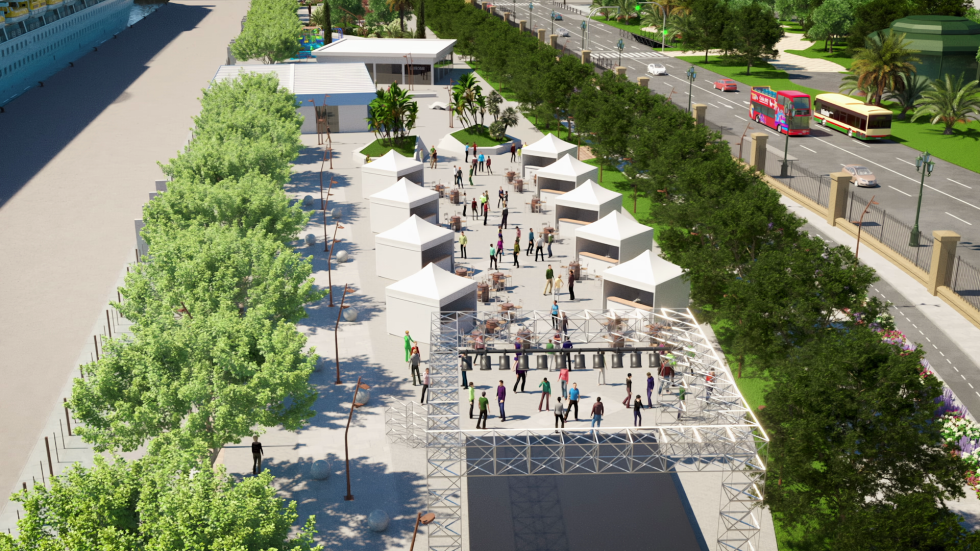
Representación oficial del futuro Muelle Ciudad. (Source: Autoridad Portuaria del la Bahía de Cádiz).
Official rendering of the future Muelle Ciudad. (Source: Port Authority of Cadiz Bay).
La segunda fase de Muelle Ciudad deberá integrar el viario que todavía da servicio a la terminal de contenedores del Muelle Reina Sofía y completar la conexión con el Muelle Reina Victoria y la terminal de catamaranes. Por eso, el avance del proyecto urbano está estrechamente relacionado con otra gran transformación portuaria: el traslado de la actividad de contenedores a la nueva terminal. La operación muestra hasta qué punto la integración puerto-ciudad no consiste simplemente en liberar suelo, sino en reorganizar funciones para que el puerto gane competitividad al mismo tiempo que la ciudad gana espacio público [2][7] [14].
Teófila Martínez lo ha expresado durante el inicio de las obras con una fórmula que resume esa voluntad de coexistencia: «el Puerto de la Bahía de Cádiz seguirá siendo puerto y será también ciudad» [2]. La frase contiene la clave del proyecto. Cádiz no está dando la espalda a su puerto para recuperar el mar; está intentando que actividad portuaria, movilidad, turismo, economía, memoria y vida cotidiana vuelvan a formar parte de un mismo paisaje [9].
El verdadero resultado no se medirá únicamente en metros cuadrados urbanizados. Se medirá en la facilidad con la que un vecino pueda caminar desde el casco histórico hasta el borde portuario, permanecer junto al agua, observar un crucero atracado o participar en una actividad sin percibir el puerto como una frontera. Y también en la capacidad de mantener esa apertura compatible con una infraestructura económica que continúa activa. Si esa convivencia funciona, Muelle Ciudad será algo más que una nueva plaza frente al mar: será el primer espacio donde Cádiz pueda comprobar, a escala humana, cómo se materializa la fusión entre puerto y ciudad [20].
The second phase of Muelle Ciudad will have to integrate the road that still serves the container terminal at Muelle Reina Sofía and complete the connection with Muelle Reina Victoria and the catamaran terminal. The progress of the urban project is therefore closely linked to another major port transformation: the transfer of container operations to the new terminal. The operation shows that port-city integration is not simply about releasing land, but about reorganising functions so that the port can become more competitive at the same time as the city gains public space [2][7] [14].
Teófila Martínez expressed this intention at the start of the works in a phrase that sums up the desired coexistence: “the Port of the Bay of Cádiz will continue to be a port and will also be a city”.[2] The sentence contains the key to the project. Cádiz is not turning its back on the port in order to recover the sea; it is trying to bring port activity, mobility, tourism, economy, memory and everyday life back into the same landscape [9].
The real outcome will not be measured only in square metres of redeveloped land. It will be measured by how easily a resident can walk from the historic centre to the port edge, stay by the water, watch a cruise ship at berth or take part in an activity without experiencing the port as a barrier. It will also depend on keeping that openness compatible with an economic infrastructure that remains active. If that coexistence works, Muelle Ciudad will be more than a new square by the sea: it will be the first place where Cádiz can test, at human scale, what the fusion of port and city actually means [20].
IMAGEN INICIAL | Visita de Teófila Martínez, Presidenta de la Autoridad Portuaria de la Bahía de Cádiz, y Bruno García, Alcalde de Cádiz, a las obras del Muelle Ciudad. (Fuente: Autoridad Portuaria de la Bahía de Cádiz, 08.05.2026).
HEAD IMAGE | Visit by Teófila Martínez, President of the Port Authority of the Bay of Cádiz, and Bruno García, Mayor of Cádiz, to the Muelle Ciudad works. (Source: Cadiz Bay Port Authority, 05.08.2026).
╝
NOTAS
NOTES
[1] https://www.puertocadiz.com/la-obra-del-muelle-ciudad-entra-en-la-fase-de-pavimentacion/
[2] https://www.juntadeandalucia.es/boja/2023/192/50/
[3] https://www.puertocadiz.com/la-presidenta-del-puerto-entrega-al-alcalde-de-cadiz-el-proyecto-de-urbanizacion-del-muelle-ciudad/
[4] https://www.puertocadiz.com/las-obras-de-integracion-del-muelle-ciudad-comenzaran-en-septiembre/
[5] https://www.puertocadiz.com/la-autoridad-portuaria-invertira-5-millones-de-euros-en-la-integracion-del-muelle-ciudad/
[6] https://www.puertocadiz.com/muelle-ciudad-simbolo-de-la-transformacion-en-la-relacion-de-cadiz-con-su-puerto/
[7] https://www.puertocadiz.com/comunicacion/noticias/
[8] https://www.puertocadiz.com/muelle-ciudad-simbolo-de-la-transformacion-en-la-relacion-de-cadiz-con-su-puerto/
[9] https://www.puertocadiz.com/muelle-ciudad-simbolo-de-la-transformacion-en-la-relacion-de-cadiz-con-su-puerto/
[10] https://www.puertocadiz.com/muelle-ciudad-simbolo-de-la-transformacion-en-la-relacion-de-cadiz-con-su-puerto/
[11] https://portusonline.org/a-traves-de-portrait-cadiz/
[12] https://portusonline.org/la-verdadera-integracion-no-se-hace-solo-abriendo-la-puerta-o-quitando-un-pano-de-la-reja-para-que-los-ciudadanos-puedan-pasar/
[13] https://www.puertocadiz.com/la-apbc-reutiliza-los-escombros-de-la-obra-de-integracion-muelle-ciudad-para-fabricar-la-zahorra-artificial-que-ira-bajo-los-nuevos-pavimentos/
[14] https://www.puertocadiz.com/muelle-ciudad-simbolo-de-la-transformacion-en-la-relacion-de-cadiz-con-su-puerto/
[15] https://www.diariodecadiz.es/cadiz/integracion-municipal-pendiente-puerto-cadiz_0_2004459267.amp.html/
[16] https://portusonline.org/la-verdadera-integracion-no-se-hace-solo-abriendo-la-puerta-o-quitando-un-pano-de-la-reja-para-que-los-ciudadanos-puedan-pasar/
[17] https://portusonline.org/a-traves-de-portrait-cadiz/
[18] https://www.puertocadiz.com/muelle-ciudad-simbolo-de-la-transformacion-en-la-relacion-de-cadiz-con-su-puerto/
[19] https://www.juntadeandalucia.es/boja/2023/192/50
[20] https://www.puertocadiz.com/la-obra-del-muelle-ciudad-entra-en-la-fase-de-pavimentacion/
[21] https://www.juntadeandalucia.es/boja/2023/192/50
[22] https://www.juntadeandalucia.es/boja/2023/192/50
[23] https://www.puertocadiz.com/la-autoridad-portuaria-invertira-5-millones-de-euros-en-la-integracion-del-muelle-ciudad/
REFERENCIAS
REFERENCES
Autoridad Portuaria de la Bahía de Cádiz (APBC), official project news and documentation on Muelle Ciudad.
Junta de Andalucía (2023), definitive approval of the amendment to the Special Plan of the Port of Cádiz, BOJA.