╔
Centroamérica portuaria: tres países, tres modelos, una interfaz por resolver
Hablar de ciudades portuarias en Centroamérica parece, a primera vista, hablar de cinco o seis casos dispares unidos por la casualidad de una geografía angosta. La lectura atenta muestra otra cosa: tres trayectorias históricas divergentes que comparten un mismo corredor bioceánico y una misma tensión no resuelta entre el puerto como nodo de la economía global y la ciudad como espacio habitado. La región es, en este sentido, un laboratorio privilegiado para pensar la interfaz puerto-ciudad desde el Sur.
La tradición analítica europea – consolidada en RETE y AIVP desde los años ochenta, con el waterfront como categoría central y la regeneración patrimonial como horizonte – ha producido un vocabulario extraordinariamente útil, pero desarrollado a partir de Génova, Róterdam, Hamburgo o Barcelona. Ese marco asume la existencia previa de una ciudad densa que reclama sus frentes de agua al puerto industrial en retirada. En Latinoamérica, y particularmente en Centroamérica, la ecuación es distinta: el puerto no se retira sino que se expande, la ciudad no reclama sino que resiste, y la interfaz no es un problema de diseño urbano sino de soberanía, gobernanza y distribución del excedente. Intentar aplicar el modelo europeo sin esta mediación produce diagnósticos elegantes pero inoperantes.
El Programa Integral de Investigación para el Desarrollo de las Ciudades Portuarias (PROCIP), adscrito a la Vicerrectoría de Investigación de la UNED en Costa Rica, cumple en 2026 dieciocho años estudiando estas asimetrías. Esa madurez permite mirar la región con una herramienta conceptual propia: no una simple adaptación del marco europeo, sino un marco de análisis que toma en serio la informalidad portuaria, las concesiones de largo plazo a operadores globales, los conflictos con comunidades costeras y la dependencia logística de economías que exportan productos de bajo valor agregado. Desde esa ubicación enunciativa, tres casos nacionales iluminan la región.
Speaking of port cities in Central America seems, at first glance, to mean speaking of five or six disparate cases held together by the accident of a narrow geography. A closer reading reveals something else: three divergent historical trajectories sharing a single bi-oceanic corridor and a single unresolved tension between the port as a node of the global economy and the city as an inhabited space. The region is, in this sense, a privileged laboratory for rethinking the port-city interface from the Global South.
The European analytical tradition – consolidated in RETE and AIVP since the 1980s, with the waterfront as its central category and patrimonial regeneration as its horizon – has produced an extraordinarily useful vocabulary, developed however from the particular experience of Genoa, Rotterdam, Hamburg or Barcelona. That framework presupposes a pre-existing dense city reclaiming its waterfronts from a retreating industrial port. In Latin America, and particularly in Central America, the equation is different: the port does not retreat but expands, the city does not reclaim but resists, and the interface is not a matter of urban design but of sovereignty, governance and distribution of the surplus. Applying the European model without this mediation produces diagnoses that are elegant but inoperative.
The Comprehensive Research Programme for the Development of Port Cities (PROCIP), based at the Research Vice-Rectorship of the Universidad Estatal a Distancia (UNED) in Costa Rica, turns eighteen in 2026 studying these asymmetries. This maturity allows us to look at the region through a conceptual tool of our own: not a mere adaptation of the European framework, but an analytical approach that takes seriously port informality, long-term concessions to global operators, conflicts with coastal communities, and the logistical dependence of economies exporting low value-added goods. From this enunciative position, three national cases illuminate the region.
Panamá: el hub como destino y como trampa
Panama: The Hub as Destination and as Trap
Panamá construyó, sobre el Canal, el mayor sistema portuario de América Latina. En 2025 movió cerca de diez millones de TEU, con el 89 por ciento correspondiente a operaciones de trasbordo [1]. Las terminales del eje Balboa-Cristóbal-Manzanillo-Colón-Rodman concentran a operadores de primera línea global – SSA Marine, PSA, Evergreen, hasta hace poco CK Hutchison – en un modelo que durante dos décadas se presentó como el éxito portuario inapelable del hemisferio. La relación con las ciudades de Colón y Ciudad de Panamá, sin embargo, nunca fue estudiada con el rigor con que se estudió la eficiencia operativa. El fallo judicial que en 2026 dejó sin efecto la concesión de Panama Ports Company sobre Balboa y Cristóbal, y su relicitación en medio de la batalla geopolítica entre Estados Unidos y China por el control de esas terminales, muestra la fragilidad estructural del modelo: un hub de clase mundial puede ser enormemente rentable sin haber resuelto jamás la cuestión de a qué ciudad pertenece.
Panama built, around the Canal, the largest port system in Latin America. In 2025 it handled close to ten million TEU, with 89 percent corresponding to transhipment operations [1]. The terminals of the Balboa-Cristóbal-Manzanillo-Colón-Rodman axis concentrate leading global operators – SSA Marine, PSA, Evergreen, and until recently CK Hutchison – in a model that for two decades was presented as the unquestioned port success story of the hemisphere. The relationship with the cities of Colón and Panama City, however, was never studied with the rigour applied to operational efficiency. The 2026 judicial ruling that voided Panama Ports Company’s concession over Balboa and Cristóbal, and their re-tendering in the midst of the geopolitical contest between the United States and China for control of those terminals, reveals the structural fragility of the model: a world-class hub can be enormously profitable while never having resolved the question of which city it belongs to.
Honduras: la concesión larga y la ciudad ausente
Honduras: The Long Concession and the Absent City
Puerto Cortés ilustra una estrategia diferente. En 2013, Honduras otorgó a la Operadora Portuaria Centroamericana (OPC), subsidiaria de la filipina ICTSI, una concesión de treinta años para la terminal de contenedores y carga general. Los resultados operativos son notables: más de 250 millones de dólares invertidos, 805.000 TEU en 2025 – récord histórico – y la condición del único puerto del CA-4 capaz de recibir los buques de mayor porte en el Atlántico [2]. Sin embargo, Puerto Cortés como ciudad-puerto apenas existe en la literatura regional: la escala de la terminal desborda cualquier marco urbano, y la interfaz puerto-ciudad se reduce a una relación de empleo directo y derrames fiscales. Aquí el marco europeo resulta particularmente ciego: no hay waterfront que regenerar, porque nunca hubo ciudad consolidada que perdiera sus frentes de agua.
Puerto Cortés illustrates a different strategy. In 2013, Honduras granted the Philippine-based ICTSI – through its subsidiary Operadora Portuaria Centroamericana (OPC) – a thirty-year concession for the container and general cargo terminal. The operational results are remarkable: over 250 million US dollars invested, 805,000 TEU in 2025 – a historical record – and the status of the only port in the CA-4 region capable of receiving the largest vessels on the Atlantic trade [2]. Puerto Cortés as a port city, however, barely exists in the regional literature: the scale of the terminal exceeds any urban framework, and the port-city interface is reduced to direct employment and fiscal spillovers. Here the European framework proves particularly blind: there is no waterfront to regenerate, because there never was a consolidated city that lost its water’s edge to the port.
Costa Rica: tres tensiones, un laboratorio
Costa Rica: Three Tensions, One Laboratory
Costa Rica ofrece, precisamente por no contar con un gran puerto de trasbordo, el escenario más rico para pensar la interfaz. Tres casos funcionan como tres tensiones distintas – Caldera, Limón-Moín, Puntarenas – y cada uno ilumina una dimensión que el repertorio europeo no contempla.
Costa Rica offers, precisely because it lacks a major transhipment hub, the richest scenario for thinking the interface. Three cases function as three distinct tensions – Caldera, Limón-Moín, Puntarenas – and each illuminates a dimension that the European repertoire does not contemplate.

Vista aérea del Puerto de Caldera, Puntarenas, sobre el Pacífico costarricense: terminal con cuatro puestos de atraque, patios de contenedores, rompeolas y línea costera inmediata. (Fuente: Sociedad Portuaria de Caldera – SPC, 2018).
Aerial view of the Port of Caldera, Puntarenas, on the Costa Rican Pacific coast: terminal with four berths, container yards, breakwater and immediate coastline. (Source: Sociedad Portuaria de Caldera – SPC, 2018).
Caldera
Caldera
Caldera, sobre el Pacífico, concesionado desde 2006 a un consorcio privado bajo el modelo de puerto-herramienta, es la tensión entre una terminal técnicamente rebasada por la demanda logística del corredor interoceánico costarricense y un municipio – Esparza – que apenas participa en las decisiones sobre su propio litoral. La discusión sobre la ampliación de Caldera, oscilando entre concesiones parciales y la figura de un posible nuevo puerto en el Pacífico Central, se ha prolongado por más de una década sin resolución institucional.
Caldera, on the Pacific, concessioned since 2006 to a private consortium under a tool-port model, embodies the tension between a terminal technically overtaken by the logistical demand of the Costa Rican interoceanic corridor and a municipality – Esparza – that barely participates in decisions about its own coastline. The debate over Caldera’s expansion, oscillating between partial concessions and the prospect of a new port in the Central Pacific, has dragged on for more than a decade without institutional resolution.
Limón-Moín y la figura de JAPDEVA
Limón-Moín and the figure of JAPDEVA
Limón-Moín, sobre el Caribe, es el caso que mejor revela por qué la analítica europea resulta insuficiente. Desde 2019 opera allí la Terminal de Contenedores de Moín (TCM), concesionada por treinta y tres años a APM Terminals, subsidiaria del grupo holandés A.P. Moller-Maersk. La terminal es hoy el principal activo contenedorizado del Caribe centroamericano y concentra prácticamente toda la carga que antes atendían los muelles estatales. Pero el rasgo que convierte a Limón en un caso analíticamente singular no está en la terminal privada, sino en la institución pública con la que convive: la Junta de Administración Portuaria y de Desarrollo Económico de la Vertiente Atlántica (JAPDEVA).
JAPDEVA no es una autoridad portuaria en el sentido europeo. Es una institución autónoma del Estado costarricense, creada en 1963, que durante más de medio siglo concentró tres funciones en una misma figura jurídica: operó los puertos estatales de Limón y Moín, ejerció la rectoría portuaria sobre la vertiente atlántica y, de manera explícita en su ley constitutiva, asumió el mandato de impulsar el desarrollo económico y social de toda la provincia. Esa triple condición –operador, autoridad y agencia de desarrollo regional – no tiene equivalente claro en la tradición europea, donde las tres funciones suelen estar institucionalmente separadas. La entrada en operación de la TCM en 2019 desestabilizó el primero de esos tres pilares: JAPDEVA dejó de ser el operador dominante del Caribe costarricense y, a cambio, recibe mensualmente el 7,5 por ciento de los ingresos brutos de APM Terminals a lo largo de los treinta y tres años de concesión, un canon estimado en alrededor de mil millones de dólares sobre la vida del contrato, legalmente destinado a proyectos de desarrollo para la provincia de Limón [3].
Aquí se abre la particularidad que un lector europeo difícilmente reconocerá sin mediación: JAPDEVA dejó de operar un puerto para convertirse, en los hechos, en una agencia pública de desarrollo regional financiada por el canon de un concesionario privado. El diseño supone, en teoría, un mecanismo redistributivo virtuoso: la renta portuaria global se traduce en inversión pública local. La realidad ha sido considerablemente más compleja. La transición exigió una reestructuración que redujo la planilla de más de mil doscientos a cerca de cuatrocientos funcionarios, proceso atravesado por conflictos judiciales, embargos promovidos por el sindicato y deudas laborales acumuladas. Hacia 2025, las auditorías de la Contraloría General de la República documentaban que, de los aproximadamente 102 millones de dólares ya transferidos por APM Terminals, apenas una fracción menor se había ejecutado efectivamente en proyectos, y una proporción significativa de los convenios firmados no había iniciado siquiera su fase constructiva. El canon, concebido como motor de desarrollo, se acumuló como reserva ociosa.
Limón-Moín, on the Caribbean, is the case that best reveals why European analytics fall short. Since 2019 the Moín Container Terminal (TCM) has operated there, concessioned for thirty-three years to APM Terminals, a subsidiary of the Dutch group A.P. Møller-Maersk. The terminal is today the main containerised asset of the Central American Caribbean and concentrates virtually all the cargo once handled by the state-owned docks. But the feature that turns Limón into an analytically singular case lies not in the private terminal, but in the public institution that coexists with it: the Junta de Administración Portuaria y de Desarrollo Económico de la Vertiente Atlántica (JAPDEVA –the Atlantic Port Administration and Economic Development Board).
JAPDEVA is not a port authority in the European sense. It is an autonomous institution of the Costa Rican State, created in 1963, that for more than half a century concentrated three functions in a single legal figure: it operated the state ports of Limón and Moín, exercised the port regulatory authority over the Atlantic seaboard and, as explicitly stated in its founding law, took on the mandate of driving the economic and social development of the entire province. This triple condition – operator, regulator, and regional development agency – has no clear equivalent in the European tradition, where the three functions are usually institutionally separated. The start of operations of the TCM in 2019 destabilised the first of these three pillars: JAPDEVA ceased to be the dominant operator of the Costa Rican Caribbean and, in return, receives monthly 7.5 percent of APM Terminals’ gross revenue over the thirty-three years of the concession – a royalty estimated at around one billion US dollars over the life of the contract, legally earmarked for development projects in the province of Limón [3].
Here lies the particularity that a European reader will hardly recognise without mediation: JAPDEVA stopped operating a port and became, in practice, a public regional development agency financed by the royalties of a private concessionaire. In theory, the design implies a virtuous redistributive mechanism: global port rent translated into local public investment. Reality has been considerably more complex. The transition required a restructuring that reduced the workforce from over 1,200 to around 400 employees, a process marked by judicial conflicts, embargoes promoted by the trade union and accumulated labour debts. By 2025, audits by the Comptroller General of the Republic documented that, of the approximately 102 million US dollars already transferred by APM Terminals, only a small fraction had actually been executed in projects, and a significant share of the signed agreements had not even begun their construction phase. The royalty, conceived as an engine of development, accumulated instead as an idle reserve.
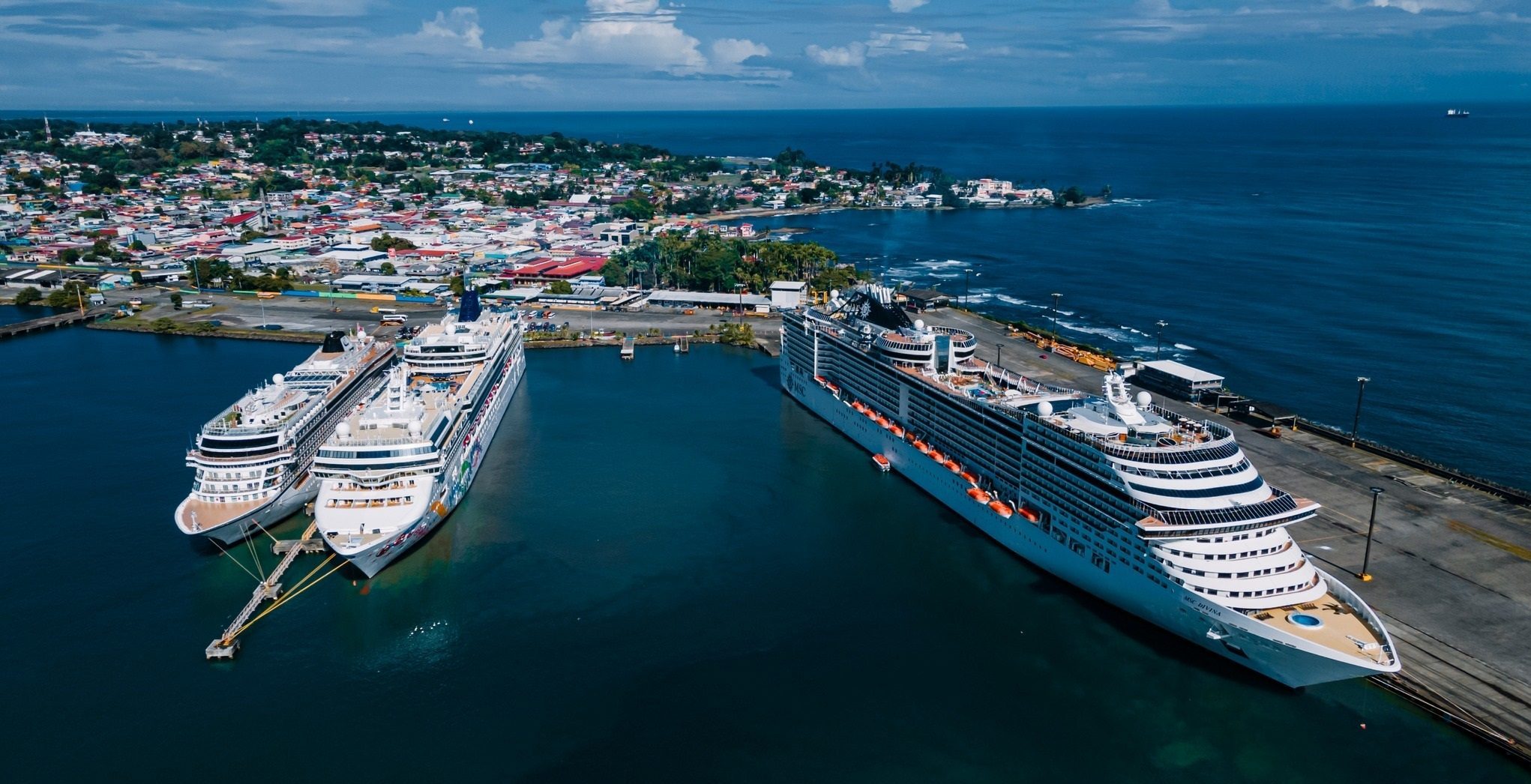
Dos cruceros internacionales – entre ellos el MSC Divina – atracados en el muelle de Limón centro, administrado por JAPDEVA tras la reestructuración de 2019. La atención de cruceros y yates es hoy una de las principales funciones operativas residuales de la institución, junto con la administración del canon de APM Terminals. (Fuente: VIDEA Audiovisuales, 2023).
Two international cruise ships – among them the MSC Divina – berthed at the Limón downtown pier, managed by JAPDEVA following the 2019 restructuring. Cruise and yacht attention is today one of the main operational residual functions of the institution, alongside the administration of the APM Terminals royalty. (Source: VIDEA Audiovisuales, 2023).
La lectura habitual de esta situación – en clave de ineficiencia administrativa o de captura política – es correcta pero parcial. Desde el marco que PROCIP ha venido construyendo, lo relevante es que JAPDEVA encarna una forma de interfaz puerto-ciudad que el vocabulario europeo no nombra: no es waterfront porque no hay regeneración urbana prevista; no es port authority porque ya no opera la terminal principal; no es port-city governance porque los municipios de Limón y Matina apenas intervienen en su junta directiva. Es, más bien, una figura híbrida – operador residual, rector nominal, agencia de desarrollo dependiente del canon – que solo puede entenderse si se incorpora la dimensión histórica de una provincia con fuerte memoria afrodescendiente y caribeña, históricamente periférica respecto del Valle Central. La ciudad de Limón mira hacia la terminal moderna desde esa memoria cultural propia, y hacia JAPDEVA desde una expectativa de redistribución que cuarenta años de promesas incumplidas han vuelto legítimamente escéptica.
The usual reading of this situation – in terms of administrative inefficiency or political capture – is correct but partial. From the framework PROCIP has been building, what matters is that JAPDEVA embodies a form of port-city interface that the European vocabulary cannot name: it is not a waterfront case because no urban regeneration is envisaged; it is not a port authority because it no longer operates the main terminal; it is not port-city governance because the municipalities of Limón and Matina barely participate in its board. It is, rather, a hybrid figure – residual operator, nominal regulator, development agency dependent on the royalty – that can only be understood by incorporating the historical dimension of a province with a strong Afro-descendant and Caribbean memory, historically peripheral to the Central Valley. The city of Limón looks at the modern terminal from that distinctive cultural memory, and at JAPDEVA with a redistributive expectation that forty years of unfulfilled promises have rendered legitimately sceptical.
Puntarenas
Puntarenas
Puntarenas, finalmente, es la tensión más productiva teóricamente: una ciudad-puerto que perdió su función comercial – primero trasladada a Caldera en 1981, luego consolidada allí – sin haber resuelto su identidad urbana posterior, y que hoy experimenta, de manera intermitente, ejercicios de reinvención costera – turismo de cruceros, paseo marítimo, iniciativas culturales – que no acaban de encontrar interlocutor institucional estable. Es el caso centroamericano que más se acerca al patrón europeo de waterfront post-portuario, y también el que mejor demuestra por qué ese patrón, trasplantado sin crítica, no funciona.
Puntarenas, finally, is the theoretically most productive tension: a port city that lost its commercial function – first relocated to Caldera in 1981, then consolidated there – without ever resolving its subsequent urban identity, and which today intermittently undertakes exercises in coastal reinvention – cruise tourism, seafront promenade, cultural initiatives – that have yet to find a stable institutional interlocutor. It is the Central American case closest to the European post-port waterfront pattern, and also the one that best demonstrates why that pattern, transplanted uncritically, does not work.
Un marco propio, en construcción
A Framework of Our Own, Under Construction
Los tres casos centroamericanos desbordan el repertorio europeo no porque sean más complejos, sino porque responden a otra historia. El hub panameño plantea el problema de la gobernanza geopolítica; la concesión hondureña, el de la asimetría entre operador global y Estado huésped; los casos costarricenses, y muy especialmente la figura institucional de JAPDEVA, plantean la pregunta más incómoda: cómo traducir la renta portuaria de una terminal global en desarrollo efectivo para una provincia históricamente excluida, cuando el diseño institucional que debería operar esa traducción está, él mismo, atravesado por la herencia que debería remediar. Construir un marco analítico que articule estas tres dimensiones es la tarea que PROCIP ha venido asumiendo, en diálogo con RETE y AIVP, durante casi dos décadas. El faro que esta sección de PORTUS ilumina hoy sobre Centroamérica no apunta a un puerto en particular, sino a la interfaz que todavía está por construirse.
The three Central American cases exceed the European repertoire not because they are more complex, but because they respond to another history. The Panamanian hub raises the question of geopolitical governance; the Honduran concession, that of the asymmetry between a global operator and a host state; the Costa Rican cases, and most especially the institutional figure of JAPDEVA, raise the most uncomfortable question: how to translate the port rent of a global terminal into effective development for a historically excluded province, when the institutional design that should perform that translation is itself shaped by the very legacy it is meant to remedy. Building an analytical framework that articulates these three dimensions is the task PROCIP has been taking on, in dialogue with RETE and AIVP, for nearly two decades. The lighthouse that this section of PORTUS shines today over Central America does not point to any port in particular, but to the interface that is still to be built.
IMAGEN INICIAL | Vista aérea de Limón, Costa Rica: en primer plano, el muelle estatal JAPDEVA con su grúa pórtico; en el centro, el centro histórico de la ciudad; al fondo, la Terminal de Contenedores Moín (TCM), operada por APM Terminals. La imagen captura, en un solo fotograma, la coexistencia espacial e institucional de los dos operadores portuarios del Caribe costarricense. (Fuente: VIDEA Audiovisuales, 2023).
HEAD IMAGE | Aerial view of Limón, Costa Rica: in the foreground, the state-owned JAPDEVA dock with its gantry crane; in the centre, the historical urban core of the city; in the background, the Moín Container Terminal (TCM) operated by APM Terminals. The image captures, in a single frame, the spatial and institutional coexistence of the two port operators of the Costa Rican Caribbean. (Source: VIDEA Audiovisuales, 2023).
╝
NOTAS
NOTES
[1] Autoridad Marítima de Panamá (AMP), Informe del Sistema Portuario Nacional, cifras preliminares 2025.
[2] Operadora Portuaria Centroamericana (OPC), comunicado corporativo sobre inversión de USD 100 millones en la segunda fase de expansión de Puerto Cortés, febrero de 2026.
[3] Contraloría General de la República de Costa Rica, informes de auditoría sobre la ejecución del canon APM Terminals-JAPDEVA, 2024-2025; Ley 9764 de Reestructuración de JAPDEVA (2019); contrato de concesión TCM-APM Terminals (2011).
[1] Panama Maritime Authority (AMP), National Port System report, preliminary figures 2025.
[2] Operadora Portuaria Centroamericana (OPC), corporate statement on the USD 100 million investment in the second phase of Puerto Cortés expansion, February 2026.
[3] Comptroller General of the Republic of Costa Rica, audit reports on the execution of the APM Terminals-JAPDEVA royalty, 2024-2025; Law 9764 on the Restructuring of JAPDEVA (2019); TCM-APM Terminals concession contract (2011).
REFERENCIAS
REFERENCES
AIVP (2021), Agenda 2030 for sustainable port cities, Association Internationale Villes et Ports, Le Havre.
Alemany, J. & Bruttomesso, R. (eds.) (2011), La ciudad portuaria del siglo XXI: nuevos desafíos en la relación Puerto-Ciudad, RETE, Venecia. ISBN 978-88-906509-0-1.
Autoridad Marítima de Panamá (2026), Sistema Portuario Nacional: estadísticas 2025, AMP, Ciudad de Panamá.
Ducruet, C. (2011), “The port city in multidisciplinary analysis”, in Alemany, J. & Bruttomesso, R. (eds.), The port city in the XXIst century: new challenges in the relationship between port and city, RETE Publications, Venice, pp. 32-49.
Hoyle, B. (2000), “Global and local change on the port-city waterfront”, in Geographical Review, vol. 90, no. 3, pp. 395-417.
Ríos Duarte, R. & Corrales Mora, M. (2011), “PROCIP. Programa Integral de Investigación para el Desarrollo de las Ciudades Portuarias, Costa Rica”, en Alemany, J. & Bruttomesso, R. (eds.), La ciudad portuaria del siglo XXI: nuevos desafíos en la relación Puerto-Ciudad, RETE, Venecia, pp. 290-297.
Royal Haskoning (2008), Plan Maestro para el complejo portuario Limón-Moín, Informe técnico 9R4672.21, JAPDEVA/Senter, Nijmegen.