╔
Fenix is a new icon on Rotterdam’s waterfront where design, technology, innovation and memories coexist.
Constructed in eight years and opened in May 2025, is the new art museum dedicated to emigration rising from the ashes of the historic San Francisco port warehouse – in the 1920s, one of the largest in the world but abandoned until a few years ago. A place full of memories and brimming with stories of goodbyes, separations, encounters, discoveries, and new adventures.
Rotterdam has a long history as a significant trading hub, with its huge deep-water port and strategic location with easy access to the North Sea and the Rhine, making it an ideal thorough fare for shipping and the gateway to Europe.
Fenix is the first European cultural project by Beijing’s renowned MAD Architects studios, while the restoration of the warehouse was handled by Bureau Polderman. At its heart, architect Ma Yansong added the Tornado: a double-helix staircase that spirals skyward to a viewing platform above the roof hovering above the city. Dramatic views across the River Maas and Hotel New York, the former headquarters of the Holland America Line – a Dutch cargo and passenger line, can be enjoyed from this point of observation.
The project is owned by the private Droom en Daad Foundation, which was established in 2016 and currently is helping redefine Rotterdam for the 21st century, developing new kinds of arts and culture institutions and fostering new creative talent that reflects the city’s diversity, its spirit and its history.
Fenix is housed in a historic harbor warehouse dating back to 1923, designed by architect Cornelis van Goor (1861-1945) and built for the Holland America Line. It was the place where the cargo line loaded and unloaded its ships carrying goods to and from destinations as far as South Africa, Canada, Mexico, and the Gulf States.
The Holland America Line facilitated the journeys of millions of migrants in the 19th and 20th centuries who arrived and departed from the surrounding docks. It was from the quays around this warehouse that over three million emigrants boarded ships bound for destinations such as America and Canada, including notable figures such as Albert Einstein, Willem de Kooning, and Max Beckmann.
The departure and arrival of people made Rotterdam the city it is today, one shaped by the more than 170 nationalities of its inhabitants.
In the 19th century, Rotterdam’s port facilities and infrastructure as an international trade hub grew dramatically, expanding to meet the new demands and opportunities generated by the industrial revolution, with larger steam ships, mechanized loading cranes, and steel bridges connecting both sides of the Maas River. The surrounding areas of Katendrecht and Rijnhaven experienced severe changes, transforming from quiet residential communities to a dynamic international shipping hotspot.
Stretching 360 meters along the quay for an extension of 16,000 sqm over two-story, the building served over the years many functions and underwent several reconstructions. During World War II, German troops destroyed much of Rotterdam, including parts of the quays, severely damaging the warehouse.
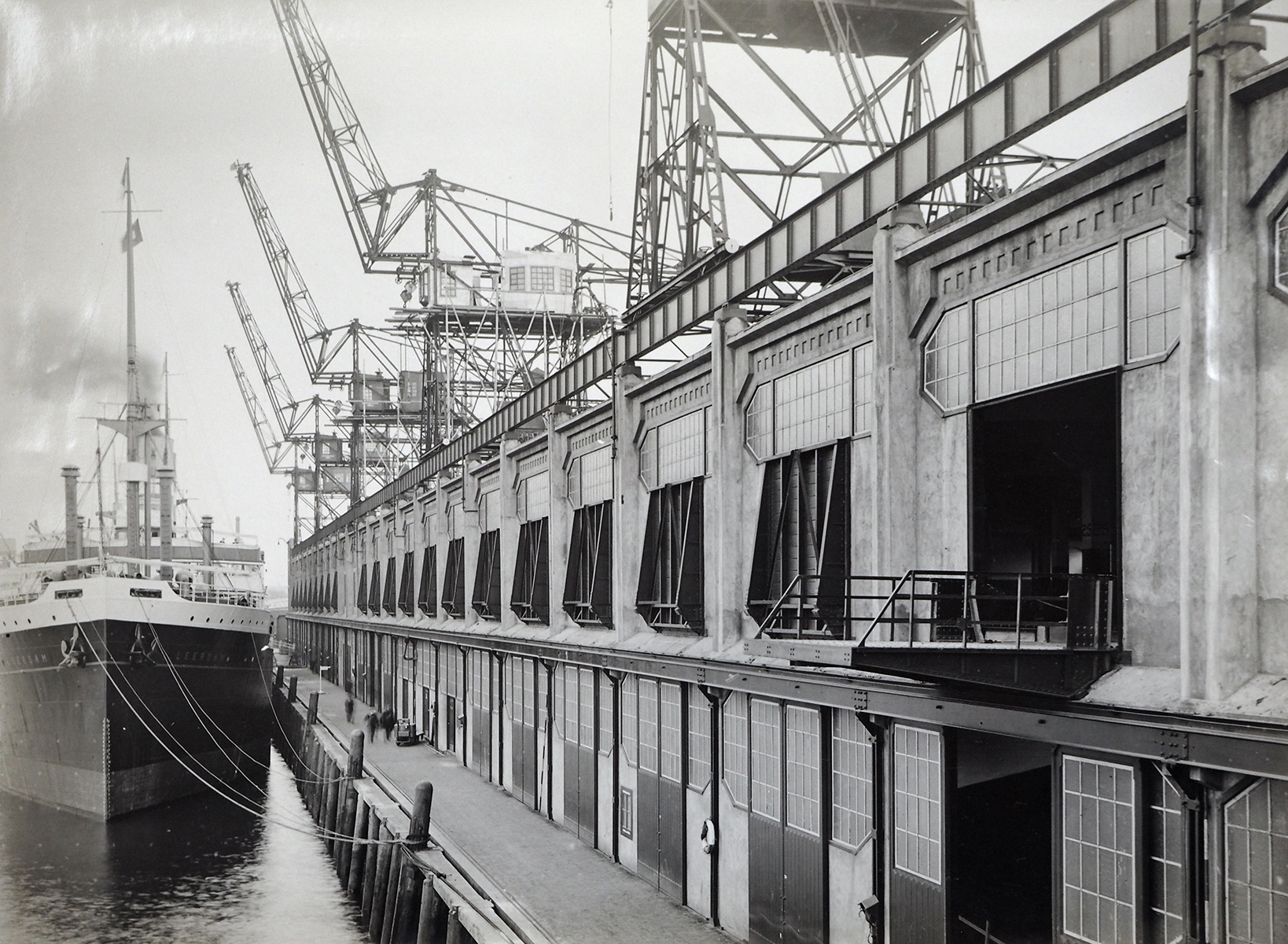
A ship docked at San Francisco warehouse – once the world’s largest transshipment warehouse – in the Port of Rotterdam in 1925, where the Fenix takes place nowadays. (© Rotterdam City Archives).
In 1948, a fire devastated part of the building, but like the mythical phoenix, the warehouse was rebuilt as two separate structures, later named Fenixloods I and Fenixloods II.
The city became then a world-class destination for architectural innovation, known for its landmark buildings and experimental constructions.
Following the advice of Bureau Polderman, the historic warehouse has been carefully restored. Window frames and façades were returned to their original green, while the regular rhythm of the original design — characterized by its concrete columns and distinctive windows — was reinstated.
The history of the building inspired Ma Yansong, Founder & Principal Partner of MAD Architects, who became the first Chinese architect to design a museum in Europe.
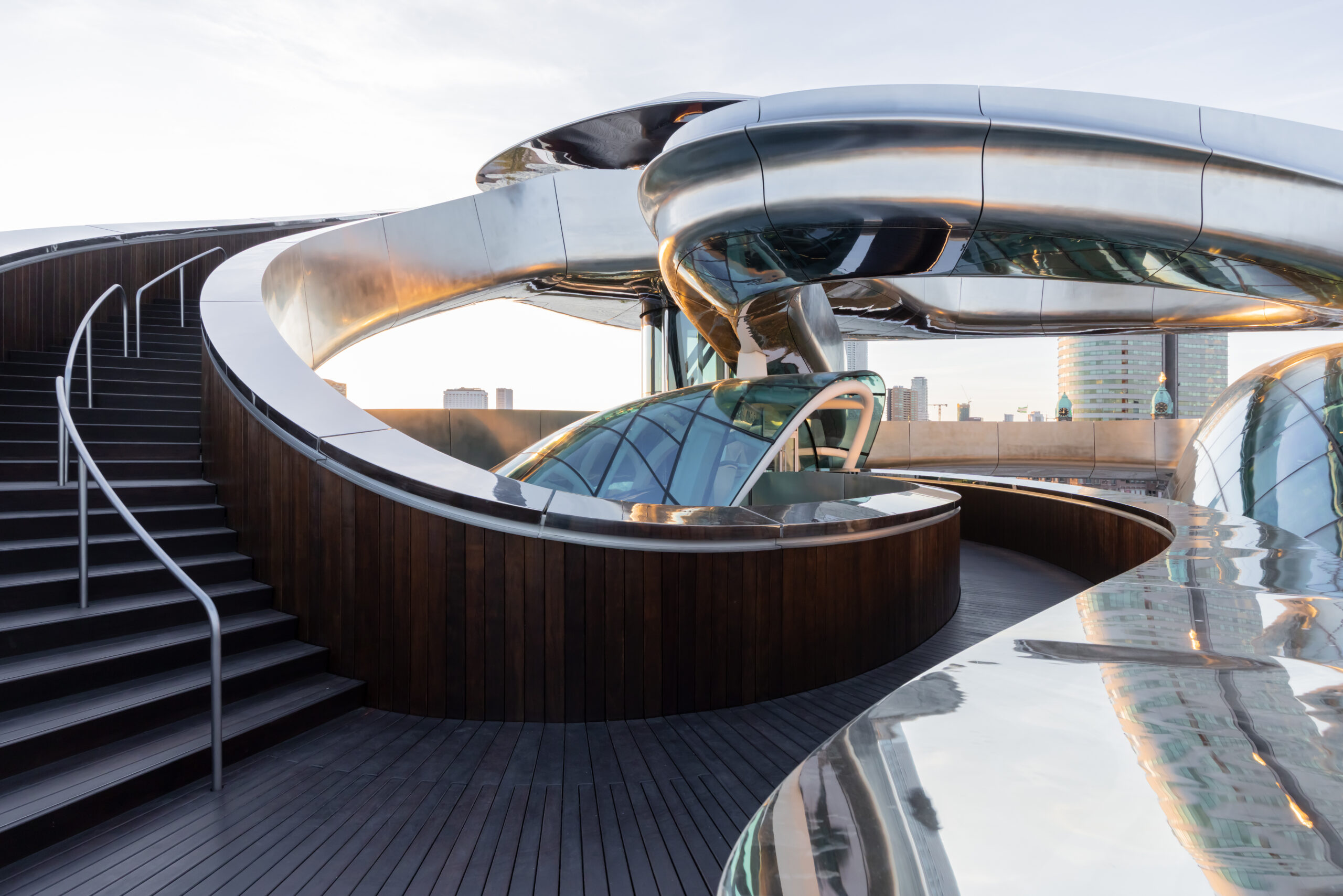
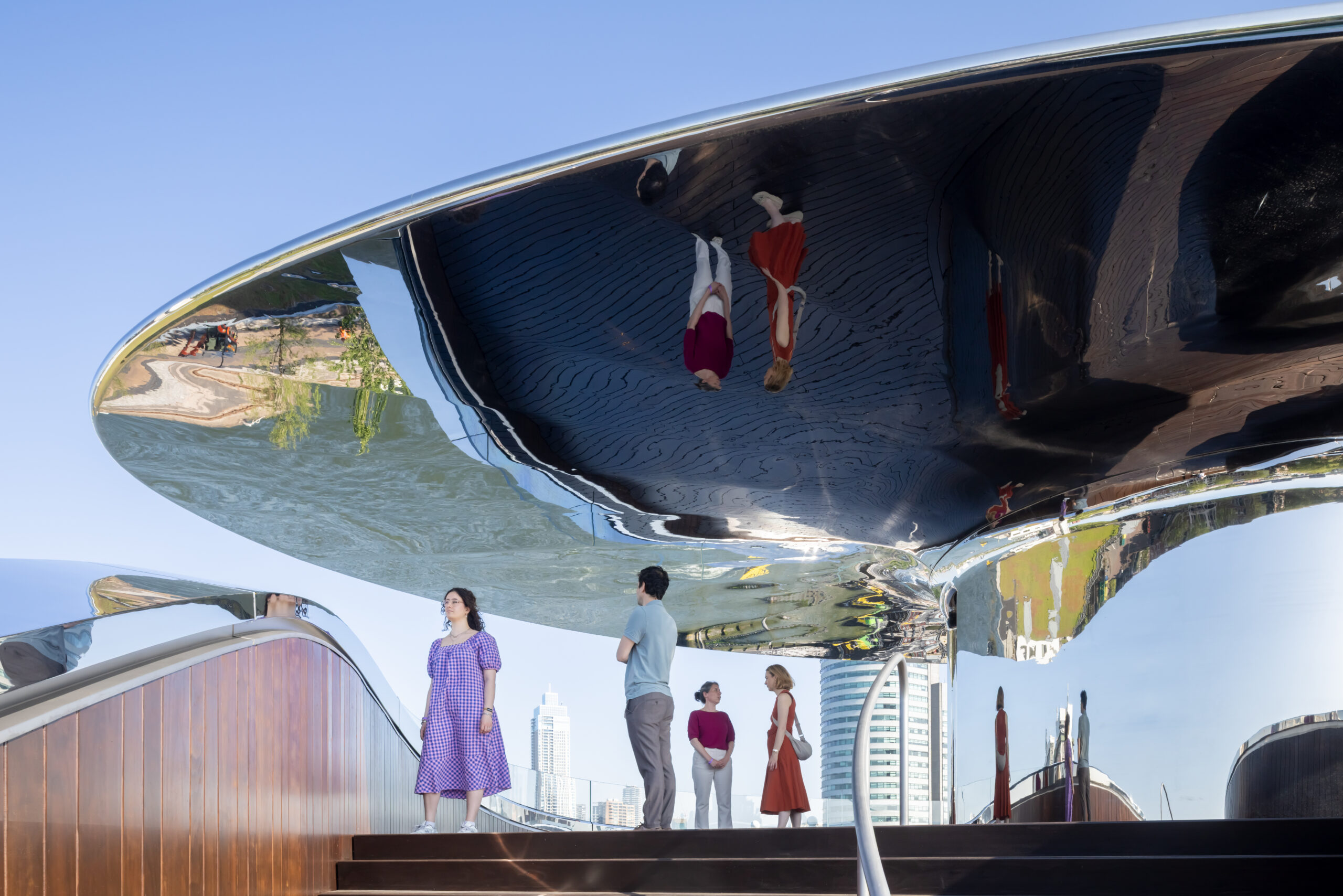
He created a futuristic addition to the century-old warehouse: the Tornado, both a sculpture and a viewing platform. Two staircases spiral upwards in a self-chosen route, leading visitors to a panoramic deck. The steel and wood double helix covers a space of 550 meters, with a step of 336 steps made of 12,500 wooden planks, covered by 297 stainless steel panels. Climbing the Tornado is like embarking on a journey. The path upwards is full of unexpected turns and shifting perspectives, much like the journey of a migrant, as architect Ma Yansong describes it.
“When MAD Architects was asked to work on Fenix, we knew we had to create a dialogue with the existing building and its surroundings – and with a past containing so many stories of migration, memories, and uncertainty” said Ma Yansong. “In designing a new structure, we had to show this dialogue between the future and the past, and so continue the story of the building. The Tornado is all about the future, but it’s rooted in the past. For me, it’s a metaphor for the journeys of migrants who passed through this building”.
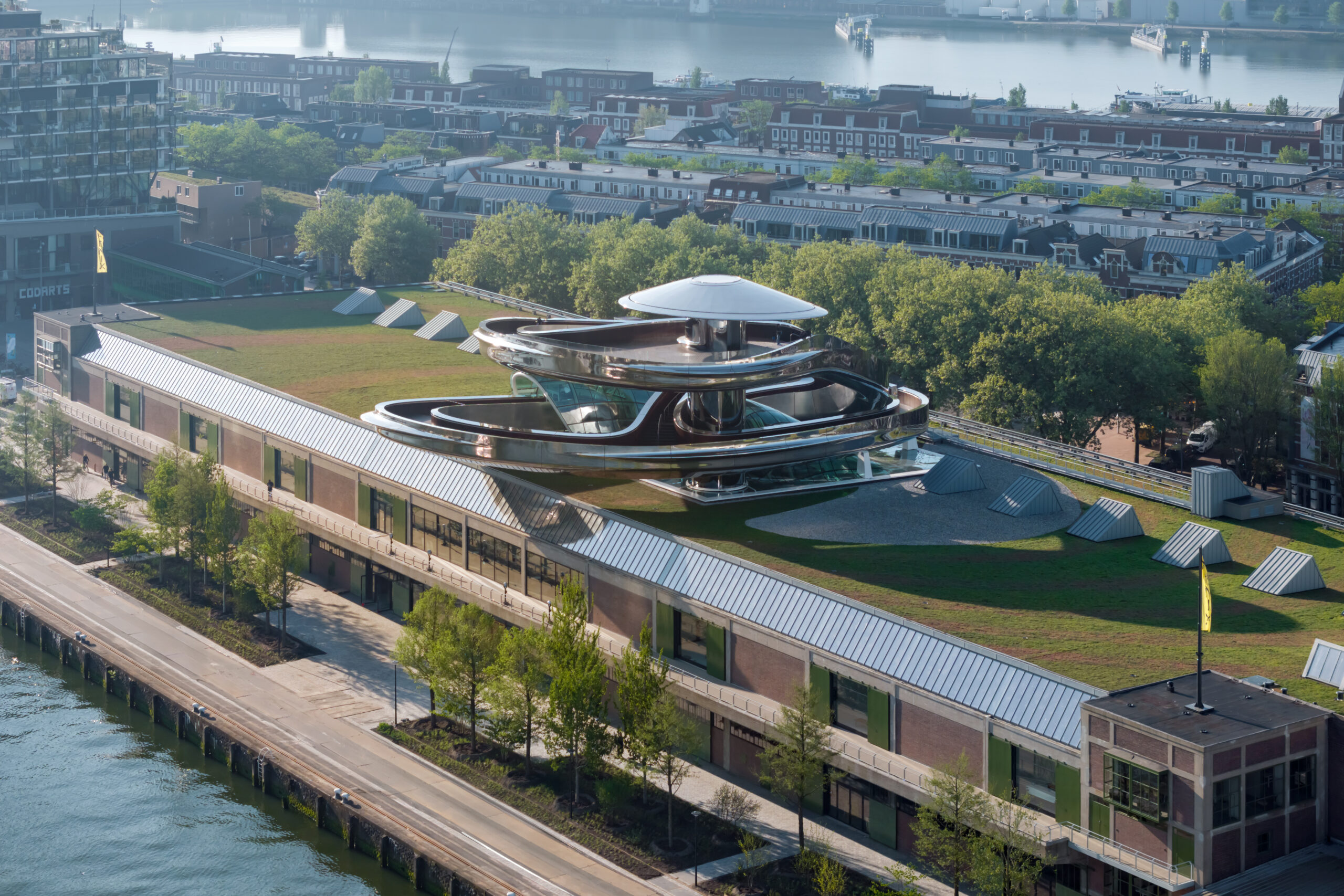
The futuristic addition of the viewing platform to the century-old warehouse. (© Iwan Baan).
With its fluid, swirling form, the Tornado appears to be in motion — an echo of the movement and stories of the quays below, where the lives of millions took a new turn embarking on journeys across the ocean. Just as many arrived in Katendrecht and Rotterdam, seeking a new home.
While the Tornado’s design feels futuristic, its foundation is firmly rooted in the century-old warehouse and the deep history of the surrounding area.
It is the centerpiece of the regeneration of the harbor-side neighborhood of Katendrecht, which is Rotterdam’s former red-light district and the oldest Chinatown of continental Europe.
The double external staircase of the Tornado, connecting the panoramic deck at 30m from the ground. (© Iwan Baan).
“The story of Fenix is inextricably linked to Rotterdam and its many communities; but that story is also the world’s. It is a story of arrivals and departures, and of constant change to face the future” said Anne Kremers, Director of Fenix “From the crossing of the Berlin Wall, to the departure for the USA on the great steam ships, to the arrival of new communities from every part of the world to build, to create, to learn, Fenix is a mirror to the experience and the stories of people from everywhere told through the lens of art. It is with this in mind that we are working not just with local and international artists to explore the topic of migration but also inviting communities across Rotterdam to co-create programming within our public spaces”.
Installation Berlin Wall at Fenix. (© Robin Utrecht).
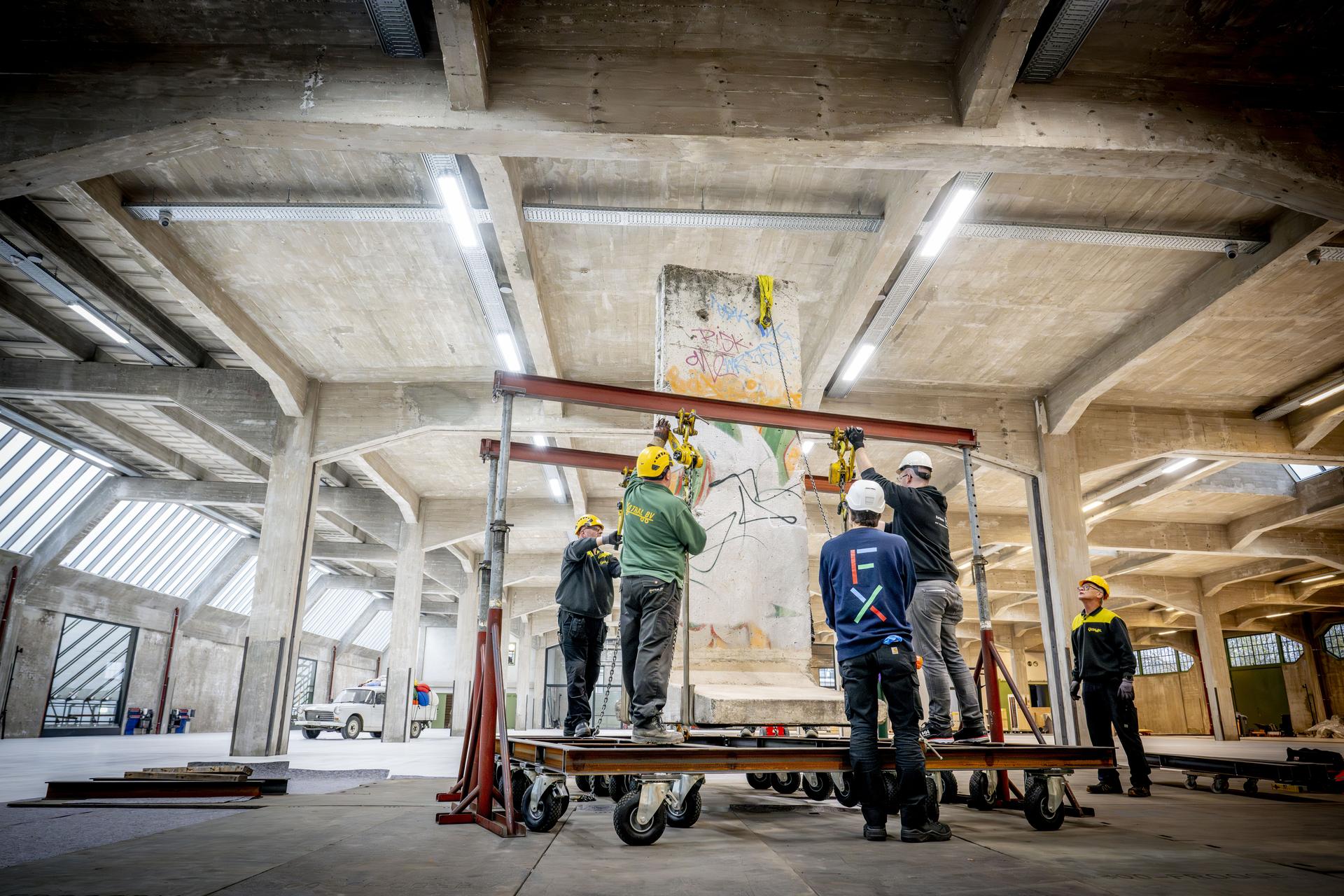
In Fenix, migration stories from around the world can be discovered through the stories told by artists, global citizens, and Rotterdammers.
A series of vast gallery spaces across the two floors of the museum house Fenix’s growing collection, exhibitions, installations and programs. A series of new works has been commissioned specifically for the museum by emerging artists from Europe, USA, and Asia exploring their views on and personal stories of migration. Among these, Beya Gille Gacha, Raquel van Haver, Hugo McCloud, Chae Eun Rhee, Martin and Inge Riebeek, Ari Versluis and Ellie Uyttenbroek, and Efrat Zehavi.
At Fenix, the experience of migration is expressed also by hundreds of documentary photos in The Family of Migrants, an exhibition inspired by Edward Steichen’s Family of Man, which was on view at MoMA in 1955 and is one of the most famous photographic exhibitions of all time.
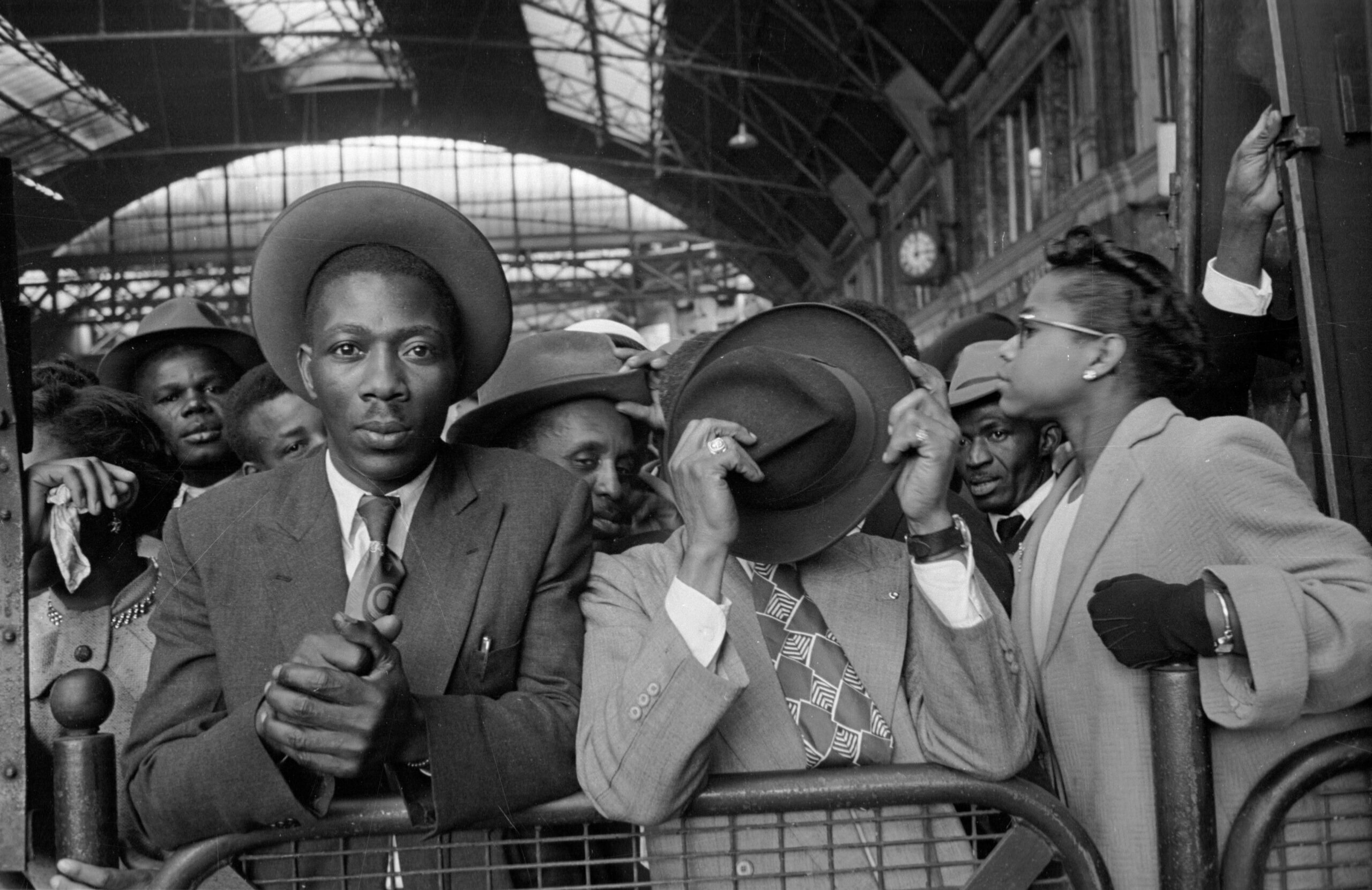
Haywood Magee. Caribbean immigrants arrive at Victoria Station, London, after their journey from Southampton Docks, 1956. Collection Fenix. (© Haywood Magee_Getty Images; Collection Fenix).
A selection of the most striking photography on the subject of migration brings together 194 photographs from 55 countries taken by 136 photographers. The works range from the late 19th century to the present day and are a mix of documentary images, portraits and journalist photography drawn from international archives, museum collections, image banks and newspapers. Photographers featured include Abbas, Eva Besnyö, Chien-Chi Chang, Fouad Elkoury, Robert de Hartogh, Lewis Hine, Ata Kandó, Dorothea Lange, Steve McCurry, Yasuhiro Ogawa, Emin Özmen and Sergey Ponomarev.
In The Suitcase Labyrinth, it is possible to hear personal stories from travelers themselves. The spacious Plein on the ground floor is a new covered city square inside the building, where Fenix creates the programming in collaboration with the people of Rotterdam. A community-led space where large scale events, explorations of different styles of food culture, community meetings, Dutch-language lessons and performances take place, free to enter.
More information
www.fenix.nl
HEAD IMAGE | Anight view of Fenix Museum seen from Rotterdam city center. (© Gregg Telussa).