╔
Mare Muto. Pianificazione urbanistica costiera e partecipazione nella rigenerazione della Costa Sud di Palermo
La Costa Sud nel progetto di rigenerazione del waterfront di Palermo
Palermo’s South Coast within the Waterfront Regeneration Strategy
Negli ultimi decenni la rigenerazione dei waterfront è divenuta uno dei principali ambiti di sperimentazione delle politiche urbane, chiamate a ricostruire il rapporto tra città e mare attraverso strategie integrate che coniughino riqualificazione ambientale, qualità dello spazio pubblico, valorizzazione del patrimonio culturale e nuove forme di governance (Bruttomesso, 1993; Hoyle, 2000). In questo quadro si colloca il processo di rigenerazione della Costa Sud di Palermo, che assume la pianificazione urbanistica costiera come strumento di riferimento per la trasformazione del fronte a mare.
Lungo la costa di Palermo, estesa per oltre ventisei chilometri, si susseguono paesaggi profondamente differenti che restituiscono le molteplici identità della città. Sul versante settentrionale si alternano la vivacità delle stazioni balneari di Sferracavallo e Mondello, la straordinaria emergenza paesaggistica di Monte Pellegrino, le borgate marinare di Vergine Maria, Arenella e Acquasanta, la vitalità commerciale e turistica del porto, l’insenatura della Cala e il lungomare del Foro Italico, recentemente riqualificato fino al porticciolo di Sant’Erasmo. Oltre la cesura del fiume Oreto, il paesaggio cambia radicalmente. La Costa Sud restituisce l’immagine di un territorio segnato da decenni di degrado ambientale e urbanistico, nel quale la fragilità ecologica della foce del fiume si accompagna all’abbandono degli arenili, alla presenza di grandi complessi di edilizia residenziale pubblica e alla frammentazione delle antiche borgate marinare di Romagnolo, Sperone, Bandita e Acqua dei Corsari.
Questa parte del waterfront, lunga oltre otto chilometri, costituisce uno dei più rilevanti ambiti di sperimentazione della politica urbana cittadina. Il Comune di Palermo ha infatti avviato un articolato programma di bonifica e recupero della Costa Sud, finanziato con più di sessanta milioni di euro e inserito all’interno del processo di rigenerazione dell’intero waterfront della città. La pianificazione urbanistica costiera si inserisce nella più ampia visione strategica promossa dall’Amministrazione comunale, su impulso dell’assessore alla rigenerazione urbana Maurizio Carta, quale anticipazione tematica e progettuale del nuovo Piano Urbanistico Generale. Essa individua nel rapporto tra Palermo e il mare uno dei principali indirizzi strategici per lo sviluppo della città, orientando le successive scelte urbanistiche verso un modello di crescita fondato sulla qualità urbana, sulla valorizzazione del patrimonio ambientale e culturale e sulla ricostruzione di una relazione più stretta, continua ed efficace tra gli spazi urbani e il waterfront (Carta, 2021).
La pianificazione urbanistica costiera costituisce il quadro di riferimento strategico entro il quale ricondurre i diversi interventi di trasformazione del fronte a mare, coordinando i numerosi programmi di investimento pubblico già finanziati, assicurando certezza agli investimenti privati e superando la frammentazione che ha caratterizzato le politiche urbane del passato (Bruttomesso, 2001). Il fronte a mare viene così interpretato non come una successione di operazioni autonome, ma come una componente strutturale del progetto di città (Carta, 2021), all’interno del quale la riqualificazione del sistema costiero diviene occasione per ridefinire le relazioni tra ambiente, infrastrutture, patrimonio culturale, spazio pubblico e qualità della vita (Marshall, 2001). L’obiettivo non si limita quindi al recupero ambientale del litorale, ma mira alla configurazione di un nuovo fronte urbano capace di ricucire il rapporto tra Palermo e il mare, restituendo continuità a un sistema territoriale che, per decenni, è stato progressivamente separato dal proprio paesaggio costiero (Carta, 2012; 2025).
Nel caso della Costa Sud tale impostazione assume un significato ancora più rilevante. Qui la rigenerazione non coincide esclusivamente con la bonifica dei siti contaminati o con il recupero degli arenili, ma implica la ricostruzione di un’identità urbana profondamente compromessa da oltre mezzo secolo di trasformazioni incontrollate. Il recupero del rapporto con il mare diventa pertanto un progetto territoriale che investe contemporaneamente la dimensione ambientale, quella urbanistica e quella sociale, richiedendo il coinvolgimento delle comunità locali nell’elaborazione di nuovi scenari di sviluppo.
In questa prospettiva si colloca il progetto Mare Muto, promosso dal Dipartimento di Architettura dell’Università degli Studi di Palermo, che interpreta la partecipazione come parte integrante del processo di rigenerazione del waterfront.
Over recent decades, waterfront regeneration has emerged as one of the principal fields of experimentation in urban policy, seeking to restore the relationship between cities and the sea through integrated strategies that combine environmental restoration, the enhancement of public space, the valorisation of cultural heritage, and innovative forms of governance (Bruttomesso, 1993; Hoyle, 2000). It is within this framework that the regeneration process of Palermo’s South Coast has been developed, adopting coastal spatial planning as the principal instrument for the transformation of the city’s waterfront.
Stretching for more than twenty-six kilometres, Palermo’s waterfront encompasses a remarkable diversity of landscapes that reflect the city’s multiple identities. Along the northern coast, the lively seaside resorts of Sferracavallo and Mondello alternate with the outstanding landscape of Monte Pellegrino, the historic fishing villages of Vergine Maria, Arenella and Acquasanta, the commercial and tourist activities of the Port of Palermo, the natural inlet of La Cala, and the Foro Italico waterfront promenade, recently redeveloped as far as the small harbour of Sant’Erasmo. Beyond the physical and symbolic divide created by the Oreto River, however, the coastal landscape changes dramatically. Palermo’s South Coast presents the image of a territory marked by decades of environmental degradation and unplanned urban development, where the ecological fragility of the river mouth is compounded by the abandonment of the beaches, the presence of extensive public housing estates, and the fragmentation of the historic coastal settlements of Romagnolo, Sperone, Bandita, and Acqua dei Corsari.
Extending for more than eight kilometres, this section of the waterfront has become one of the city’s most significant areas of urban policy experimentation. The Municipality of Palermo has launched a comprehensive programme of environmental remediation and regeneration for the South Coast, supported by public investment exceeding €60 million and incorporated into the wider regeneration strategy for the entire urban waterfront. The coastal spatial planning framework forms part of the broader strategic vision promoted by the Municipal Administration, under the leadership of the Councillor for Urban Regeneration, Maurizio Carta, as both a thematic and a design-oriented precursor to the new Municipal Master Plan. Within this vision, the relationship between Palermo and the sea is identified as one of the city’s principal strategic priorities, guiding subsequent planning decisions towards a model of urban development based on spatial quality, the enhancement of environmental and cultural heritage, and the reconstruction of a closer, more continuous, and more effective relationship between the urban fabric and the waterfront (Carta, 2021).
Within this strategic framework, coastal spatial planning provides the overarching reference for coordinating the diverse transformation projects affecting the waterfront. It seeks to integrate the numerous publicly funded investment programmes already underway, provide certainty for private investment, and overcome the fragmentation that has long characterised previous urban policies (Bruttomesso, 2001). Accordingly, the waterfront is conceived not as a sequence of isolated interventions but as a structural component of the wider urban project (Carta, 2021), in which the regeneration of the coastal system becomes an opportunity to redefine the relationships between the natural environment, infrastructure, cultural heritage, public space, and urban liveability (Marshall, 2001). The objective therefore extends beyond the environmental restoration of the coastline to encompass the creation of a new urban waterfront capable of reconnecting Palermo with the sea and restoring continuity to a territorial system that has progressively become detached from its coastal landscape over several decades (Carta, 2012; 2025).
In the case of Palermo’s South Coast, this approach acquires particular significance. Here, regeneration is not limited to the remediation of contaminated sites or the restoration of the beaches; rather, it entails the reconstruction of an urban identity profoundly compromised by more than half a century of uncontrolled transformation. Re-establishing the relationship between the city and the sea therefore becomes a comprehensive territorial project addressing environmental, spatial, and social dimensions simultaneously, while requiring the active involvement of local communities in the formulation of new development scenarios.
It is within this context that the Silent Sea project, promoted by the Department of Architecture of the University of Palermo, positions public participation as an integral component of the waterfront regeneration process.

Spiaggia nella Costa Sud di Palermo. Le discariche di sfabbricidi riversate lungo il watefront meridionale della città hanno determinato l’avanzamento del profilo costiero, causando inquinamento ambientale e eutrofizzazione marina. (Foto: A. Badami, 2024).
Beach on Palermo’s South Coast. The disposal of construction and demolition waste along the city’s southern waterfront has caused significant seaward extension of the coastline, resulting in environmental degradation and marine eutrophication. (Photo: A. Badami, 2024).
Dal degrado ambientale alla ricostruzione dell’identità costiera
From Environmental Degradation to the Reconstruction of Coastal Identity
L’esigenza di un progetto integrato per la Costa Sud nasce dalla storia stessa di questo tratto di litorale. Fino agli inizi degli anni Settanta del Novecento, il fronte a mare oltre il fiume Oreto costituiva una delle principali mete balneari della città. Le borgate marinare, gli stabilimenti balneari, i ristoranti affacciati sul mare e le residenze di villeggiatura contribuivano a definire un paesaggio costiero fortemente identitario, frequentato quotidianamente dai cittadini palermitani durante la stagione estiva. In pochi decenni questo paesaggio è stato radicalmente trasformato, fino a perdere gran parte delle proprie qualità ambientali, urbane e sociali.
Le cause di questa trasformazione sono strettamente connesse alle modalità di crescita della città nella seconda metà del Novecento. Tra gli anni Cinquanta e Ottanta Palermo registra un incremento di circa duecentomila abitanti e concentra il proprio sviluppo prevalentemente verso nord, dove vengono realizzati i nuovi quartieri residenziali. Parallelamente, la fascia costiera meridionale diventa il principale luogo di conferimento degli scarti provenienti dai cantieri edilizi. Milioni di metri cubi di sfabbricidi e rifiuti di diversa natura vengono riversati lungo il litorale, modificando profondamente la linea di costa con avanzamenti che in alcuni punti raggiungono diverse centinaia di metri. La nuova morfologia artificiale cancella progressivamente il paesaggio originario, costituito da scogli, calette e spiagge sabbiose, sostituendolo con estesi depositi di detriti, fanghi e materiali eterogenei che hanno compromesso l’equilibrio ecologico del sistema costiero. L’inquinamento del mare e i fenomeni di eutrofizzazione hanno determinato il progressivo abbandono della balneazione e segnato l’interruzione del rapporto storico tra la città e il suo mare.
Alle conseguenze ambientali si sono affiancate profonde trasformazioni urbanistiche e sociali. I grandi complessi di edilizia residenziale pubblica costruiti lungo la costa si inseriscono senza alcuna relazione con i tessuti storici delle borgate marinare, caratterizzate da edifici bassi e da una fitta rete di spazi pubblici di prossimità. L’introduzione di queste nuove volumetrie ha alterato irreversibilmente il paesaggio costiero e contribuito ad accentuare processi di marginalizzazione sociale che, negli anni successivi, hanno innescato fenomeni di degrado urbano, aumento della criminalità e isolamento di interi quartieri rispetto al resto della città. La frattura tra Palermo e la sua costa meridionale non è dunque soltanto fisica o ambientale, ma investe anche la dimensione sociale e culturale dei luoghi.
Nonostante la radicalità di tali trasformazioni, la Costa Sud conserva un patrimonio storico, architettonico e paesaggistico di straordinario valore che costituisce il supporto materiale e simbolico della ricostruzione dell’identità costiera. Lungo questo tratto di costa sopravvivono testimonianze che raccontano le diverse fasi della storia urbana di Palermo: il Ponte dell’Ammiraglio, inserito dal 2015 nella World Heritage List dell’UNESCO, e i resti del Ponte delle Teste Mozze lungo il fiume Oreto; la chiesa arabo-normanna di San Giovanni dei Lebbrosi con il complesso dell’antico lebbrosario; il lavatoio pubblico di Settecannoli, recentemente restaurato; la Tavernetta del Tiro al Piccione progettata da Ernesto Basile; il Solarium Vittorio Emanuele III, realizzato nel 1928 su progetto di Pietro Valenza; la casa di cura Buccheri La Ferla-Fatebenefratelli; i resti dell’Agrumaria Corleone, significativa testimonianza dell’archeologia industriale cittadina; la Casa-Museo del Beato Pino Puglisi; le ville storiche appartenute, tra gli altri, a Francesco Moncada, principe di Larderia, al marchese Ugo delle Favare, a Gabriello Ortolani di Bordonaro e al senatore Corradino Romagnolo (Badami, 2024).
The need for an integrated regeneration strategy for Palermo’s South Coast is rooted in the history of this stretch of coastline itself. Until the early 1970s, the waterfront beyond the Oreto River was one of the city’s principal seaside destinations. Historic fishing villages, bathing establishments, seafront restaurants, and holiday residences shaped a coastal landscape with a strong local identity, frequented daily by the citizens of Palermo throughout the summer season. Within the space of only a few decades, however, this landscape underwent a profound transformation, losing much of its environmental, urban, and social value.
The causes of this transformation are closely linked to the patterns of urban expansion that characterised Palermo during the second half of the twentieth century. Between the 1950s and the 1980s, the city’s population increased by approximately 200,000 inhabitants, while urban growth was directed predominantly towards the northern districts, where new residential neighbourhoods were constructed. At the same time, the southern coastal belt became the principal disposal area for waste generated by the building industry. Millions of cubic metres of construction debris and other forms of waste were deposited along the shoreline, profoundly altering the coastline, with land reclamation extending the coast by several hundred metres in some locations. This artificially created morphology progressively erased the original coastal landscape of rocky outcrops, coves, and sandy beaches, replacing it with extensive deposits of rubble, sludge, and heterogeneous materials that severely compromised the ecological balance of the coastal system. Marine pollution and widespread eutrophication gradually rendered bathing impossible, ultimately severing the long-standing relationship between the city and its sea.
These environmental impacts were accompanied by profound spatial and social transformations. Large public housing estates were constructed along the coastline without any meaningful integration with the historic fabric of the traditional fishing villages, which had been characterised by low-rise buildings and a dense network of neighbourhood public spaces. The introduction of these large residential complexes irreversibly altered the coastal landscape and contributed to processes of social marginalisation that subsequently fuelled urban decline, increased levels of crime, and the growing isolation of entire neighbourhoods from the rest of the city. The rupture between Palermo and its southern coastline is therefore not merely physical or environmental; it also encompasses the social and cultural dimensions of the territory.
Despite the scale of these transformations, Palermo’s South Coast retains an exceptionally rich historical, architectural, and landscape heritage that provides both the material and symbolic foundations for the reconstruction of its coastal identity. This section of the coastline preserves evidence of the successive phases of Palermo’s urban history, including the Ponte dell’Ammiraglio, inscribed on the UNESCO World Heritage List since 2015, together with the remains of the Ponte delle Teste Mozze along the Oreto River; the Arab-Norman church of San Giovanni dei Lebbrosi and its historic leper hospital; the recently restored public washhouse of Settecannoli; the Tavernetta del Tiro al Piccione designed by Ernesto Basile; the Vittorio Emanuele III Solarium, completed in 1928 to a design by Pietro Valenza; the Buccheri La Ferla–Fatebenefratelli healthcare complex; the remains of the Agrumaria Corleone citrus-processing facility, a significant example of the city’s industrial archaeological heritage; the House Museum of Pino Puglisi; and a series of historic villas formerly owned by, among others, Francesco Moncada, Ugo delle Favare, Gabriello Ortolani di Bordonaro, and Corradino Romagnolo (Badami, 2024).
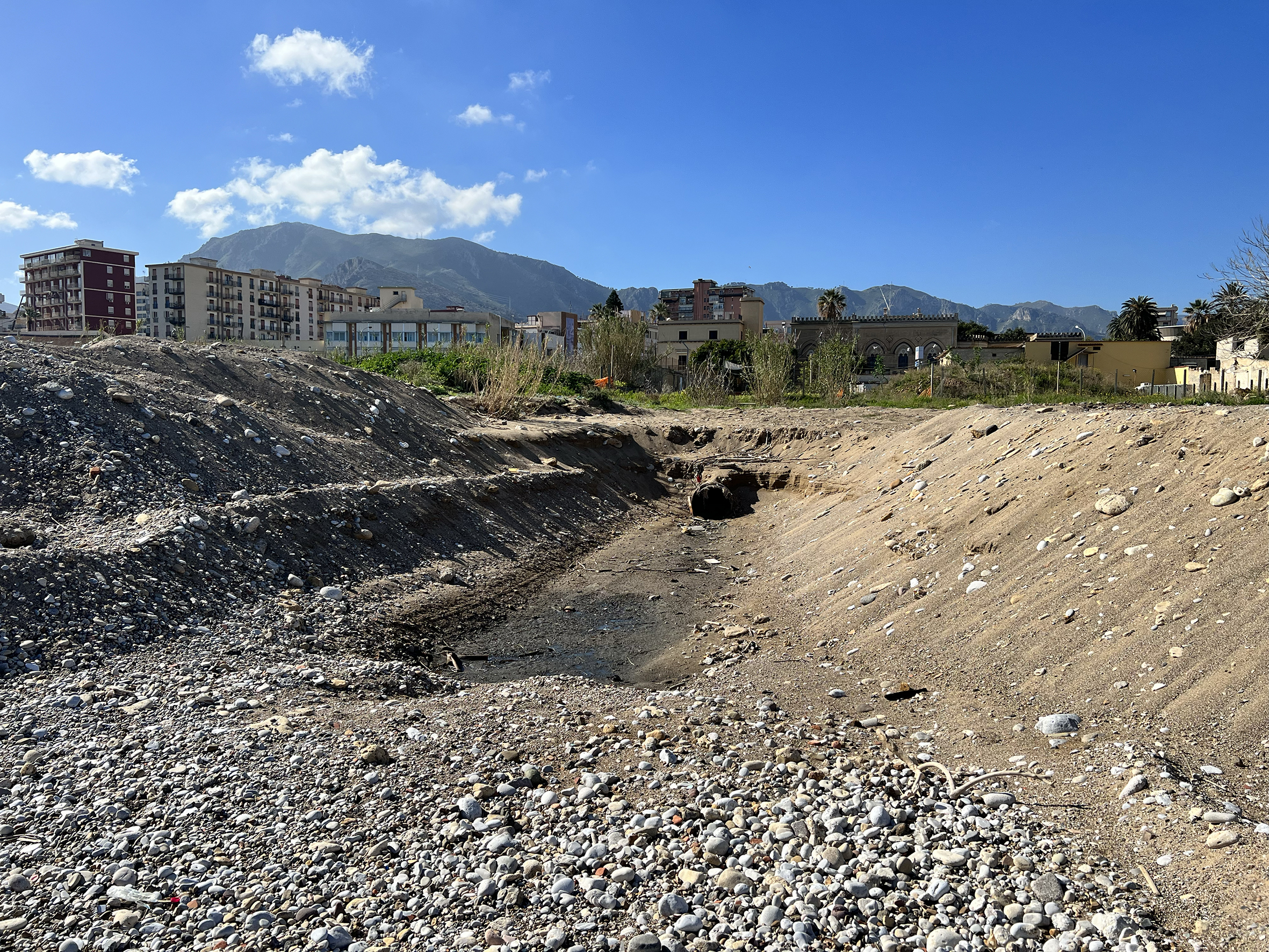
Arenile nella Costa Sud di Palermo, caratterizzato da discariche di detriti e scarichi fognari abusivi. (Foto: A. Badami).
Tra queste presenze assume un ruolo particolarmente significativo l’Ecomuseo Mare Memoria Viva, ospitato nell’ex deposito locomotive di Sant’Erasmo. Fin dalla sua apertura, nel 2014, l’Ecomuseo ha raccolto un articolato patrimonio di testimonianze orali, fotografie, filmati e documenti dedicati alla storia della Costa Sud, dando vita a un archivio della memoria collettiva e promuovendo numerose iniziative educative, sociali e culturali. L’attività dell’Ecomuseo ha contribuito a restituire visibilità a un patrimonio spesso dimenticato e a rafforzare il senso di appartenenza delle comunità locali, divenendo un interlocutore privilegiato nei processi di rigenerazione del waterfront. Attraverso la valorizzazione della memoria dei luoghi e delle comunità che li hanno abitati, l’Ecomuseo ha infatti contribuito a ricollocare il patrimonio culturale al centro delle strategie di trasformazione della Costa Sud, mostrando come la riqualificazione degli spazi fisici debba procedere parallelamente alla ricostruzione dei legami tra memoria, identità urbana e paesaggio, riconoscendo nel capitale culturale del territorio una risorsa strategica per orientarne il futuro.
Among these heritage assets, a particularly significant role is played by the Mare Memoria Viva Ecomuseum (literally, “Sea of Living Memory”), housed in the former locomotive depot at Sant’Erasmo. Since its inauguration in 2014, the ecomuseum has assembled an extensive collection of oral histories, photographs, films, and archival documents relating to the history of Palermo’s South Coast, creating a repository of collective memory while promoting a wide range of educational, social, and cultural initiatives. Its activities have helped restore visibility to a heritage that had long remained overlooked and have strengthened the sense of belonging among local communities, making the institution a key stakeholder in the regeneration of the waterfront. By enhancing the memory of places and the communities that have inhabited them, the Ecomuseum has helped to reposition cultural heritage at the core of the South Coast’s transformation strategies. In doing so, it has demonstrated that the regeneration of physical spaces must proceed in parallel with the reconstruction of the relationships between memory, urban identity and landscape, recognising the area’s cultural capital as a strategic resource for shaping its future.
Mare Muto: progetti condivisi per la rigenerazione della Costa Sud
Silent Sea: Collaborative Projects for the Regeneration of Palermo’s South Coast
L’avvio dei primi interventi di bonifica della Costa Sud, cantierati nel 2024, ha inaugurato una nuova fase per il waterfront meridionale di Palermo. Accanto alle opere di recupero ambientale e di riqualificazione degli spazi pubblici è emersa la necessità di costruire una più ampia consapevolezza collettiva sul futuro di questo tratto di città, coinvolgendo la popolazione nei processi di trasformazione e, in particolare, le giovani generazioni, alle quali il mare della Costa Sud è stato per lungo tempo negato.
Muove da queste premesse il percorso «Il mare a Palermo non c’è: rigenerazione urbana/umana del waterfront di Palermo» [2], promosso dal Dipartimento di Architettura dell’Università degli Studi di Palermo nell’ambito dei Percorsi per le Competenze Trasversali e l’Orientamento (PCTO). L’iniziativa ha coinvolto oltre duecentoventicinque studenti degli Istituti superiori Einaudi-Pareto, Majorana, Vincenzo Ragusa e Otama Kiyohara–Filippo Parlatore di Palermo, invitati a confrontarsi con uno dei temi più complessi della trasformazione urbana contemporanea: immaginare il riscatto della Costa Sud attraverso l’elaborazione di nuovi scenari di relazione tra città e mare (PCTO Magazine, 2024).
Il percorso ha offerto agli studenti un’esperienza di cittadinanza attiva fondata sull’osservazione diretta del territorio, sulla conoscenza dei problemi reali e sulla formulazione di proposte per il futuro del waterfront. La rigenerazione urbana è stata così assunta come tema di apprendimento interdisciplinare, capace di mettere in relazione urbanistica, architettura, paesaggio, patrimonio culturale, ambiente, arte e inclusione sociale. Attraverso progetti, piani, fotografie, elaborati grafici, modelli tridimensionali, video, scenografie e prototipi, gli studenti hanno elaborato una pluralità di visioni progettuali, restituendo un’immagine della Costa Sud non più come periferia degradata, ma come parte vitale del sistema costiero della città.
Uno degli aspetti più significativi dell’esperienza è rappresentato dalla rete di collaborazioni che ne ha sostenuto lo sviluppo. Le attività di conoscenza del territorio sono state realizzate con il contributo dell’Ecomuseo Mare Memoria Viva, interlocutore privilegiato per comprendere la complessità storica, sociale e culturale della Costa Sud [3]. I Laboratori di Scenografia del Teatro Massimo di Palermo hanno offerto agli studenti un’inedita riflessione sul progetto come prefigurazione di scenari, mostrando come la rappresentazione possa diventare uno strumento per immaginare e comunicare futuri possibili [4]. Alle attività hanno inoltre partecipato architetti, urbanisti, botanici, designer e operatori sociali [5], mentre i docenti degli istituti scolastici coinvolti hanno accompagnato gli studenti durante tutte le fasi del percorso [6].
La pluralità dei soggetti coinvolti ha dato vita a un processo collaborativo nel quale università, scuole, istituzioni culturali, professionisti, amministrazione comunale e associazioni hanno contribuito, attraverso competenze differenti, alla definizione di scenari condivisi per il futuro della Costa Sud. La conoscenza del territorio non si è fondata esclusivamente sull’analisi tecnica dei luoghi, ma anche sull’ascolto delle comunità, sulla ricostruzione delle memorie e sull’interpretazione delle identità che caratterizzano questo tratto di waterfront. Il processo formativo si è così configurato anche come un processo partecipativo, nel quale la produzione di idee progettuali è diventata occasione di confronto tra differenti competenze e sensibilità.
The launch of the first environmental remediation works on Palermo’s South Coast in 2024 marked the beginning of a new phase in the regeneration of the city’s southern waterfront. Alongside interventions aimed at environmental restoration and the enhancement of public spaces, there emerged a growing need to foster broader public awareness of the future of this part of the city by actively engaging local communities in the transformation process, particularly younger generations, for whom access to the South Coast and its sea had long been denied.
Against this background, the educational programme The Sea Does Not Exist in Palermo: Urban/Human Regeneration of Palermo’s Waterfront [2], was launched by the Department of Architecture of the University of Palermo as part of the Percorsi per le Competenze Trasversali e l’Orientamento (PCTO – Pathways for Transversal Skills and Career Guidance). The initiative involved more than 225 students from the Einaudi-Pareto, Majorana, Vincenzo Ragusa e Otama Kiyohara–Filippo Parlatore secondary schools in Palermo, inviting them to engage critically with one of the most challenging issues in contemporary urban transformation: envisioning the regeneration of the South Coast through the development of new relationships between the city and the sea (PCTO Magazine, 2024).
The programme provided students with a practical experience of active citizenship based on direct observation of the territory, the understanding of real-world challenges, and the formulation of proposals for the future of the waterfront. Urban regeneration was therefore approached as an interdisciplinary learning process capable of bringing together spatial planning, architecture, landscape design, cultural heritage, environmental studies, art, and social inclusion. Through projects, strategic proposals, photography, graphic representations, three-dimensional models, videos, stage designs, and prototypes, students developed a wide range of design visions that reimagined Palermo’s South Coast not as a neglected urban periphery but as an integral and vibrant component of the city’s coastal system.
One of the most significant aspects of the initiative was the extensive network of partnerships that supported its development. Field-based learning activities were carried out in collaboration with the Mare Memoria Viva Ecomuseum, whose long-standing work on the history and collective memory of the South Coast provided an essential framework for understanding the area’s historical, social, and cultural complexity [3]. The Stage Design Workshops of the Teatro Massimo Foundation introduced students to an innovative understanding of design as the anticipation of future scenarios, demonstrating how visual representation can become a powerful instrument for imagining and communicating alternative urban futures [4]. The programme also benefited from the participation of architects, urban planners, botanists, designers, and social practitioners [5], while teachers from the participating schools accompanied students throughout every stage of the educational process [6].
The diversity of actors involved generated a genuinely collaborative process in which the university, secondary schools, cultural institutions, professional practitioners, the municipal administration, and local associations contributed their complementary expertise to the development of shared scenarios for the future of Palermo’s South Coast. Knowledge of the territory was therefore constructed not solely through technical analysis but also through listening to local communities, recovering collective memories, and interpreting the multiple identities that characterise this section of the waterfront. Consequently, the educational experience evolved into a participatory planning process in which the production of design proposals became an opportunity for dialogue between different forms of knowledge, professional expertise, and civic engagement.
Progetto di riqualificazione del waterfront di Palermo tra via Bazzano e via Armando Diaz degli allievi architetti Riccardo Sciortino, Sofia Giulia Seddio, Ivan Sungkur e Liliana Torregrossa. Laboratorio di Urbanistica 2, prof. Alessandra Badami, a.a. 2023-24.
Waterfront regeneration proposal for the section of Palermo between Via Bazzano and Via Armando Diaz, developed by architecture students Riccardo Sciortino, Sofia Giulia Seddio, Ivan Sungkur, and Liliana Torregrossa. Urban Planning Studio 2, Prof. Alessandra Badami, Academic Year 2023-24.
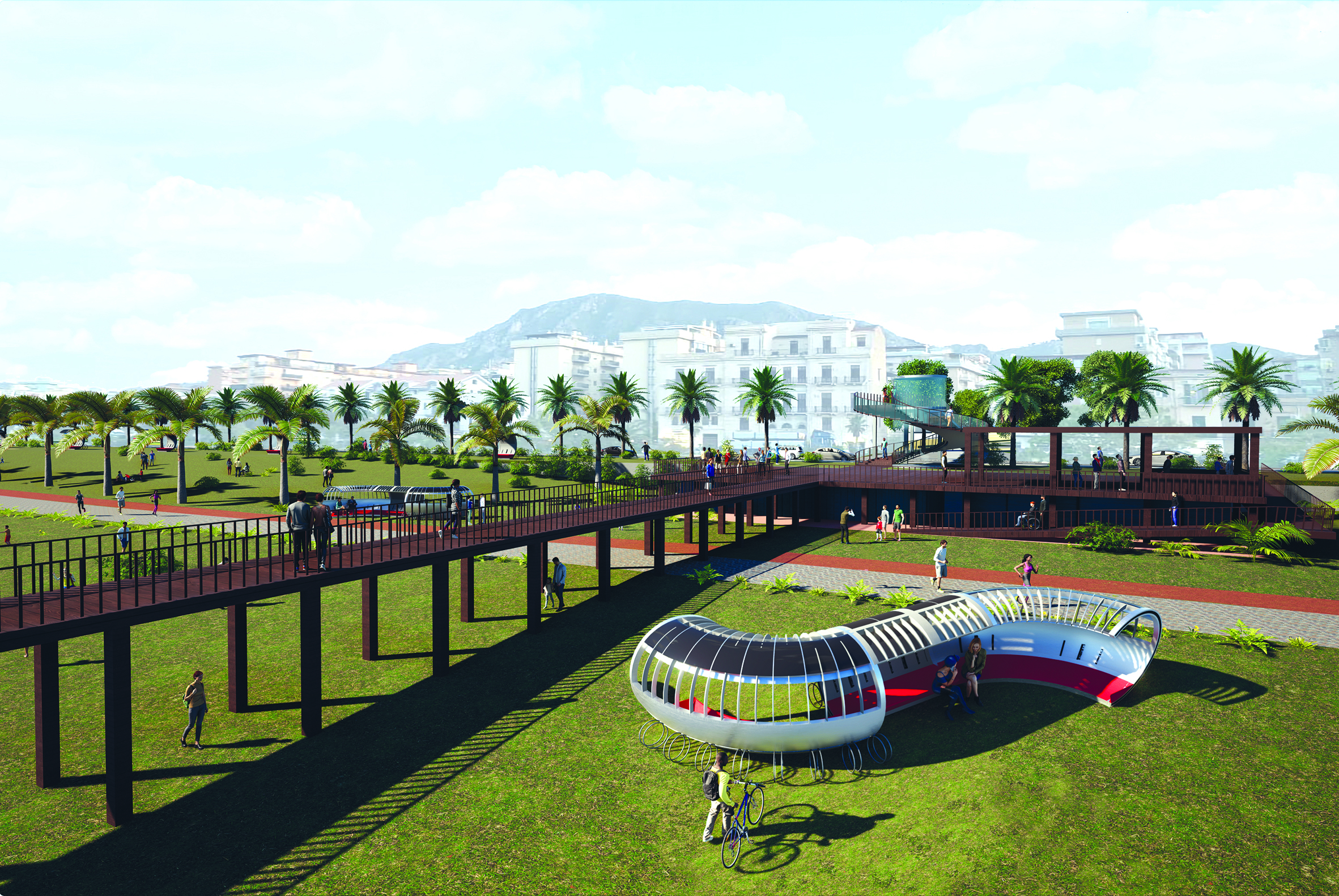
Progetto di riqualificazione del waterfront di Palermo degli allievi architetti Amélie Andreani, Juliet Charbonnier, Elena Palazzolo e Rachele Scurria. Laboratorio di Urbanistica 2, prof. Alessandra Badami, a.a. 2023-24.
Waterfront regeneration proposal for the section of Palermo between Via Tiro a Segno and the Oreto River, developed by architecture students Amélie Andreani, Juliet Charbonnier, Elena Palazzolo, and Rachele Scurria. Urban Planning Studio 2, Prof. Alessandra Badami, Academic Year 2023-24.
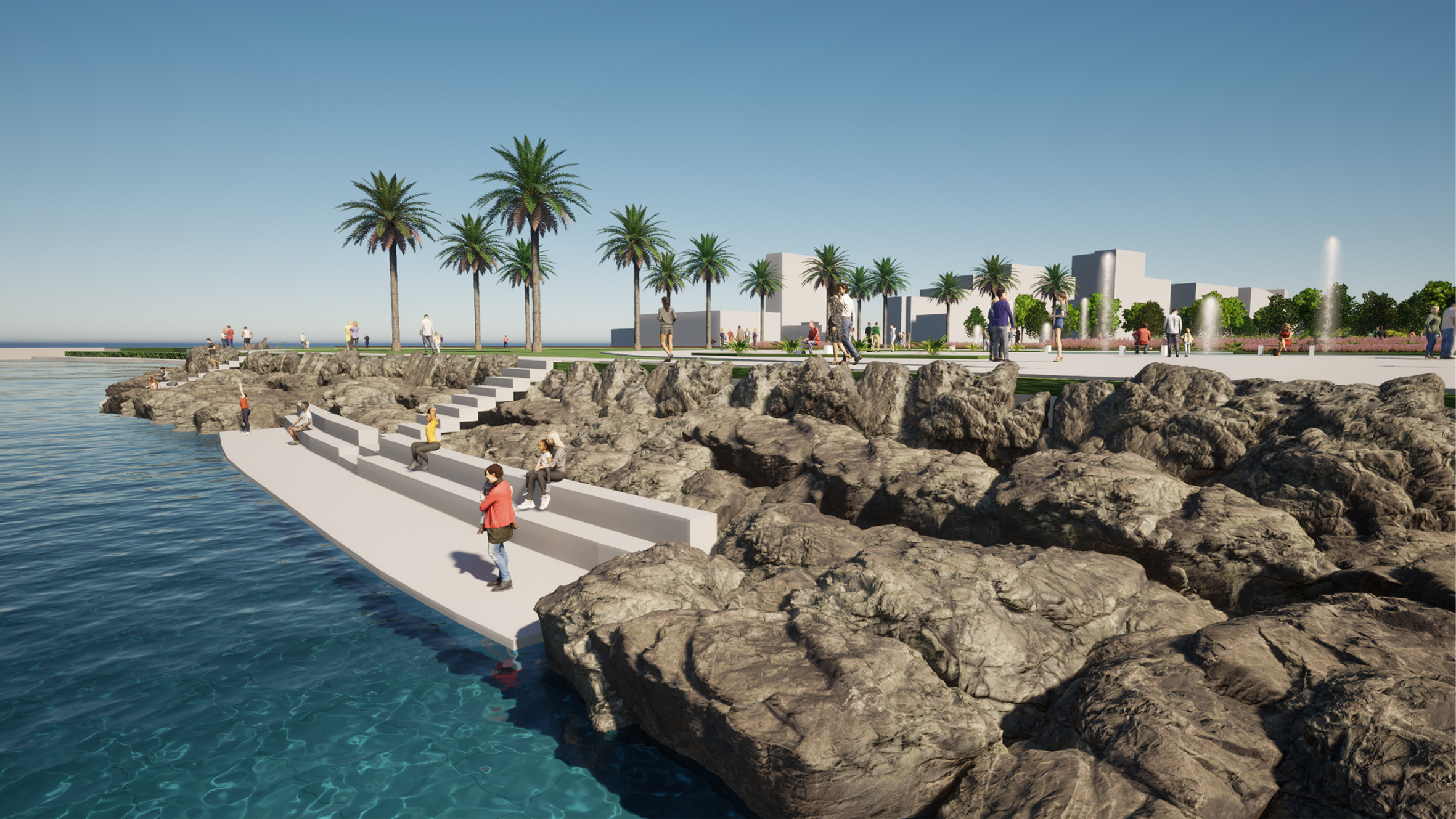
Progetto di riqualificazione del waterfront di Palermo tra via Bazzano e via Armando Diaz degli allievi architetti Riccardo Sciortino, Sofia Giulia Seddio, Ivan Sungkur e Liliana Torregrossa. Laboratorio di Urbanistica 2, prof. Alessandra Badami, a.a. 2023-24.
Waterfront regeneration proposal for the section of Palermo between Via Bazzano and Via Armando Diaz, developed by architecture students Riccardo Sciortino, Sofia Giulia Seddio, Ivan Sungkur, and Liliana Torregrossa. Urban Planning Studio 2, Prof. Alessandra Badami, Academic Year 2023-24.
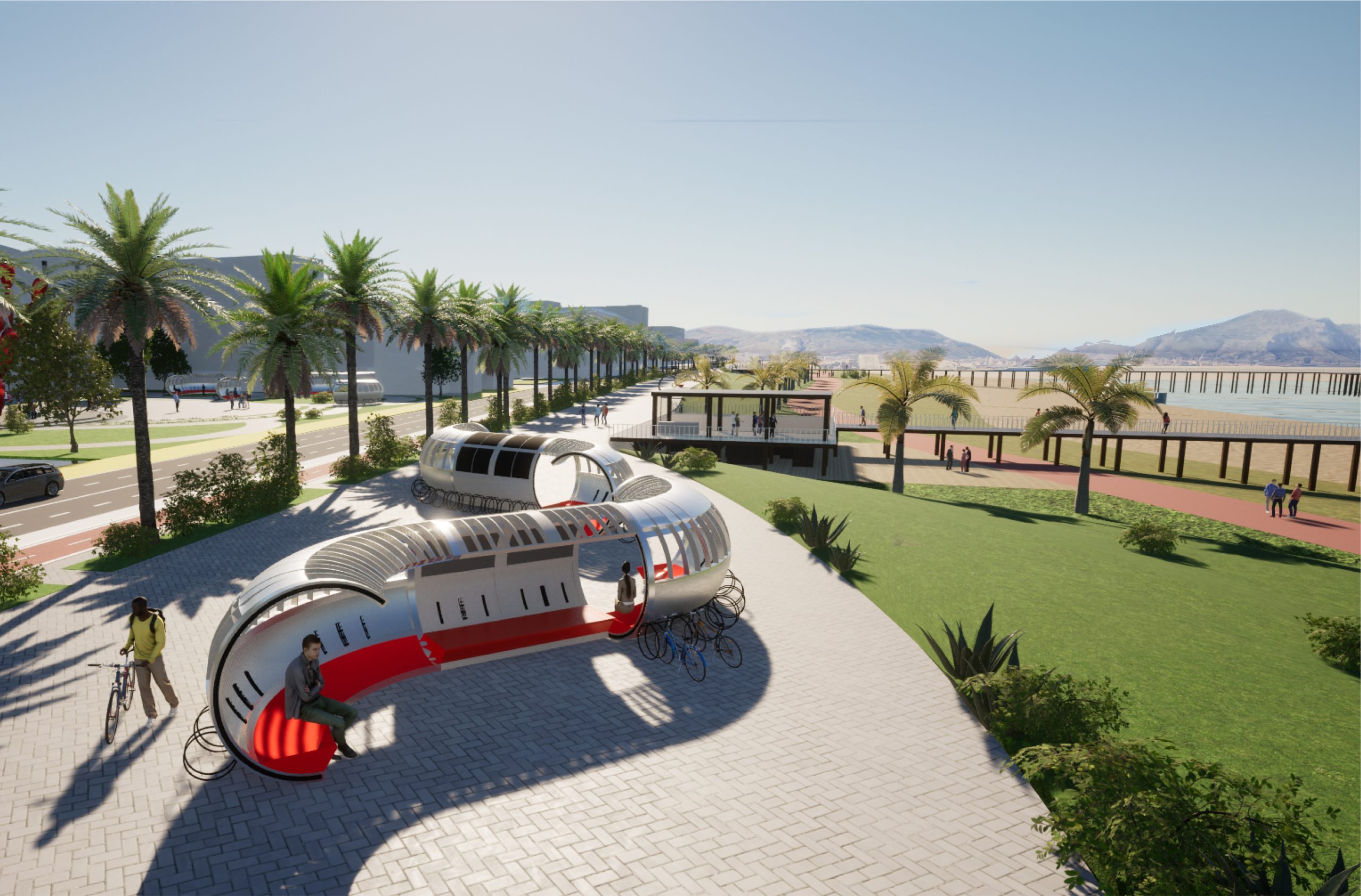
Progetto di riqualificazione del waterfront di Palermo tra via Bazzano e via Armando Diaz degli allievi architetti Riccardo Sciortino, Sofia Giulia Seddio, Ivan Sungkur e Liliana Torregrossa. Laboratorio di Urbanistica 2, prof. Alessandra Badami, a.a. 2023-24.
Waterfront regeneration proposal for the section of Palermo between Via Bazzano and Via Armando Diaz, developed by architecture students Riccardo Sciortino, Sofia Giulia Seddio, Ivan Sungkur, and Liliana Torregrossa. Urban Planning Studio 2, Prof. Alessandra Badami, Academic Year 2023–2024.

L’intero percorso ha contribuito a spostare l’attenzione dalla sola riqualificazione fisica del waterfront alla definizione di una nuova cultura della trasformazione urbana. Gli studenti sono stati invitati a riflettere non soltanto sulle infrastrutture, sugli spazi pubblici, sulla mobilità e sul verde urbano, ma anche sulle funzioni sociali, sulla sicurezza, sull’accessibilità, sulle occasioni di incontro e sulla qualità della vita nelle borgate marinare. La rigenerazione è stata così interpretata come un processo integrato, nel quale gli interventi materiali acquistano significato soltanto se accompagnati dalla ricostruzione delle relazioni sociali e del senso di appartenenza ai luoghi.
Questa impostazione si inserisce pienamente nella strategia di pianificazione urbanistica costiera promossa dal Comune di Palermo. Se la pianificazione definisce il quadro entro cui orientare le trasformazioni del waterfront, iniziative come Mare Muto contribuiscono a costruire il consenso, la consapevolezza e la partecipazione necessari affinché tali trasformazioni possano essere condivise e durature.
The programme as a whole shifted the focus beyond the physical regeneration of the waterfront towards the development of a broader culture of urban transformation. Students were encouraged to reflect not only on infrastructure, public spaces, mobility, and urban green systems, but also on social functions, safety, accessibility, opportunities for social interaction, and the quality of life within the historic coastal neighbourhoods. Regeneration was thus understood as an integrated process in which physical interventions acquire lasting significance only when accompanied by the reconstruction of social relationships and the strengthening of local identity and sense of place.
This approach fits perfectly into the coastal spatial planning strategy promoted by the Municipality of Palermo. While the planning framework establishes the strategic direction for the transformation of the waterfront, initiatives such as Silent Sea help to generate the public awareness, social consensus, and active participation necessary to ensure that these transformations become genuinely shared, inclusive, and sustainable over the long term.
Progetto per panchina “Onda cubica” di Manuel Lo Cascio, Felice Arusa e Vito Gabriele Scozzari, studenti dell’Istituto Parlatore di Palermo, Indirizzo CAT, classe IV D, prof. Francesca Maria Pecoraro, a.s. 2023-24.
Design proposal for the “Cubic Wave” bench by Manuel Lo Cascio, Felice Arusa, and Vito Gabriele Scozzari, students of the CAT (Construction, Environment and Territory) programme at the Parlatore Secondary School of Palermo, Class IV D. Tutor: Prof. Francesca Maria Pecoraro. Academic Year 2023–2024.

Comunicare il progetto di città
Communicating the Urban Vision
Gli esiti del percorso sono stati presentati nella mostra Mare Muto. Visioni di futuro per la nostra Costa Sud, allestita presso l’Ecomuseo Mare Memoria Viva. L’esposizione ha raccolto gli elaborati realizzati dagli studenti durante il percorso formativo, affiancandoli ai lavori sviluppati nell’ambito del Laboratorio di Urbanistica 2 [7] del Corso di Laurea Magistrale in Architettura dell’Università degli Studi di Palermo. Un grande plastico della Costa Sud, tavole analitico-progettuali, prototipi di arredi urbani e rendering in scala reale, utilizzati per realizzare un’installazione immersiva, hanno consentito ai visitatori di sperimentare una possibile trasformazione del paesaggio costiero, offrendo una rappresentazione concreta degli scenari elaborati dagli studenti (PCTO Magazine, 2024).
Il titolo della mostra restituisce efficacemente il significato dell’intero progetto. L’espressione Mare Muto [8] richiama un’apparente contraddizione: il mare, elemento naturalmente associato al rumore delle onde e alla vitalità del paesaggio costiero, viene descritto come privo di voce. L’ossimoro restituisce la condizione della Costa Sud, dove l’inquinamento, l’abbandono e la perdita di accessibilità hanno progressivamente interrotto il rapporto tra la città e il mare. Più che descrivere una condizione fisica, il titolo esprime il rifiuto di considerare irreversibile tale situazione e diventa metafora della possibilità di immaginare un diverso futuro per questo tratto di waterfront.
In questa esperienza di urbanistica partecipata ha preso forma uno spazio di elaborazione collettiva della conoscenza, nel quale il progetto urbano è diventato occasione di confronto tra differenti soggetti istituzionali e sociali e tra diverse generazioni di cittadini. La restituzione pubblica delle proposte ha contribuito ad ampliare il dibattito sulla rigenerazione della Costa Sud, rafforzando la consapevolezza che il recupero del waterfront non dipende esclusivamente dalla qualità delle opere realizzate, ma anche dalla capacità di coinvolgere la comunità nella definizione delle trasformazioni future.
The outcomes of the programme were presented in the exhibition Silent Sea. Visions of the Future for Our South Coast, held at the Mare Memoria Viva Ecomuseum. The exhibition brought together the work produced by secondary school students during the educational programme alongside projects developed within the Urban Planning Studio 2 [7] of the Master’s Degree in Architecture of the University of Palermo. A large-scale model of the South Coast, analytical and design panels, prototypes of urban furniture, and life-size renderings incorporated into an immersive installation enabled visitors to experience a possible transformation of the coastal landscape, providing a tangible representation of the future scenarios developed by the students (PCTO Magazine, 2024).
The title of the exhibition effectively encapsulates the meaning of the entire project. The expression Silent Sea [8] evokes an apparent paradox: the sea, an element naturally associated with the sound of waves and the vitality of the coastal landscape, is portrayed as voiceless. This oxymoron reflects the condition of Palermo’s South Coast, where pollution, neglect, and the loss of public accessibility have progressively severed the relationship between the city and the sea. Rather than simply describing a physical condition, the title rejects the notion that this situation is irreversible, becoming instead a metaphor for the possibility of imagining a different future for this section of the waterfront.
Within this participatory planning experience, the exhibition became a space for the collective production of knowledge, where the urban project served as a platform for dialogue between diverse institutional and social actors, as well as between different generations of citizens. By presenting the proposals to a wider public, the exhibition contributed to broadening the debate on the regeneration of Palermo’s South Coast, reinforcing the awareness that the successful recovery of the waterfront depends not only on the quality of the physical interventions undertaken but also on the capacity to involve local communities in shaping the future transformation of their territory.
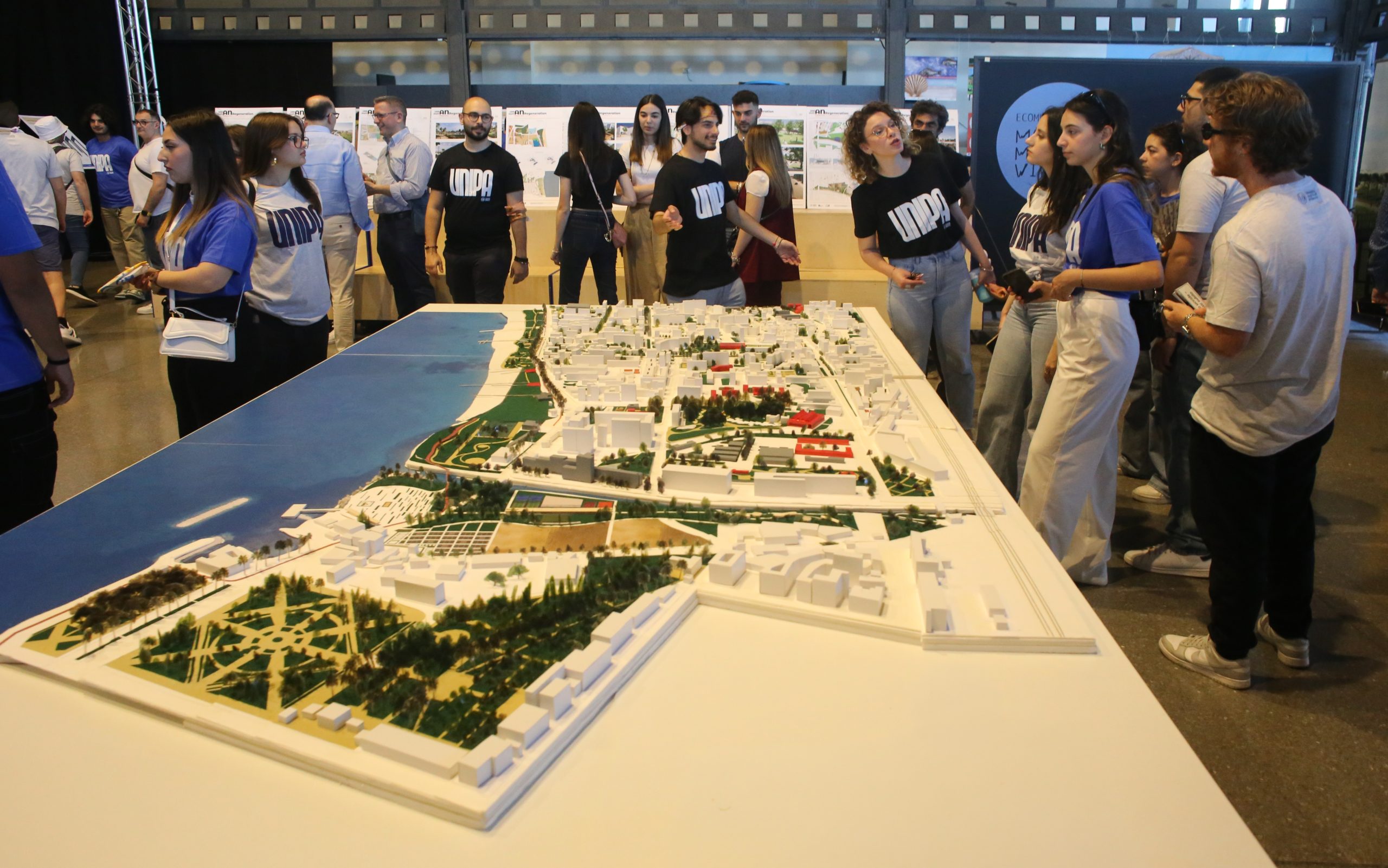
Plastico del waterfront della Costa Sud di Palermo realizzato dagli allievi architetti del Laboratorio di Urbanistica 2, prof.ssa Alessandra Badami, a.a. 2023-24, esposto alla mostra Mare Muto presso l’ex Deposito Locomotive di Sant’Erasmo, Palermo.
Scale model of the regeneration proposal for Palermo’s South Coast waterfront, produced by architecture students of Urban Planning Studio 2, Prof. Alessandra Badami, Academic Year 2023–2024. Displayed at the Silent Sea exhibition, held at the former Sant’Erasmo Locomotive Depot, Palermo.

Allestimento dei progetti e dei prototipi realizzati dagli allievi del Liceo Artistico Vincenzo Ragusa e Otama Kiyohara, Indirizzo Architettura e Ambiente, classe III H, coordinati dalla prof.ssa Giusi Viola, a.s. 2023-24, esposto nella mostra Mare Muto presso l’ex Deposito Locomotive di Sant’Erasmo, Palermo.
Installation of projects and prototypes produced by students of the Vincenzo Ragusa and Otama Kiyohara Artistic High School, Architecture and Environment programme, Class III H, coordinated by Prof. Giusi Viola, Academic Year 2023–2024. Displayed at the Silent Sea exhibition, held at the former Sant’Erasmo Locomotive Depot, Palermo.

Scenografia “Paesaggi stratificati” esposta nella mostra Mare Muto presso l’ex Deposito Locomotive di Sant’Erasmo, Palermo. Concept di Cassandra Funsten. Disegni di Sofia Quartararo, Angelica Virgilio, Vittoria Calò, Irene Luparello, Marta Giuliano, Federico Mauro, Gianluca Mazzara, Martina Monforte, Roberta Costantino e Giorgio Provenzano, studenti del Liceo Artistico Vincenzo Ragusa e Otama Kiyohara, indirizzo Arti figurative, classe III C, prof. Agostino Di Trapani. Rielaborazione dei disegni di Agostino Di Trapani. Rielaborazione in grafica digitale della prof.ssa Alessandra Badami.
Stage set “Layered Landscapes”, displayed at the Silent Sea exhibition, held at the former Sant’Erasmo Locomotive Depot, Palermo. Concept by Cassandra Funsten. Drawings by Sofia Quartararo, Angelica Virgilio, Vittoria Calò, Irene Luparello, Marta Giuliano, Federico Mauro, Gianluca Mazzara, Martina Monforte, Roberta Costantino, and Giorgio Provenzano, students of the Vincenzo Ragusa and Otama Kiyohara Artistic High School, Fine Arts programme, Class III C, under the supervision of Prof. Agostino Di Trapani. Drawings reworked by Agostino Di Trapani. Digital graphic design by Prof. Alessandra Badami.
La mostra ha rappresentato non solo la conclusione di un programma educativo, ma una componente integrante del processo partecipativo stesso. Traducendo idee, analisi e proposte progettuali in un’esperienza immersiva e accessibile al pubblico, ha trasformato la pianificazione urbana in una pratica culturale condivisa, favorendo il dialogo, incoraggiando l’impegno civico e rafforzando la responsabilità collettiva nei confronti del processo di rigenerazione. In tal modo, Mare Muto ha dimostrato come la comunicazione possa diventare una dimensione essenziale della pianificazione del lungomare, colmando il divario tra competenza tecnica e comprensione pubblica, e contribuendo alla costruzione di una visione condivisa per il futuro della costa sud di Palermo.
The exhibition represented not merely the final dissemination of an educational programme but an integral component of the participatory process itself. By translating ideas, analyses, and design proposals into a publicly accessible and immersive experience, it transformed urban planning into a shared cultural practice, fostering dialogue, encouraging civic engagement, and strengthening collective ownership of the regeneration process. In doing so, Silent Sea demonstrated how communication can become an essential dimension of waterfront planning, bridging the gap between technical expertise and public understanding, and contributing to the construction of a shared vision for the future of Palermo’s South Coast.
Conclusioni
Conclusions
La rigenerazione della Costa Sud di Palermo rappresenta una delle principali sfide della trasformazione urbana della città. Dopo decenni di degrado ambientale, perdita di accessibilità e marginalizzazione sociale, gli interventi di bonifica e recupero trovano nella pianificazione urbanistica costiera il quadro strategico entro cui ricondurre le trasformazioni del waterfront. Anticipando gli indirizzi del nuovo Piano Urbanistico Generale, essa orienta la ricostruzione del rapporto tra Palermo e il mare attraverso una visione unitaria capace di integrare qualità urbana, tutela del patrimonio ambientale e culturale e sviluppo sostenibile (Carta, 2021; Carta, 2025).
L’esperienza della Costa Sud conferma che la rigenerazione dei waterfront contemporanei non dipende esclusivamente dalla qualità del progetto urbano o dalla disponibilità delle risorse economiche. La sua efficacia è strettamente legata alla capacità della pianificazione di coordinare interventi fisici, valorizzazione del patrimonio e coinvolgimento delle comunità locali, promuovendo forme di collaborazione tra amministrazioni pubbliche, università, scuole, istituzioni culturali, associazioni e cittadini. La partecipazione assume così il ruolo di componente strutturale del processo di trasformazione, contribuendo alla definizione condivisa degli obiettivi e alla costruzione del consenso necessario alla loro attuazione (Bruttomesso, 1993; Hoyle, 2000).
Il progetto Mare Muto dimostra come il coinvolgimento attivo delle giovani generazioni possa trasformare un’esperienza formativa in un’occasione di ricerca, confronto e produzione collettiva di conoscenza. L’elaborazione condivisa di scenari progettuali ha contribuito a rafforzare la consapevolezza del valore del waterfront e delle sue potenzialità, consolidando il senso di appartenenza ai luoghi e la responsabilità nei confronti del loro futuro.
La rigenerazione del waterfront emerge, quindi, non come un insieme di interventi rivolti al recupero di una fascia costiera degradata, ma come un progetto di città costruito collettivamente, nel quale pianificazione, qualità dello spazio pubblico, patrimonio culturale e partecipazione concorrono, fin dalle prime fasi di elaborazione delle strategie, alla ricostruzione del rapporto tra Palermo e il suo mare. Questo dimostra che il successo a lungo termine della rigenerazione delle aree costiere dipende tanto dalla creazione di visioni condivise e dal coinvolgimento civico quanto dalla trasformazione fisica dello spazio urbano.
The regeneration of Palermo’s South Coast represents one of the most significant challenges in the city’s contemporary urban transformation. After decades of environmental degradation, loss of public accessibility, and social marginalisation, the ongoing remediation and regeneration initiatives find their strategic framework in coastal spatial planning, which provides an integrated approach to the transformation of the waterfront. Anticipating the strategic directions of the new Municipal Master Plan, this planning framework seeks to re-establish the relationship between Palermo and the sea through a coherent vision that integrates urban quality, the conservation and enhancement of environmental and cultural heritage, and the principles of sustainable urban development (Carta, 2021; Carta, 2025).
The experience of Palermo’s South Coast demonstrates that the regeneration of contemporary waterfronts cannot be achieved solely through the quality of urban design or the availability of financial resources. Its success depends fundamentally on the capacity of spatial planning to coordinate physical interventions, heritage enhancement, and the active involvement of local communities, fostering collaborative relationships among public authorities, universities, schools, cultural institutions, voluntary organisations, and citizens. Within this perspective, participation becomes a structural component of the regeneration process, contributing both to the co-production of shared objectives and to the development of the social consensus required for their long-term implementation (Bruttomesso, 1993; Hoyle, 2000).
The Silent Sea project demonstrates how the active engagement of younger generations can transform an educational initiative into a process of research, dialogue, and the collective production of knowledge. The collaborative development of design scenarios strengthened awareness of the value and potential of the waterfront while fostering a stronger sense of place and a greater sense of responsibility for its future among the participants.
The regeneration of the waterfront therefore emerges not simply as a programme of interventions aimed at restoring a degraded coastal zone, but as a collectively constructed urban project in which spatial planning, the quality of public space, cultural heritage, and public participation are integrated from the earliest stages of strategy-making. Together, these dimensions contribute to the reconstruction of the relationship between Palermo and its sea, demonstrating that the long-term success of waterfront regeneration depends as much on the creation of shared visions and civic engagement as on the physical transformation of urban space.
IMMAGINE INIZIALE | Proposta di rigenerazione del lungomare per il tratto di Palermo compreso tra Via Tiro a Segno e il fiume Oreto. (Fonte: Dipartimento di Architettura, Università di Palermo) [1].
HEAD IMAGE | Waterfront regeneration proposal for the section of Palermo between Via Tiro a Segno and the Oreto River. (Source: Department of Architecture, University of Palermo) [1].
╝
NOTE
NOTES
[1] Progetto a cura degli allievi architetti Amélie Andreani, Juliet Charbonnier, Elena Palazzolo e Rachele Scurria. Laboratorio di Urbanistica 2, prof. Alessandra Badami, a.a. 2023-24.
[2] Il percorso è stato ideato e condotto su iniziativa dell’autore dell’articolo.
[3] Hanno collaborato alla conduzione dei percorsi Cristina Alga, Valentina Mandalari e Gabriele Morana dell’Ecomuseo Mare Memoria Viva.
[4] Si ringraziano per l’accoglienza ai Laboratori di Scenografia Marco Betta, soprintendente del Teatro Massimo di Palermo, Raffaele Ajovalasit, Stefano Canzoneri, Christian Lanni, Nikita Schifaudo, Giovanni Vallone e gli altri operatori dei Laboratori.
[5] Si ringraziano i tutor alla didattica Cassandra Funsten, Manlio Speciale, Eleonora Balsamo e Eleonora Panza.
[6] Hanno collaborato ai percorsi didattici i professori degli Istituti Superiori Einaudi-Pareto, V. Ragusa e O. Kiyohara-Parlatore e Majorana Gloria Aquila, Emanuela Bosco, Calogero Campo, Viviana Di Gloria, Agostino Di Trapani, Daniela Ficile, Bruno Giannusa, Adamo Carmelo Lamponi, Francesca Maria Pecoraro, Tiziana Provenzani, Monica Troja, Giusi Viola, Mario Virga e Norman Vitale.
[7] Laboratorio condotto dall’autore dell’articolo.
[8] Il titolo della mostra è stato ideato da Israt Ahmed, Giulia Morana ed Emanuela Pileri, studentesse dell’Istituto Parlatore.
[1] Project by architectural students Amélie Andreani, Juliet Charbonnier, Elena Palazzolo, and Rachele Scurria. Urban Planning Laboratory 2, Prof. Alessandra Badami, academic year 2023-24.
[2] The programme was conceived and led by the author of this article.
[3] The educational programme was supported by Cristina Alga, Valentina Mandalari, and Gabriele Morana of the Mare Memoria Viva Ecomuseum, who collaborated in the delivery of the activities.
[4] The author wishes to thank Marco Betta, Superintendent of the Teatro Massimo Foundation, Palermo, together with Raffaele Ajovalasit, Stefano Canzoneri, Christian Lanni, Nikita Schifaudo, Giovanni Vallone, and the staff of the Stage Design Workshops for their generous hospitality and support.
[5] The author is also grateful to the educational tutors Cassandra Funsten, Manlio Speciale, Eleonora Balsamo, and Eleonora Panza.
[6] The educational activities also benefited from the collaboration of the teachers of the Einaudi-Pareto, Vincenzo Ragusa and Otama Kiyohara-Parlatore, and Majorana secondary schools: Gloria Aquila, Emanuela Bosco, Calogero Campo, Viviana Di Gloria, Agostino Di Trapani, Daniela Ficile, Bruno Giannusa, Adamo Carmelo Lamponi, Francesca Maria Pecoraro, Tiziana Provenzani, Monica Troja, Giusi Viola, Mario Virga, and Norman Vitale.
[7] The educational programme was conceived and led by the author of this article.
[8] The title of the exhibition was devised by Israt Ahmed, Giulia Morana, and Emanuela Pileri, students of the Parlatore Secondary School.
RIFERIMENTI
REFERENCES
Badami A. (a cura di) (2024). Romagnolo. Patrimonio culturale materiale e immateriale della borgata marinara. Palermo: Palermo University Press.
Bruttomesso R. (a cura di) (1993). Waterfronts. A New Frontier for Cities on Water. Venice: Citta D’Acqua/Cities on Water.
Bruttomesso R. (2001). “Complexity on the Urban Waterfront”. In Marshall R. (a cura di), Waterfronts in Post-Industrial Cities. London: Taylor & Francis, pp. 39–50.
Carta M. (2012). “Palermo Waterfront: the ‘Fluid City’ Planning”. PORTUS, 24, pp. 88–95.
Carta M. (a cura di) (2021). Palermo. Biografia progettuale di una città aumentata. Siracusa: LetteraVentidue.
Carta M. (2025). “Palermo Waterfront: A Twenty-year Journey Between Storms and Safe Landings”. PORTUS, 50.
Hoyle B. (2000). “Global and Local Change on the Port-City Waterfront”. Geographical Review, 90(3), pp. 395–417.
Marshall R. (a cura di) (2001). Waterfronts in Post-Industrial Cities. London: Taylor & Francis.
Meyer H. (1999). City and Port. The Transformation of Port Cities: London, Barcelona, New York and Rotterdam. Utrecht: International Books.
PCTO Magazine (2024). Mare Muto, n. 2. Palermo: Palermo University Press. Disponibile su: https://unipapress.com/book/mare-muto/.
BADAMI, Angela Alessandra. “Silent Sea. Coastal Spatial Planning and Public Participation in the Regeneration of Palermo’s South Coast”. PORTUS | Port-City Relationship and Urban Waterfront Redevelopment, 51 (August 2026). RETE Publisher, Venice. ISSN 2282-5789. URL: https://portusonline.org/silent-sea-coastal-spatial-planning-and-public-participation-in-the-regeneration-of-palermos-south-coast/