╔
Ciascuno cresce solo se sognato
Danilo Dolci
Palermo città liquida. L’arcipelago dei luoghi del nuovo waterfront
Ci sono città che abitano il mare e città che sono abitate dal mare. Palermo appartiene a questa seconda specie. La differenza è sottile ma decisiva. Le prime usano l’acqua come infrastruttura: vi transitano merci, energie, persone. Le seconde, invece, si lasciano plasmare dall’acqua, ne assorbono la grammatica, ne incorporano i ritmi, ne fanno una forma di pensiero urbano.
È una città che il mare non ha semplicemente lambito, ma generato. Palermo, infatti, non è una città omogenea affacciata sul mare, ma un arcipelago urbano di luoghi differenti, ciascuno con una propria intensità, memoria e vocazione, tenuti insieme dall’acqua come infrastruttura relazionale.
Per questa ragione dedicare a Palermo la sezione speciale Portrait di PORTUS non significa raccontare soltanto una stagione di trasformazioni urbane o una serie di progetti sul waterfront. Significa interrogare una questione più ampia e più urgente: come può una città mediterranea del XXI secolo tornare a riconoscere nell’acqua la propria matrice originaria e, insieme, il proprio dispositivo di futuro?
Il Novecento ha costruito città contro l’acqua. Ha irrigidito le coste, separato i porti dai quartieri, recintato le banchine, trasformato i fiumi in canali tecnici e la pioggia in un problema idraulico. La modernità urbana ha pensato l’acqua come ostacolo o come servizio: da regimentare, deviare, accelerare. Ma le città portuali – e Palermo più di molte altre per il suo eponimo di città tutta porto – ci ricordano che l’acqua non è solo materia da governare: è condizione di urbanità.
Per questo oggi, nell’epoca delle crisi climatiche, delle transizioni ecologiche, delle economie mobili e delle nuove geografie del turismo, il fronte d’acqua torna a essere il luogo dove la città misura la propria capacità di mutare. Non è più soltanto bordo, ma soglia. Non più margine, ma cerniera. Non più limite, ma interfaccia.
I waterfront sono oggi i laboratori più intensi della trasformazione urbana globale. Da Rotterdam ad Amburgo, da Barcellona a Marsiglia, da Brest ad Aalborg, le città portuali hanno compreso che il loro futuro non dipende solo dall’efficienza logistica, ma dalla capacità di costruire nuove alleanze tra economia marittima, spazio pubblico, cultura e abitare. Palermo entra in questo campo non come allieva tardiva, ma come caso paradigmatico, perché qui il rapporto tra città e acqua è sempre stato una questione ontologica prima ancora che funzionale [1].
Con i suoi ventisei chilometri di costa urbana e con un porto cresciuto storicamente dentro il corpo stesso della città, Palermo rappresenta una delle più complesse geografie liquide del Mediterraneo. Qui progettare il waterfront non significa intervenire su una fascia specialistica. Significa ripensare l’intero metabolismo urbano. Significa comprendere che porto, waterfront e costa non sono tre oggetti distinti, ma tre stati della stessa materia urbana.
Ed è proprio da questa consapevolezza che nasce l’idea di Palermo come città liquida.
La città liquida non è una metafora estetica. È un paradigma operativo. È il riconoscimento che le città d’acqua non possono più essere progettate come macchine rigide, ma devono essere pensate come organismi adattivi, capaci di assorbire, filtrare, connettere, trasformare.
Nel caso di Palermo, la liquidità si manifesta in quattro forme complementari, che insieme compongono una nuova grammatica urbana. La prima è la liquidità portuale. Il porto non è più enclave produttiva separata dalla città, ma dispositivo osmotico: gradiente di relazioni che passa dal porto rigido dei cantieri e della logistica pesante al porto permeabile delle crociere e dei servizi, fino al porto liquido della Cala e del Molo Trapezoidale, dove nautica, cultura, archeologia e vita urbana si mescolano in un unico ecosistema.
La seconda è la liquidità costiera. La costa non è una sequenza di episodi isolati, ma un grande cardo lineare che attraversa la città da nord a sud, da Sferracavallo ad Acqua dei Corsari. Un asse che non collega soltanto luoghi, ma attiva possibilità: è la nuova infrastruttura narrativa della Palermo contemporanea.
La terza è la liquidità ecologica. Palermo è una città idraulicamente fragile perché ha progressivamente impermeabilizzato il proprio suolo e interrotto i cicli naturali dell’acqua. Oggi deve ritrovare quella sapienza antica per cui acqua, agricoltura e insediamento formavano un unico sistema metabolico.
La quarta è la liquidità sociale. Il waterfront non è solo spazio economico, ma è spazio civico. È il luogo in cui si costruiscono nuove forme di prossimità, nuovi quarti spazi, nuove comunità ibride tra abitare, lavoro, cultura e cura. La liquidità, qui, significa capacità di mescolare usi, tempi, popolazioni.
Da questa visione è nato il Piano Regolatore Portuale del 2008 (approvato nel 2018), non come piano settoriale, ma come infrastruttura di riconciliazione tra città e mare (come vi racconteremo più avanti in un altro contributo). Un piano che ha introdotto una gradazione di permeabilità tra porto e città, distinguendo per integrare, separando per ricucire. Non è stato pensato come strumento regolativo tradizionale, ma come piano direttore, dispositivo di scenario e di indirizzo, per riportare Palermo sull’acqua, riordinando le funzioni portuali per liberarne alcune a favore di nuovi usi urbani e disegnando, lungo l’intero arco del porto, una serie di spazi di transizione a diverso grado di apertura verso la città: dal porto più intimamente fuso col tessuto urbano, dedicato a nautica, cultura e tempo libero, fino al nucleo produttivo e cantieristico che deve restare protetto e impermeabile alle contaminazioni. Un piano, insomma, che declina per connettere, e che affianca alla razionalizzazione funzionale del porto un disegno preciso delle soglie – dei varchi, degli innesti, degli affacci – attraverso cui la città può riappropriarsi del suo mare.
Da quella intuizione di piano direttore sono nati, progressivamente, i progetti che il lettore troverà raccontati nelle pagine seguenti e che, insieme ad altri alimentati dalla medesima idea, costituiscono l’arcipelago della città d’acqua. Il nuovo quartiere d’acqua del Molo Trapezoidale, accanto al parco archeologico del Castello a Mare, che ibrida nautica da diporto, convivialità, commercio, residenzialità alberghiera, coworking, congressualità, cultura e archeologia in un unico paesaggio urbano-portuale; il nuovo fronte permeabile lungo via Crispi, pensato come sistema di spazi pubblici e giardini che restituiscono alla città le visuali sul mare; il terminal passeggeri sulla banchina Sammuzzo. E poi i progetti in itinere per la Manifattura Tabacchi, la Chimica Arenella, il Foro Italico e gli immobili pubblici di Piazza Marina.
Un arcipelago di luoghi che reclama una connessione perché non rimangano isolati, tenuti insieme solo da un’idea: serve una dorsale che ne costituisca la struttura portante di senso.
There are cities that inhabit the sea, and cities that are inhabited by the sea. Palermo belongs to the second category. The distinction is subtle, yet decisive. The former use water as infrastructure: goods, energy and people move across it. The latter, instead, allow themselves to be shaped by water; they absorb its grammar, incorporate its rhythms and turn it into a form of urban thought.
Palermo is a city that the sea has not merely touched, but generated. Indeed, it is not a homogeneous city facing the sea, but an urban archipelago of different places, each with its own intensity, memory and vocation, held together by water as a relational infrastructure.
For this reason, dedicating the special PORTUS Portrait section to Palermo does not simply mean describing a season of urban transformations or a series of waterfront projects. It means addressing a broader and more urgent question: how can a twenty-first-century Mediterranean city once again recognize water as both its original matrix and its device for the future?
The twentieth century-built cities against water. It hardened coastlines, separated ports from urban districts, fenced off quays, turned rivers into technical channels and reduced rain to a hydraulic problem. Urban modernity conceived water either as an obstacle or as a service: something to be regulated, diverted and accelerated. Yet port cities – and Palermo perhaps more than many others, given its ancient identity as an “all-port” city – remind us that water is not merely matter to be governed: it is a condition of urbanity.
Today, in an age of climate crises, ecological transitions, mobile economies and new geographies of tourism, the waterfront has once again become the place where the city measures its capacity to change. It is no longer simply an edge, but a threshold. No longer a margin, but a hinge. No longer a limit, but an interface.
Waterfronts are now among the most intense laboratories of global urban transformation. From Rotterdam to Hamburg, from Barcelona to Marseille, from Brest to Aalborg, port cities have understood that their future depends not only on logistical efficiency, but on the capacity to build new alliances between maritime economy, public space, culture and dwelling. Palermo enters this field not as a latecomer, but as a paradigmatic case, because here the relationship between city and water has always been an ontological question before being a functional one [1].
With its twenty-six kilometres of urban coastline and a port that has historically grown within the body of the city itself, Palermo represents one of the most complex fluid geographies in the Mediterranean. Here, designing the waterfront does not mean intervening on a specialized strip. It means rethinking the entire urban metabolism. It means understanding that port, waterfront and coast are not three separate objects, but three states of the same urban matter.
It is precisely from this awareness that the idea of Palermo as a fluid city emerges.
The fluid city is not an aesthetic metaphor. It is an operational paradigm. It acknowledges that water cities can no longer be designed as rigid machines, but must be conceived as adaptive organisms, capable of absorbing, filtering, connecting and transforming.
In the case of Palermo, fluidity manifests itself in four complementary forms, which together compose a new urban grammar. The first is port fluidity. The port is no longer a productive enclave separated from the city, but an osmotic device: a gradient of relations that moves from the rigid port of shipyards and heavy logistics to the permeable port of cruise activities and services, and finally to the fluid port of the Cala and the Molo Trapezoidale, where yachting, culture, archaeology and urban life merge into a single ecosystem.
The second is coastal fluidity. The coast is not a sequence of isolated episodes, but a great linear cardo crossing the city from north to south, from Sferracavallo to Acqua dei Corsari. It is an axis that does not merely connect places, but activates possibilities: the new narrative infrastructure of contemporary Palermo.
The third is ecological fluidity. Palermo is hydraulically fragile because it has progressively sealed its soils and interrupted the natural cycles of water. Today it must recover the ancient knowledge through which water, agriculture and settlement once formed a single metabolic system.
The fourth is social fluidity. The waterfront is not only an economic space; it is also a civic space. It is the place where new forms of proximity, new fourth spaces and new hybrid communities are constructed between dwelling, work, culture and care. Here, fluidity means the capacity to mix uses, temporalities and populations.
This vision informed the 2008 Port Masterplan, approved in 2018, conceived not as a sectoral plan but as an infrastructure of reconciliation between city and sea, as will be discussed in a later contribution. The plan introduced a gradient of permeability between port and city, distinguishing in order to integrate, separating in order to reconnect. It was not conceived as a traditional regulatory instrument, but as a guiding plan, a scenario-building and strategic device to bring Palermo back to the water. It reorganized port functions so as to release some areas for new urban uses and designed, along the entire port arc, a series of transitional spaces with varying degrees of openness towards the city: from the port most intimately merged with the urban fabric, dedicated to yachting, culture and leisure, to the productive and shipbuilding core that must remain protected and impermeable to incompatible uses. In other words, it is a plan that differentiates in order to connect, combining functional rationalization with a precise design of thresholds – gates, insertions and viewpoints – through which the city may reclaim its sea.
From that guiding plan, the projects described in the following pages progressively emerged and, together with others shaped by the same idea, now form the archipelago of the water city: the new water district of the Molo Trapezoidale, next to the archaeological park of Castello a Mare, which hybridizes yachting, conviviality, commerce, hotel accommodation, coworking, congress functions, culture and archaeology into a single urban-port landscape; the new permeable frontage along Via Crispi, conceived as a system of public spaces and gardens restoring views of the sea to the city; the passenger terminal on Banchina Sammuzzo; and the ongoing projects for the Manifattura Tabacchi, Chimica Arenella, the Foro Italico and the public buildings of Piazza Marina.
This archipelago of places requires connection if it is not to remain a constellation of isolated fragments held together only by an idea. It needs a backbone capable of becoming its structural axis of meaning.
La costa come nuovo cardo della città liquida
The Coast as the New Cardo of the Fluid City
Nella nostra idea di Palermo come arcipelago di luoghi rigenerati, il fronte a mare non è soltanto una sequenza di margini da recuperare o di vuoti da riempire. È il nuovo cardo della città, il suo asse generativo. La grande infrastruttura lineare che, da nord a sud, può riconnettere parti separate, riattivare economie latenti, riscrivere relazioni sociali e ambientali, ridefinire il metabolismo urbano. Non si tratta di un arcipelago di frammenti isolati, ma di isole urbane interdipendenti: borgate, porti, cale, parchi, approdi, aree dismesse, quartieri in transizione. Luoghi autonomi ma connessi, ciascuno capace di generare urbanità propria e insieme di contribuire a una più ampia ecologia costiera.
Se per oltre un secolo il cardo moderno di Palermo è stato via Libertà – asse borghese, monumentale, interno, costruito come spina dorsale della modernizzazione ottocentesca e novecentesca – oggi il nuovo asse strategico è la costa. Un cardo diverso: non più centripeto ma estroverso, non più lineare ma poroso, non più soltanto urbano ma urbano-marittimo. È lungo questo asse che Palermo torna a connettersi al mondo, attraverso un arcipelago di luoghi che si innestano sulla dorsale costiera.
La costa, infatti, non è più frontiera ma zona di negoziazione. Non è il bordo terminale della città, ma la sua membrana più permeabile e fertile, il luogo dove si intrecciano mobilità globali e pratiche locali, economie del mare e spazi pubblici, turismo e produzione, memoria e innovazione.
In our understanding of Palermo as an archipelago of regenerated places, the waterfront is not merely a sequence of margins to be recovered or voids to be filled. It is the city’s new cardo, its generative axis. It is the great linear infrastructure that, from north to south, can reconnect separated parts, reactivate latent economies, rewrite social and environmental relations, and redefine the urban metabolism. This is not an archipelago of isolated fragments, but a system of interdependent urban islands: seaside villages, ports, coves, parks, landings, disused areas and districts in transition. These are autonomous yet connected places, each capable of generating its own urbanity while contributing to a wider coastal ecology.
If for more than a century the modern cardo of Palermo was Via Libertà – a bourgeois, monumental and inland axis, constructed as the backbone of nineteenth- and twentieth-century modernization – today the new strategic axis is the coast. It is a different cardo: no longer centripetal but outward-looking, no longer linear but porous, no longer merely urban but urban-maritime. Along this axis Palermo reconnects to the world through an archipelago of places grafted onto the coastal backbone.
The coast is no longer a frontier, but a zone of negotiation. It is not the terminal edge of the city, but its most permeable and fertile membrane, the place where global mobilities and local practices, maritime economies and public spaces, tourism and production, memory and innovation intersect.

Tavola che illustra il nuovo waterfront di Palermo, inteso come un arcipelago di luoghi pubblici, infrastrutture verdi-blu e aree di rigenerazione urbana che ridefiniscono il rapporto tra la città e il mare. (© Maurizio Carta).
A plate illustrating the new waterfront of Palermo, conceived as an archipelago of public spaces, green-blue infrastructures, and urban regeneration areas that redefine the relationship between the city and the sea. (© Maurizio Carta).
La città liquida è il paradigma, il nuovo cardo costiero ne costituisce la struttura portante e l’arcipelago dei luoghi rappresenta la forma urbana attraverso cui quella struttura prende corpo.
Da Sferracavallo a Mondello, dall’Addaura a Vergine Maria, fino ad Arenella e Acquasanta con le loro grandi aree produttive dismesse, dal porto storico in trasformazione fino al Foro Italico e alla Cala di Palermo e più a sud verso Romagnolo, Settecannoli, Sperone, Bandita, Roccella e fino ad Acqua dei Corsari, si dispiega una sequenza di luoghi che non devono più essere pensati come episodi isolati, ma come parti di una stessa geografia strategica. È un arcipelago cosmopolita.
A A questa dorsale costiera si affianca, in parallelo, un secondo asse prezioso e poco più interno: la sequenza via Butera-via Torremuzza, che possiamo leggere come la dorsale delle fondazioni delle arti contemporanee. È un tracciato breve ma densissimo, in cui Palermo mostra la propria capacità di trasformare il patrimonio storico in infrastruttura culturale del presente.
Da un lato, la Fondazione Sant’Elia e il Loggiato di San Bartolomeo, affacciato sul porto della Cala, aprono il sistema verso il cuore monumentale e marittimo della città. Poco oltre, Palazzo Butera, restituito alla città da Massimo e Francesca Valsecchi, ospita una straordinaria collezione d’arte e un programma di attività didattiche che ne fanno non solo una dimora-museo, ma un laboratorio culturale aperto. Accanto, Palazzo Piraino potrà rafforzare questa vocazione accogliendo una nuova accademia delle arti e dell’artigianato. Procedendo lungo questo asse, la Fondazione Barbaro e la Fondazione Tomasi di Lampedusa aggiungono ulteriori presidi di memoria, cultura e produzione simbolica, mentre la nuova sede palermitana della Fondazione Hauser & Wirth, nel favoloso Palazzo Forcella-De Seta, proietta Palermo dentro le reti internazionali dell’arte contemporanea. Più a sud, Palazzo Jung, in via Lincoln, con la Fondazione Falcone e il Museo del Presente dedicato alla memoria di Giovanni Falcone e Paolo Borsellino e alla loro eroica lotta contro la mafia, completa questa dorsale trasformandola in un asse civile oltre che culturale.
Questa sequenza non è un semplice itinerario museale, ma è un’infrastruttura urbana immateriale, capace di connettere arte contemporanea, educazione, memoria civile, artigianato, collezionismo, internazionalizzazione e spazio pubblico. Dentro la città liquida, la dorsale delle fondazioni agisce come un controcanto terrestre del waterfront: mentre la costa riconnette Palermo al mare, questo asse culturale riconnette il mare alla profondità storica e civile della città.
The fluid city is the paradigm, the new coastal cardo is its structural backbone, and the archipelago of places is the urban form through which that structure takes shape.
From Sferracavallo to Mondello, from Addaura to Vergine Maria, to Arenella and Acquasanta with their large disused productive areas, from the historic port in transformation to the Foro Italico and the Cala of Palermo, and further south towards Romagnolo, Settecannoli, Sperone, Bandita, Roccella and Acqua dei Corsari, a sequence of places unfolds that should no longer be conceived as isolated episodes, but as parts of a single strategic geography. It is a cosmopolitan archipelago.
Parallel to this coastal backbone, slightly inland, lies a second precious axis: the sequence of Via Butera and Via Torremuzza, which can be read as the backbone of contemporary art foundations. It is a short yet extremely dense trajectory, in which Palermo reveals its capacity to transform historic heritage into a cultural infrastructure for the present.
On one side, Fondazione Sant’Elia and the Loggiato di San Bartolomeo, overlooking the port of the Cala, open this system towards the monumental and maritime heart of the city. A little further on, Palazzo Butera, returned to the city by Massimo and Francesca Valsecchi, hosts an extraordinary art collection and an educational programme that make it not only a house-museum, but also an open cultural laboratory. Nearby, Palazzo Piraino may reinforce this vocation by hosting a new academy of arts and crafts. Continuing along this axis, Fondazione Barbaro and Fondazione Tomasi di Lampedusa add further presences of memory, culture and symbolic production, while the new Palermo venue of Hauser & Wirth, in the remarkable Palazzo Forcella-De Seta, projects Palermo into the international networks of contemporary art. Further south, Palazzo Jung in Via Lincoln, with Fondazione Falcone and the Museo del Presente dedicated to the memory of Giovanni Falcone and Paolo Borsellino and to their heroic struggle against the Mafia, completes this backbone by turning it into a civic as well as cultural axis.
This sequence is not simply a museum itinerary. It is an immaterial urban infrastructure, capable of connecting contemporary art, education, civic memory, craftsmanship, collecting, internationalization and public space. Within the fluid city, the backbone of foundations acts as a terrestrial counterpoint to the waterfront: while the coast reconnects Palermo to the sea, this cultural axis reconnects the sea to the historical and civic depth of the city.

Composizione fotografica dedicata all’Urban Center Sicilia, che mostra la storica facciata monumentale della sede e gli spazi interni adibiti a sale espositive e aree per conferenze e dibattiti (© Maurizio Carta).
A photographic composition dedicated to the Urban Center Sicilia, showing the historical monumental facade of the headquarters and the interior spaces used as exhibition halls and areas for conferences and debates. (© Maurizio Carta).
Connessi a questa stessa dorsale, due grandi contenitori pubblici attendono di essere restituiti alla città come tasselli dello stesso disegno: il Palazzo della Zecca e il Palazzo delle Finanze, inseriti nel Piano Città degli immobili pubblici siglato tra il Comune di Palermo e l’Agenzia del Demanio e chiamati a diventare edifici ibridi in cui residenza, uffici, cultura e convivialità si mescolino dentro un unico ambito di rigenerazione che i due enti immaginano come un Piazza Marina e Cala Mixed District, una nuova isola dell’abitare urbano capace di tenere insieme investimento privato e interesse pubblico, ricettività e servizi aperti alla città, in dialogo con il sistema universitario e museale che già anima piazza Marina. Il primo segnale di questa vocazione è già visibile: al piano terra del Palazzo della Zecca ha aperto da poco un Urban Center, luogo in cui il dibattito pubblico sulla rigenerazione urbana può farsi esso stesso motore di trasformazione, prima ancora che i cantieri comincino.
Il nuovo cardo costiero, quindi, non è solo una linea geografica, ma un sistema di risonanze: al mare come infrastruttura ecologica e produttiva corrisponde una dorsale culturale capace di trasformare i palazzi storici in dispositivi contemporanei di conoscenza, memoria e cittadinanza.
In questa visione – il sogno che fa crescere, per dirla con le parole di Danilo Dolci – la dorsale urbana costiera mette in relazione le borgate marinare con i nuovi hub della mobilità, le aree industriali in transizione con i paesaggi ecologici emergenti, i porticcioli con le nuove centralità culturali, i parchi urbani con le economie blu, le economie della cultura con le nuove geografie dell’abitare, la produzione artigianale con la performatività dello spazio pubblico. Una dorsale che, se progettata unitariamente, può fare della costa il più potente dispositivo di riequilibrio territoriale della Palermo contemporanea. Qui la città liquida si manifesta nella sua forma più concreta.
Liquidità significa infatti capacità di mettere in continuità ciò che la città moderna aveva separato: porto e quartieri, logistica e spazio pubblico, produzione e tempo libero, infrastruttura e paesaggio. Significa trasformare la costa in una lunga soglia urbana, capace di alternare densità e vuoti, protezione e apertura, permanenza e adattabilità.
Se la costa è il nuovo cardo della città liquida, i suoi luoghi sono l’arcipelago attraverso cui quella linearità si rompe, si addensa e si moltiplica in una pluralità di centralità. È un arcipelago connesso dalla costa, infrastruttura comune di enorme potenziale che pretende però una regia unitaria, una visione comune, una linea di spartito su cui appoggiare le note di una nuova partitura urbana.
Per questo nel novembre 2022 il Comune di Palermo e l’Autorità di Sistema Portuale del Mare di Sicilia Occidentale hanno sottoscritto un Accordo Quadro che per la prima volta supera i confini giurisdizionali tra le due istituzioni senza intaccarne le rispettive competenze. È un passaggio decisivo, perché riconosce finalmente che il rapporto città-porto non può più essere amministrato come conflitto di perimetri, ma deve essere governato come co-progettazione di interfacce. Dal Foro Italico al Molo Trapezoidale, dal porticciolo di Sant’Erasmo alla foce dell’Oreto, dalla Manifattura Tabacchi alla borgata dell’Acquasanta, questo accordo apre una nuova stagione di convergenza, resa successivamente ancora più concreta attraverso la sottoscrizione di un nuovo accordo operativo tra la presidente Annalisa Tardino e il Sindaco Roberto Lagalla, mirato, soprattutto, al miglioramento delle relazioni osmotiche tra città e porto nell’area dell’asse pedonale di via Emerico Amari.
È un accordo che nasce da una lunga genealogia di conflitti: basti pensare alle “aree bersaglio” – stralciate dal piano già nel 2011 come sintomo di una storica incapacità di pensare unitariamente il margine costiero. Oggi, invece, proprio lì dove prima c’erano fratture, la città liquida comincia finalmente a prendere forma attraverso un bricolage consapevole di visioni, progetti e interventi.
Tra i luoghi più rappresentativi di questo arcipelago liquido occupa una posizione centrale il grande Parco del Foro Italico, cerniera tra il centro storico, il porto della Cala, Sant’Erasmo e la Costa Sud. Nato come passeggiata monumentale affacciata sul mare e restituito negli ultimi decenni alla città come grande prato urbano, il Foro Italico è oggi uno dei più significativi spazi pubblici del Mediterraneo, ma anche uno dei più complessi da governare proprio per la straordinaria pluralità di pratiche che lo attraversano. È uno spazio che cambia continuamente identità senza perdere la propria natura, capace di accogliere i rituali quotidiani della cittadinanza, la corsa, il gioco, il riposo e l’incontro, ma anche le grandi celebrazioni collettive come la preghiera conclusiva del Ramadan, che ogni anno riunisce migliaia di fedeli provenienti dalle diverse comunità islamiche della città, i grandi concerti estivi, le manifestazioni sportive, gli eventi gastronomici e le attività culturali delle molte comunità che compongono la Palermo contemporanea.
Proprio questa straordinaria capacità di ospitare usi differenti ha suggerito, nell’ambito dell’Accordo Quadro tra il Comune e l’Autorità Portuale, di promuovere un concorso internazionale di idee dedicato alla riconfigurazione dell’intero sistema compreso tra il Molo Sud, il Parco del Foro Italico, il porticciolo di Sant’Erasmo, la foce dell’Oreto e il litorale fino allo Stand Florio. Più che il progetto di un parco, il concorso rappresenta il progetto di una nuova geografia pubblica del waterfront, capace di mettere in relazione porto, città, paesaggio costiero e sistemi ecologici in un’unica visione.
L’obiettivo non è costruire nuovi volumi, ma aumentare la qualità urbana attraverso il progetto dello spazio aperto. Piccoli padiglioni reversibili, dispositivi temporanei, pontili e piattaforme galleggianti, nuove connessioni pedonali e ciclabili, attrezzature leggere per lo sport, la cultura e il tempo libero dovranno intensificare il rapporto tra cittadini e mare senza alterare il carattere aperto e paesaggistico di questo straordinario fronte urbano. Allo stesso tempo il concorso estende la propria attenzione al Foro Umberto I lungo le Mura delle Cattive, ricucendo il dialogo tra il waterfront e uno dei più preziosi sistemi monumentali della città, dove il Palchetto della Musica, Porta dei Greci, Palazzo Butera e l’intera dorsale delle fondazioni culturali compongono una delle più dense sequenze urbane del Mediterraneo. Le diverse proposte dei partecipanti al concorso, a breve, comporranno una sintesi di interventi immediatamente realizzabili nell’ambito delle risorse dell’accordo tra Regione Siciliana, Autorità Portuale e Comune per iniziare a prototipare l’arricchimento delle dotazioni civiche e comunitarie del Foro Italico, perché non perda la sua straordinaria adattabilità a usi imprevedibili e informali e acquisti alcuni servizi che aumentino il benessere per le persone e favoriscano la cura dello spazio. Sarà non solo uno spazio più curato, ma anche uno spazio che cura le persone che lo frequentano.
In questa prospettiva il Foro Italico non è soltanto un parco urbano. È un “quarto spazio” [2] della Palermo liquida: una grande infrastruttura civica adattiva, capace di ospitare la continua trasformazione della città senza perdere la propria identità. È il luogo dove il mare diventa spazio pubblico, dove la pluralità delle culture trova una scena comune e dove l’arcipelago dei luoghi che compone Palermo si manifesta nella sua forma più aperta, inclusiva e cosmopolita.
Proseguendo lungo la dorsale costiera verso nord, l’arcipelago della città liquida incontra due grandi luoghi della memoria industriale che rappresentano alcune delle più importanti riserve di futuro di Palermo: l’ex Manifattura Tabacchi e gli stabilimenti dell’ex Chimica Arenella. Non sono soltanto vaste aree dismesse affacciate sul mare, ma autentiche infrastrutture territoriali che attendono una nuova urbanogenesi. La loro posizione strategica, tra l’Acquasanta, l’Arenella, i Cantieri Navali e il sistema dei porti turistici, consente di immaginare una trasformazione capace di intrecciare rigenerazione urbana, economia blu, innovazione e qualità dell’abitare.
L’ex Manifattura Tabacchi, sorta sul sito dello storico Lazzaretto e oggi di proprietà di Cassa Depositi e Prestiti Immobiliare, possiede tutte le caratteristiche per diventare uno dei principali poli delle imprese creative e innovative del Mediterraneo. Non un semplice recupero edilizio, ma un vero ecosistema produttivo in cui ricerca scientifica, manifattura avanzata, industrie culturali e creative, formazione superiore, sperimentazione tecnologica e nuove forme dell’abitare possano convivere in un ambiente aperto e multifunzionale. Insieme agli ex Magazzini Tirrenia, collocati poco oltre i Cantieri Navali e affacciati anch’essi sul mare, potrebbe costituire un grande distretto dell’innovazione urbana, capace di ospitare funzioni permanenti e temporanee, residenze condivise, foresterie per ricercatori e creativi, spazi per startup, laboratori, incubatori, attività culturali e servizi dedicati alla crescente economia del mare. Una trasformazione che dovrebbe ricucire anche il rapporto con l’entroterra, integrando il sistema di via Montalbo e restituendo valore paesaggistico e ambientale al corridoio geomorfologico del torrente Passo di Rigano, che proprio qui ritrova il mare.
Linked to this same backbone, two major public buildings await their return to the city as components of the same design: Palazzo della Zecca and Palazzo delle Finanze. Included in the Piano Città for public real estate signed by the Municipality of Palermo and the State Property Agency, they are expected to become hybrid buildings where housing, offices, culture and conviviality coexist within a single regeneration district, conceived by the two institutions as the Piazza Marina and Cala Mixed District. This new island of urban dwelling is intended to combine private investment and public interest, hospitality and services open to the city, in dialogue with the university and museum system that already animates Piazza Marina. The first sign of this vocation is already visible: an Urban Center has recently opened on the ground floor of Palazzo della Zecca, a place where public debate on urban regeneration can itself become a driver of transformation even before construction sites begin.
The new coastal cardo, therefore, is not merely a geographical line, but a system of resonances: corresponding to the sea as ecological and productive infrastructure is a cultural backbone capable of transforming historic palaces into contemporary devices of knowledge, memory and citizenship.
Within this vision – the dream that allows growth, to use Danilo Dolci’s words – the coastal urban backbone relates seaside villages to new mobility hubs, industrial areas in transition to emerging ecological landscapes, small harbours to new cultural centralities, urban parks to blue economies, cultural economies to new geographies of dwelling, and artisanal production to the performativity of public space. If designed as a unitary system, this backbone can make the coast the most powerful device for territorial rebalancing in contemporary Palermo. Here the fluid city manifests itself in its most concrete form.
Fluidity means the capacity to place in continuity what the modern city had separated: port and districts, logistics and public space, production and leisure, infrastructure and landscape. It means transforming the coast into a long urban threshold, capable of alternating density and void, protection and openness, permanence and adaptability.
If the coast is the new cardo of the fluid city, its places form the archipelago through which that linearity breaks, thickens and multiplies into a plurality of centralities. It is an archipelago connected by the coast, a common infrastructure of enormous potential that nevertheless requires unified direction, a shared vision, a line of musical notation upon which the notes of a new urban score can be placed.
For this reason, in November 2022 the Municipality of Palermo and the Port System Authority of the Western Sicilian Sea signed a Framework Agreement that, for the first time, moved beyond the jurisdictional boundaries between the two institutions without undermining their respective competences. This was a decisive step, because it finally acknowledged that the city-port relationship can no longer be managed as a conflict of perimeters, but must be governed as the co-design of interfaces. From the Foro Italico to the Molo Trapezoidale, from the small harbour of Sant’Erasmo to the mouth of the Oreto, from the Manifattura Tabacchi to the Acquasanta district, this agreement opened a new season of convergence, later made even more concrete through a new operational agreement between President Annalisa Tardino and Mayor Roberto Lagalla, aimed above all at improving osmotic relations between city and port in the area of the pedestrian axis of Via Emerico Amari.
It is an agreement rooted in a long genealogy of conflicts: one need only recall the “target areas” removed from the plan as early as 2011, symptomatic of a historical inability to conceive the coastal margin as a unitary system. Today, by contrast, precisely where fractures once existed, the fluid city is finally beginning to take shape through a conscious bricolage of visions, projects and interventions.
Among the most representative places of this fluid archipelago, the great park of the Foro Italico occupies a central position, acting as a hinge between the historic centre, the port of the Cala, Sant’Erasmo and the Costa Sud. Born as a monumental promenade overlooking the sea and returned in recent decades to the city as a large urban lawn, the Foro Italico is today one of the most significant public spaces in the Mediterranean, but also one of the most complex to govern because of the extraordinary plurality of practices that cross it. It is a space that continuously changes identity without losing its nature, capable of hosting the everyday rituals of citizenship – running, playing, resting and meeting – as well as major collective celebrations such as the final Ramadan prayer, which every year brings together thousands of worshippers from the city’s different Islamic communities, summer concerts, sporting events, food festivals and cultural activities organized by the many communities that compose contemporary Palermo.
This extraordinary capacity to host different uses has led, within the Framework Agreement between the Municipality and the Port Authority, to the promotion of an international ideas competition for the reconfiguration of the entire system between the Molo Sud, the Foro Italico park, the small harbour of Sant’Erasmo, the mouth of the Oreto and the coastline up to the Stand Florio. More than the design of a park, the competition represents the design of a new public geography of the waterfront, capable of relating port, city, coastal landscape and ecological systems within a single vision.
The objective is not to construct new volumes, but to increase urban quality through the design of open space. Small reversible pavilions, temporary devices, floating platforms and piers, new pedestrian and cycling connections, and light equipment for sport, culture and leisure will intensify the relationship between citizens and the sea without altering the open and landscape character of this extraordinary urban frontage. At the same time, the competition extends its attention to Foro Umberto I along the Mura delle Cattive, reconnecting the dialogue between the waterfront and one of the city’s most precious monumental systems, where the Palchetto della Musica, Porta dei Greci, Palazzo Butera and the entire backbone of cultural foundations compose one of the densest urban sequences in the Mediterranean. The various proposals submitted by the competition participants will soon be synthesized into a set of immediately implementable interventions, within the resources of the agreement between the Sicilian Region, the Port Authority and the Municipality, in order to begin prototyping the enrichment of civic and community facilities at the Foro Italico. The aim is to ensure that the space does not lose its extraordinary adaptability to unpredictable and informal uses, while acquiring services that enhance people’s wellbeing and foster care for the place. It will become not only a better-cared-for space, but also a space that cares for the people who use it.
From this perspective, the Foro Italico is not merely an urban park. It is a “fourth space” [2] of fluid Palermo: a large adaptive civic infrastructure, capable of hosting the continuous transformation of the city without losing its identity. It is the place where the sea becomes public space, where the plurality of cultures finds a common stage, and where the archipelago of places that composes Palermo manifests itself in its most open, inclusive and cosmopolitan form.
Moving north along the coastal backbone, the archipelago of the fluid city encounters two major places of industrial memory that represent some of Palermo’s most important reserves for the future: the former Manifattura Tabacchi and the former Chimica Arenella plants. They are not merely vast disused areas overlooking the sea, but genuine territorial infrastructures awaiting a new urbanogenesis. Their strategic location between Acquasanta, Arenella, the shipyards and the system of marinas makes it possible to imagine a transformation capable of intertwining urban regeneration, the blue economy, innovation and the quality of dwelling.
The former Manifattura Tabacchi, built on the site of the historic Lazzaretto and now owned by Cassa Depositi e Prestiti Immobiliare, has all the characteristics required to become one of the main centres for creative and innovative enterprises in the Mediterranean. This would not be a simple building reuse, but a true productive ecosystem in which scientific research, advanced manufacturing, cultural and creative industries, higher education, technological experimentation and new forms of dwelling could coexist in an open and multifunctional environment. Together with the former Magazzini Tirrenia, located just beyond the shipyards and also facing the sea, it could form a large district of urban innovation, capable of hosting permanent and temporary functions, shared housing, guesthouses for researchers and creatives, spaces for start-ups, laboratories, incubators, cultural activities and services linked to the growing economy of the sea. Such a transformation should also reconnect the area with the hinterland, integrating the Via Montalbo system and restoring landscape and environmental value to the geomorphological corridor of the Passo di Rigano stream, which reaches the sea precisely here.
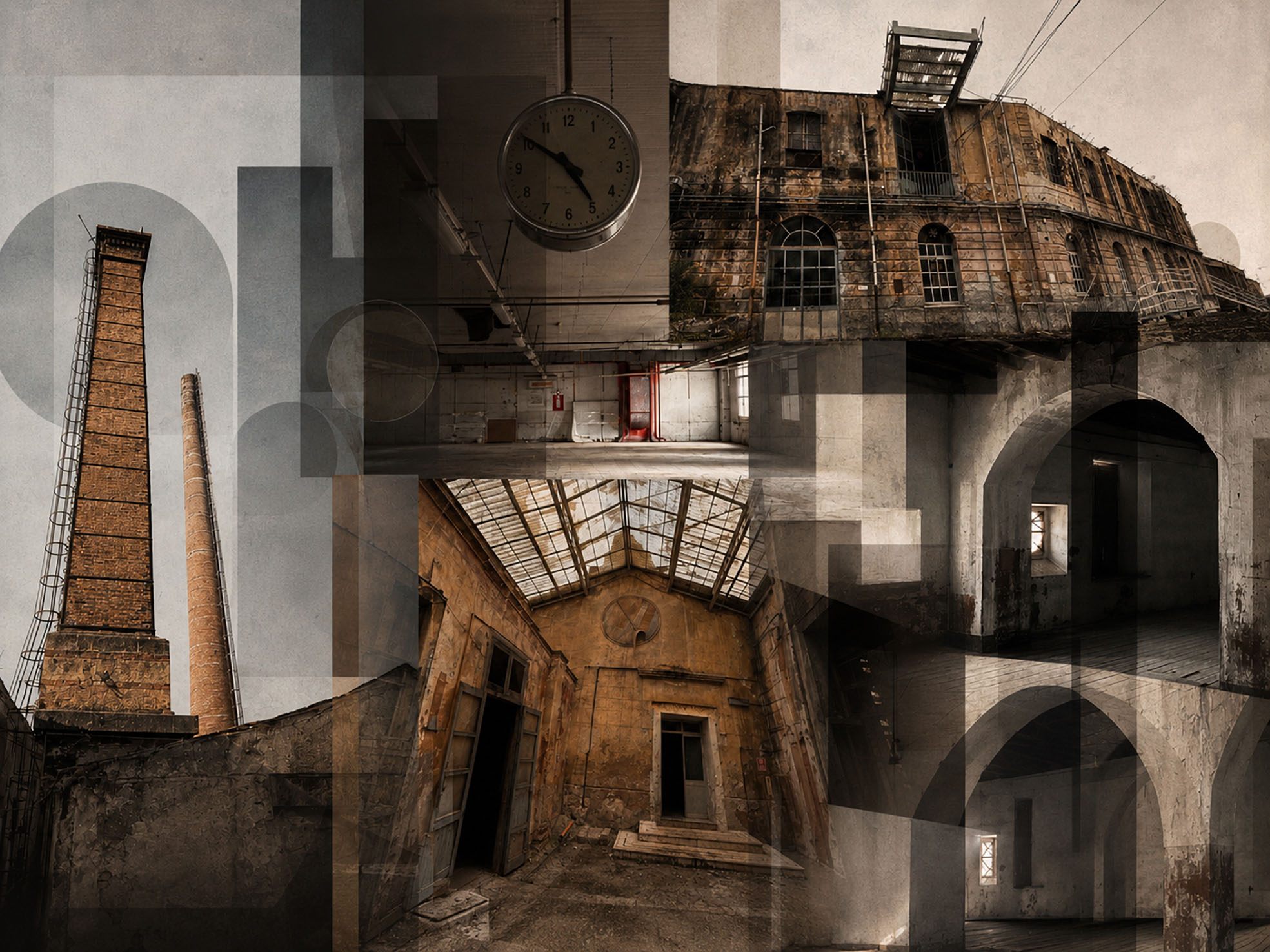
Mosaico dedicato al complesso dell’ex Manifattura Tabacchi di Palermo, situato nel quartiere dell’Acquasanta, dove l’architettura industriale racconta decenni di storia e lavoro. (© Maurizio Carta).
A mosaic dedicated to the former Manifattura Tabacchi complex in Palermo, located in the Acquasanta district, where industrial architecture tells the story of decades of history and labor. (© Maurizio Carta).
Poco più avanti, la grande area industriale dell’ex Chimica Arenella rappresenta un’altra isola strategica di questo arcipelago costiero. Le sue architetture di archeologia industriale, affacciate sul porto turistico e peschereccio dell’Arenella e sulla storica tonnara dei Florio, costituiscono uno dei più straordinari patrimoni di memoria produttiva della città. La loro rigenerazione attraverso la procedura del concorso internazionale Reinventing Cities promosso dal Comune insieme a C40 e all’Agenzia del Demanio può diventare il motore della rinascita dell’intera borgata, ospitando funzioni metropolitane ad alta intensità di innovazione e di relazione: ricettività di qualità, residenze temporanee, studentati, foresterie, co-housing, servizi per la nautica e la balneazione, attività culturali e imprenditoriali capaci di dialogare con il mare. In questo caso la sostenibilità economica della trasformazione non rappresenta un elemento accessorio, ma la condizione stessa della rigenerazione: soltanto attività capaci di generare elevato valore aggiunto potranno sostenere i complessi interventi di bonifica ambientale e, al tempo stesso, finanziare quelle opere di riequilibrio sociale, ecologico e urbano indispensabili per restituire benefici duraturi alla comunità dell’Arenella.
A little further on, the large industrial area of the former Chimica Arenella represents another strategic island in this coastal archipelago. Its industrial archaeological architecture, overlooking the tourist and fishing harbour of Arenella and the historic Florio tuna fishery, constitutes one of the city’s most extraordinary heritages of productive memory. Its regeneration through the international Reinventing Cities competition, promoted by the Municipality together with C40 and the State Property Agency, could become the engine for the rebirth of the entire seaside district, hosting metropolitan functions of high innovation and relational intensity: quality accommodation, temporary residences, student housing, guesthouses, co-housing, services for yachting and bathing, and cultural and entrepreneurial activities capable of engaging with the sea. In this case, the economic sustainability of the transformation is not an accessory element, but the very condition of regeneration: only activities capable of generating high added value will be able to support the complex environmental remediation works and, at the same time, finance the social, ecological and urban rebalancing measures required to return lasting benefits to the Arenella community.

Immagini suggestive dell’ex Chimica Arenella di Palermo, storico sito industriale dei primi del ‘900 dominato dall’iconica torre piezometrica visibile al centro della composizione e caratterizzato da imponenti navate e strutture geometriche che si fondono con i colori della terra e del sole, custodi della memoria operaia della costa palermitana. (© Maurizio Carta).
Evocative images of the former Chimica Arenella in Palermo, a historic early 20th-century industrial site dominated by the iconic water tower visible at the center of the composition. Its imposing naves and geometric structures blend with the colors of the earth and the sun, standing as guardians of the working-class memory of the Palermitan coast. (© Maurizio Carta).
Questi due grandi complessi non rappresentano dunque semplicemente occasioni di riuso del patrimonio industriale. Essi costituiscono due nuove isole dell’innovazione produttiva dell’arcipelago della città liquida: luoghi nei quali la memoria del lavoro manifatturiero può trasformarsi in una nuova economia della conoscenza, della creatività e dell’innovazione e concorrere alle nuove forme dell’abitare. Connessi alla dorsale costiera, ai Cantieri Navali, ai porti turistici, al sistema delle fondazioni culturali e alle borgate marinare, essi contribuiscono a definire una geografia urbana nella quale ogni luogo conserva la propria identità ma partecipa a una visione comune, facendo della costa non la periferia della città, ma il suo principale laboratorio di futuro.
Non lasciamoci sedurre da questo arcipelago in formazione, dalle pratiche di urbanogenesi incrementale e adattiva [3] che vanno componendo la nuova forma liquida della città, perché, per consolidarsi, ha bisogno di una visione urbanistica complessiva, sebbene con il necessario grado di flessibilità per non comprimere la tumultuosa potenza delle città d’acqua. Bisogna scongiurare il rischio che la costa continui a trasformarsi solo per frammenti, per eccezioni, per opportunità contingenti. Palermo ha invece bisogno di un grande progetto urbanistico costiero – composto dalla integrazione del Piano d’uso del demanio marittimo (PUDM), del Piano Urbanistico Generale PUG e dei progetti di rigenerazione urbana partenariali e negoziali – capace di costruire organicità, continuità e identità condivisa lungo l’intero cardo.
These two large complexes, therefore, do not simply represent opportunities for the reuse of industrial heritage. They constitute two new islands of productive innovation within the archipelago of the fluid city: places where the memory of manufacturing work can be transformed into a new economy of knowledge, creativity and innovation, while contributing to new forms of dwelling. Connected to the coastal backbone, to the shipyards, to the marinas, to the system of cultural foundations and to the seaside villages, they help define an urban geography in which every place preserves its own identity while participating in a shared vision, making the coast not the periphery of the city, but its main laboratory for the future.
We should not, however, allow ourselves to be seduced by this emerging archipelago, or by the practices of incremental and adaptive urbanogenesis [3] that are composing the new fluid form of the city. In order to consolidate, this process requires an overall urban planning vision, while retaining the necessary degree of flexibility so as not to compress the turbulent power of water cities. The risk that the coast continues to transform only through fragments, exceptions and contingent opportunities must be avoided. Palermo instead needs a major coastal urban project – composed through the integration of the Maritime State Property Use Plan (PUDM), the General Urban Plan (PUG) and partnership-based and negotiated urban regeneration projects – capable of constructing organicity, continuity and shared identity along the entire cardo.
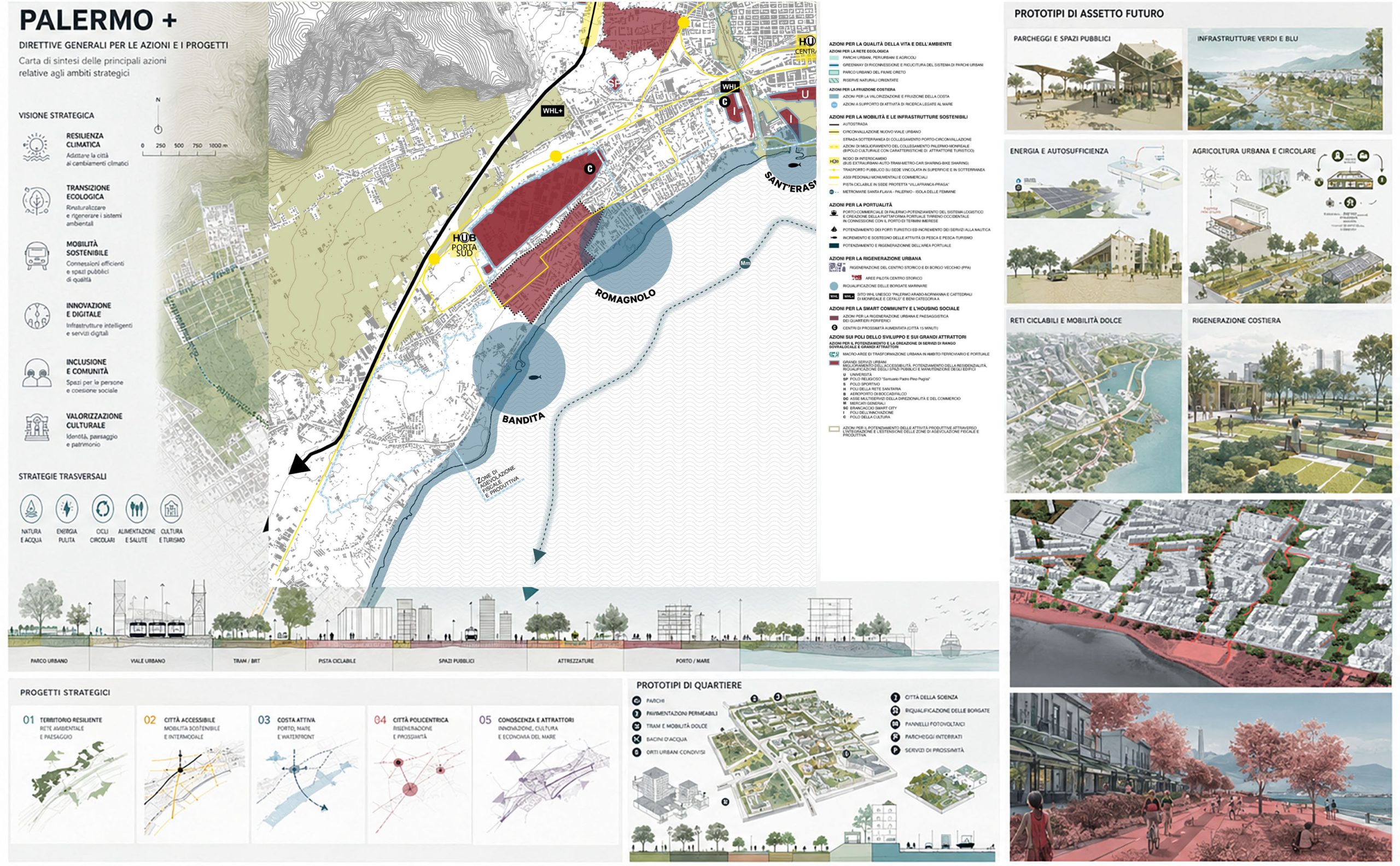
La visione strategica del Piano Urbanistico Generale per la rigenerazione della costa sud di Palermo, orientata a ricucire il rapporto tra la città e il mare all’interno di un ecosistema urbano resiliente e integrato. (© Maurizio Carta).
The strategic vision of the General Urban Plan for the regeneration of Palermo’s south coast, aimed at reconnecting the relationship between the city and the sea within a resilient and integrated urban ecosystem. (© Maurizio Carta).
Costa Sud, laboratorio del 2050
Costa Sud, Laboratory of 2050
Per evitare che questo arcipelago rimanga una costellazione di episodi sono stati messi in campo due strumenti per concretizzare la visione della città liquida e la geografia del cardo.
Il PUDM, inviato al Consiglio Comunale nel giugno 2026 per la sua adozione, costituisce il primo strumento operativo di questa visione. Esso non si limita a disciplinare l’uso del demanio marittimo, ma costruisce una nuova geografia della costa fondata sulla tutela ambientale, sull’accessibilità universale al mare e sull’equilibrio tra fruizione pubblica e attività economiche. Infrastrutture verdi, percorsi costieri, parchi, accessi al mare e una gestione condivisa del litorale trasformano la costa da semplice limite amministrativo a spazio civico, ecologico e produttivo.
Ma la città liquida non può esaurirsi nella sola pianificazione del demanio. Per questo il piano del demanio marittimo dialoga con il piano urbanistico, che estende la stessa visione all’intero territorio urbano, ricucendo waterfront, aree di trasformazione, sistemi ecologici e nuove economie dentro un’unica strategia. Perché il nuovo cardo della città liquida non è una strada, ma una geografia: ed è dentro questa geografia che Palermo può riscrivere il proprio futuro.
Il PUG, in corso di redazione, prova a consolidare la visione: non una fascia costiera da recuperare pezzo per pezzo, ma un grande progetto urbano unitario, capace di ricucire il rapporto tra la città e il suo mare. Il punto di partenza è la visione complessiva delle Direttive Generali – approvate dalla Giunta Lagalla nel 2023 – definita “Palermo +”: l’idea di una città metropolitana policentrica, produttiva, educativa, inclusiva, cosmopolita e resiliente, capace di tenere insieme tradizione e transizione nell’orizzonte operativo strategico del 2050. La Costa Sud, in questo disegno, non è un capitolo a parte: è il banco di prova dove le ambizioni del piano si misurano con un territorio fragile e insieme strategico, stretto fra mare, fiume Oreto, aree agricole e impianti produttivi.
Se la costa è il nuovo cardo della città e il porto è il cuore liquido di Palermo, la Costa Sud è il suo laboratorio radicale. Essa è una porzione di città che per decenni è stata raccontata solo per sottrazione: industria dismessa, balneabilità negata, periferie isolate dal resto della città. Invece, la Costa Sud è una fascia di vitalità e fragilità, di risorse e opportunità che da Sant’Erasmo a Romagnolo, da Brancaccio allo Sperone, da Bandita fino ad Acqua dei Corsari accompagna il lungomare sud-orientale della città.
Le direttive generali del Piano articolano la trasformazione della Costa Sud lungo quattro assi che si integrano in scenari concreti di rigenerazione.
Qualità della vita e fruizione costiera. Il completamento della bonifica – finanziata e in corso di realizzazione – del Parco Libero Grassi ad Acqua dei Corsari e dei litorali dello Sperone, della Bandita e di Romagnolo per realizzare un grande parco costiero è la premessa per restituire ai cittadini un lungo spazio pubblico vegetale e marino che accolga attività balneari, sportive, sociali ed educative. A questo si affianca il rilancio delle borgate marinare storiche, con il recupero degli edifici, la pedonalizzazione delle aree di interfaccia città-porto e la riqualificazione delle piazze davanti ai porticcioli, per restituire centralità e identità a quartieri che hanno smarrito il loro ruolo di comunità costiere autonome.
Ambiente ed eco-quartieri. Il Piano prevede l’istituzione del Parco Fluviale dell’Oreto, in un’azione che dovrà coinvolgere anche i Comuni di Monreale e Altofonte, per ricongiungere la città all’entroterra e alla costa attraverso il corso del fiume. Parallelamente, il parco agricolo di Ciaculli è candidato a diventare un distretto agricolo rururbano, mentre i grandi quartieri di edilizia residenziale pubblica sono al centro di un programma di trasformazione in eco-quartieri ad alta efficienza energetica, secondo il modello near zero energy neighbourhood.
Innovazione e produttività. L’area industriale di Brancaccio, oggi in contrazione produttiva, è pensata come una possibile Fab City: una cittadella manifatturiera che unisca tecnologie digitali, artigianato avanzato e gestione dei rifiuti elettronici. Lungo le due sponde dell’Oreto, tra l’ex Gasometro e l’ex Macello di proprietà comunale, il Piano propone la nascita di una “zona speciale dell’innovazione” capace di mettere a sistema il parco fluviale, la sua foce e il sito Unesco del Ponte dell’Ammiraglio.
Mobilità sostenibile e interconnessione. La proposta più visibile è la metromare, un collegamento marittimo rapido che dovrebbe unire Torre Ciachea a Cefalù, con approdi intermedi lungo tutta la costa palermitana, da Isola delle Femmine a Termini Imerese. A completare il disegno della mobilità, il potenziamento dei porti turistici e pescherecci e la creazione di grandi hub di interscambio – tra cui l’Hub Porta Sud – pensati per integrare logistica, trasporto pubblico e mobilità condivisa.
È un cambio di paradigma che i materiali di visione progettuale sintetizzano in una formula efficace: da periferia a quartieri delle transizioni – ecologica, sociale, energetica, culturale, economica – attraverso pannelli fotovoltaici diffusi, pavimentazioni permeabili, bacini per la gestione delle piogge, orti urbani condivisi e un lungomare scandito da lidi modulari leggeri, pontili e percorsi ciclabili continui, con un linguaggio materico – legno naturale, pietra locale, vegetazione autoctona – che dialoga con la storia di balneazione popolare di questo litorale. Ma il punto su cui insiste con più forza il documento di indirizzo è la necessità di superare la frammentazione: la Costa Sud è una dorsale che connette organi urbani – parco, fiume, area produttiva, fronte mare, borgate – e richiede perciò una pianificazione attuativa unitaria, capace di intercettare le aree di trasformazione in senso longitudinale e trasversale fino a penetrare nel tessuto consolidato, dando un quadro di coerenza che attragga i fondi extra-comunali necessari e offra agli investitori quella certezza del diritto che la frammentazione degli interventi ha finora reso più difficile.
Per la Costa Sud, il passaggio dal corposo masterplan degli interventi pubblici (più di 200 milioni di opere) al Piano Urbanistico Generale significa innanzitutto un cambio di scala: da un insieme di progetti – la bonifica del Parco Libero Grassi e del litorale, la riqualificazione delle borgate, il recupero dell’ex Gasometro, la metromare – a un disegno unico che li tiene insieme dentro una regola urbanistica condivisa. È un processo ancora in corso: le Direttive Generali sono state il primo passo di un percorso politico e tecnico che il redigendo Documento Preliminare e la successiva pianificazione attuativa dovranno tradurre in norme, perimetrazioni e strumenti operativi. Ma la direzione, per la prima volta in forma organica, è già scritta: la Costa Sud come laboratorio della Palermo del futuro.
To prevent this archipelago from remaining a constellation of episodes, two instruments have been put in place to turn the vision of the fluid city and the geography of the cardo into concrete form.
The PUDM, submitted to the City Council in June 2026 for adoption, is the first operational instrument of this vision. It does not merely regulate the use of maritime state property; it constructs a new geography of the coast based on environmental protection, universal access to the sea and a balance between public enjoyment and economic activities. Green infrastructures, coastal paths, parks, sea access points and shared management of the shoreline transform the coast from a simple administrative boundary into a civic, ecological and productive space.
Yet the fluid city cannot be exhausted by the planning of maritime state property alone. For this reason, the maritime demesne plan dialogues with the urban plan, extending the same vision to the entire urban territory and reconnecting waterfront, transformation areas, ecological systems and new economies within a single strategy. Because the new cardo of the fluid city is not a road, but a geography: and it is within this geography that Palermo can rewrite its future.
The PUG, currently being drafted, seeks to consolidate this vision: not a coastal strip to be recovered piece by piece, but a large unitary urban project capable of reconnecting the city to its sea. The starting point is the overall vision set out in the General Directives – approved by the Lagalla administration in 2023 – under the name “Palermo +”: the idea of a metropolitan city that is polycentric, productive, educational, inclusive, cosmopolitan and resilient, capable of holding together tradition and transition within the strategic operational horizon of 2050. Within this framework, the Costa Sud is not a separate chapter: it is the testing ground where the ambitions of the plan confront a fragile yet strategic territory, compressed between sea, the Oreto river, agricultural areas and productive facilities.
If the coast is the city’s new cardo and the port is the fluid heart of Palermo, the Costa Sud is its radical laboratory. It is a portion of the city that for decades has been narrated only through subtraction: disused industry, denied bathing, peripheral districts isolated from the rest of the city. Yet the Costa Sud is instead a strip of vitality and fragility, of resources and opportunities, which accompanies the south-eastern waterfront of the city from Sant’Erasmo to Romagnolo, from Brancaccio to Sperone, from Bandita to Acqua dei Corsari.
The General Directives of the Plan articulate the transformation of the Costa Sud along four axes that converge into concrete regeneration scenarios.
Quality of life and coastal enjoyment. The completion of the remediation works – funded and currently under way – for Parco Libero Grassi at Acqua dei Corsari and for the shorelines of Sperone, Bandita and Romagnolo, aimed at creating a large coastal park, is the precondition for returning to citizens a long vegetal and maritime public space capable of hosting bathing, sport, social and educational activities. This is accompanied by the revival of the historic seaside villages through building recovery, the pedestrianization of city-port interface areas and the redevelopment of the squares in front of the small harbours, in order to restore centrality and identity to neighbourhoods that have lost their role as autonomous coastal communities.
Environment and eco-districts. The Plan envisages the creation of the Oreto River Park, in an action that will also involve the municipalities of Monreale and Altofonte, reconnecting the city to the hinterland and the coast through the river course. At the same time, the agricultural park of Ciaculli is identified as a potential rural-urban agricultural district, while the large public housing neighbourhoods are at the centre of a programme aimed at transforming them into high-energy-efficiency eco-districts, according to the model of the near-zero energy neighbourhood.
Innovation and productivity. The industrial area of Brancaccio, currently experiencing productive contraction, is conceived as a possible Fab City: a manufacturing district combining digital technologies, advanced craftsmanship and the management of electronic waste. Along the two banks of the Oreto, between the former Gasometer and the former municipal slaughterhouse, the Plan proposes the creation of a “special innovation zone” capable of integrating the river park, its mouth and the UNESCO site of Ponte dell’Ammiraglio.
Sustainable mobility and interconnection. The most visible proposal is the metromare, a fast maritime connection that would link Torre Ciachea to Cefalù, with intermediate stops along the entire Palermo coastline, from Isola delle Femmine to Termini Imerese. Completing the mobility strategy are the enhancement of tourist and fishing harbours and the creation of large interchange hubs – including the Porta Sud Hub – designed to integrate logistics, public transport and shared mobility.
This represents a paradigm shift that the design vision documents summarize effectively: from periphery to districts of transition – ecological, social, energy, cultural and economic – through distributed photovoltaic panels, permeable paving, basins for rainwater management, shared urban gardens and a waterfront punctuated by lightweight modular bathing facilities, piers and continuous cycling routes, using a material language – natural wood, local stone and native vegetation – that dialogues with the history of popular seaside life along this coast. Yet the point most strongly emphasized by the strategic document is the need to overcome fragmentation: the Costa Sud is a backbone connecting urban organs – park, river, productive area, waterfront and seaside villages – and therefore requires unitary implementation planning, capable of intercepting transformation areas both longitudinally and transversally, penetrating the consolidated urban fabric and providing the coherence needed to attract extra-municipal funding and offer investors the legal certainty that fragmented interventions have so far made difficult.
For the Costa Sud, the transition from the substantial masterplan of public works – more than 200 million euros in interventions – to the General Urban Plan primarily means a change of scale: from a set of projects – the remediation of Parco Libero Grassi and the shoreline, the redevelopment of seaside villages, the recovery of the former Gasometer, the metromare – to a single design that holds them together within a shared planning rule. The process is still ongoing: the General Directives were the first step in a political and technical pathway that the forthcoming Preliminary Document and subsequent implementation planning will have to translate into regulations, perimeters and operational instruments. But the direction, for the first time in organic form, is already written: the Costa Sud as the laboratory of Palermo’s future.
Città porosa
Porous City
Come ho già detto, c’è un secondo rapporto, meno felice e più inquieto, che lega Palermo all’acqua: non quella che la lambisce, ma quella che le cade addosso. È la pioggia, un’acqua verticale, improvvisa, spesso violenta, che negli ultimi anni ha trasformato sempre più frequentemente le strade in torrenti, le piazze in bacini, i sottopassi in trappole. Se il mare è la memoria lunga della città, la pioggia è oggi il suo futuro più incerto.
Una città liquida è anche una città porosa: capace di trattenere, rallentare, infiltrare e riusare l’acqua. Come molte città d’acqua del mondo – da Rotterdam a Miami, da Boston a New Orleans – Palermo deve fare i conti con un nuovo regime climatico, fatto di precipitazioni anomale, eventi estremi e temporalità alterate che i tradizionali modelli pluviometrici non riescono più a prevedere.
Ridurre il problema a una semplice questione climatica sarebbe un errore perché il dissesto è anche urbano. È il prodotto di decenni di impermeabilizzazione progressiva del suolo, di canalizzazione rigida delle acque, di riduzione delle aree di espansione naturale dei corsi d’acqua, di frammentazione del patrimonio vegetale e di consumo sistematico delle superfici assorbenti. È il risultato di una modernizzazione che ha interpretato l’acqua come elemento da espellere rapidamente, anziché come risorsa da trattenere, governare e restituire al ciclo urbano. La Palermo contemporanea paga così il prezzo di una lunga separazione dal proprio metabolismo idrico.
Eppure, questa città, più di molte altre, possiede nella propria storia una sapienza alternativa. Palermo era la Conca d’Oro non solo per la fertilità del suo suolo, ma perché aveva costruito nei secoli una sofisticata ecologia dell’acqua: fiumi, canali, agrumeti, giardini, cisterne, sistemi irrigui, suoli permeabili. L’acqua non era nemica, ma era infrastruttura vivente.
Recuperare questa intelligenza antica significa oggi immaginare Palermo come città porosa, necessario della città liquida. Se la città liquida governa la relazione orizzontale tra terra e mare, la città porosa governa la relazione verticale tra cielo e suolo. Sono due facce della stessa ecologia urbana.
La risposta, dunque, non può essere solo idraulica. Non basta ingrandire condotte o accelerare deflussi. Serve un progetto urbano integrato, fondato sulle nature-based solutions, capace di apprendere dalle Water Squares di Rotterdam o dai sistemi “città-spugna” sperimentati in molte città, trattando l’acqua in eccesso non come nemico da respingere ma come presenza da accogliere, rallentare, assorbire e persino convertire in nuovo spazio pubblico. Una piazza che si allaga temporaneamente, un parco che trattiene acqua, un boulevard permeabile, una scuola con giardini drenanti, una rete di suoli vegetali continui: non sono semplici dispositivi tecnici, ma frammenti di una nuova urbanistica climatica.
Palermo possiede ancora, negli interstizi della città costruita, una geografia latente di questa porosità possibile: l’anello vegetale dei parchi urbani che circonda la città consolidata, il grande e maestoso Parco della Favorita e di Monte Pellegrino, poderosa riserva di biodiversità, il sistema delle ville storiche della Piana dei Colli, il mosaico agricolo di Ciaculli, le grandi aree aperte residuali, le dorsali ecologiche costiere. Un patrimonio disperso che oggi non lavora come sistema, ma che potrebbe tornare a farlo. Tra questi dispositivi, il corridoio ecologico e idraulico dell’Oreto potrebbe diventare la grande spina dorsale della Palermo porosa: un’infrastruttura climatica capace di connettere montagna, città e mare.
Riconnettere tutte le riserve di porosità idraulica significherebbe costruire una vera infrastruttura ecologica metropolitana: un organismo capace di trattenere le acque, abbassare le temperature, aumentare biodiversità, mitigare il rischio e offrire nuovi spazi di prossimità. È una forma di resilienza che non si basa sulla resistenza, ma sull’assorbimento. Non sull’opposizione, ma sulla coabitazione.
Ed è, in fondo, lo stesso principio che dovrebbe regolare anche il rapporto tra Palermo e il suo mare: non contrastare l’acqua ma governarla, non irreggimentarla ma dialogare con essa, non costruire contro i suoi movimenti ma dentro i suoi cicli. Perché una città d’acqua non può salvarsi dalla crisi climatica irrigidendosi. Può salvarsi solo tornando liquida. E, insieme, tornando porosa.
As already noted, there is a second, less harmonious and more unsettled relationship that connects Palermo to water: not the water that laps against it, but the water that falls upon it. This is rain: vertical, sudden and often violent water, which in recent years has increasingly transformed streets into torrents, squares into basins and underpasses into traps. If the sea is the city’s long memory, rain is now its most uncertain future.
A fluid city is also a porous city: capable of retaining, slowing, infiltrating and reusing water. Like many water cities around the world – from Rotterdam to Miami, from Boston to New Orleans – Palermo must confront a new climatic regime, made of anomalous rainfall, extreme events and altered temporalities that traditional rainfall models are no longer able to predict.
Reducing the problem to a purely climatic issue would be a mistake, because hydrogeological instability is also urban. It is the product of decades of progressive soil sealing, rigid canalization of watercourses, reduction of natural flood expansion areas, fragmentation of vegetated heritage and systematic consumption of absorbent surfaces. It is the result of a modernization process that interpreted water as an element to be expelled rapidly, rather than as a resource to be retained, governed and returned to the urban cycle. Contemporary Palermo is thus paying the price of a long separation from its own water metabolism.
Yet this city, more than many others, holds an alternative knowledge within its history. Palermo was the Conca d’Oro not only because of the fertility of its soil, but because over the centuries it had constructed a sophisticated ecology of water: rivers, canals, citrus groves, gardens, cisterns, irrigation systems and permeable soils. Water was not an enemy; it was a living infrastructure.
Recovering this ancient intelligence today means imagining Palermo as a porous city, the necessary counterpart of the fluid city. If the fluid city governs the horizontal relationship between land and sea, the porous city governs the vertical relationship between sky and ground. They are two faces of the same urban ecology.
The response, therefore, cannot be merely hydraulic. It is not enough to enlarge pipes or accelerate runoff. An integrated urban project is required, based on nature-based solutions and capable of learning from Rotterdam’s Water Squares or from sponge-city systems tested in many cities, treating excess water not as an enemy to be repelled but as a presence to be welcomed, slowed down, absorbed and even converted into new public space. A square that temporarily floods, a park that retains water, a permeable boulevard, a school with draining gardens, a network of continuous vegetated soils: these are not merely technical devices, but fragments of a new climate urbanism.
Palermo still possesses, within the interstices of the built city, a latent geography of possible porosity: the vegetated ring of urban parks surrounding the consolidated city, the great and majestic Parco della Favorita and Monte Pellegrino, a powerful biodiversity reserve, the system of historic villas of the Piana dei Colli, the agricultural mosaic of Ciaculli, the large residual open areas and the coastal ecological backbones. This dispersed heritage does not currently function as a system, but could once again do so. Among these devices, the ecological and hydraulic corridor of the Oreto could become the major spine of porous Palermo: a climate infrastructure capable of connecting mountain, city and sea.
Reconnecting all reserves of hydraulic porosity would mean constructing a genuine metropolitan ecological infrastructure: an organism capable of retaining water, reducing temperatures, increasing biodiversity, mitigating risk and offering new spaces of proximity. This is a form of resilience based not on resistance, but on absorption; not on opposition, but on cohabitation.
And this is, ultimately, the same principle that should also govern the relationship between Palermo and its sea: not to oppose water, but to govern it; not to regiment it, but to dialogue with it; not to build against its movements, but within its cycles. A water city cannot save itself from the climate crisis by becoming rigid. It can only do so by becoming fluid again – and, at the same time, porous.
Una città che danza anche nella tempesta
A City That Dances Even in the Storm
Il lungo, talvolta faticoso, spesso carsico processo di recupero del waterfront di Palermo non è soltanto una vicenda urbanistica o infrastrutturale. È, prima di tutto, una vicenda culturale, il racconto di una città che prova a ritrovare se stessa nel punto esatto in cui, per decenni, aveva smesso di guardarsi: il mare.
Quello che oggi emerge lungo il suo fronte d’acqua – tra nuove banchine urbane, parchi costieri, spazi pubblici riconquistati, funzioni ibride e nuove economie marittime – è una rinnovata immagine di futuro. Non un semplice paesaggio rigenerato, ma un campo di possibilità. Uno spazio reale dove coltivare il cosmopolitismo originario di Palermo, la sua vocazione mediterranea di soglia, di porto, di attraversamento.
Palermo torna così ad alimentare la propria economia del mare, ma soprattutto torna a ripensare il proprio paesaggio costiero dentro una nuova alleanza tra natura e città, tra infrastrutture e comunità, tra logistica e desiderio urbano. Una sorellanza necessaria, perché oggi nessuna città d’acqua può più pensarsi separando le proprie funzioni dalla propria ecologia.
Ed è lo stesso principio che deve valere, su scala diversa ma con uguale radicalità, per il rapporto con le acque che attraversano la città, la bagnano, talvolta la feriscono. La pioggia, i fiumi, i deflussi, le mareggiate, le alluvioni non sono eventi esterni al progetto urbano: ne sono parte costitutiva. Prevenzione, manutenzione, gestione ecologica, adattamento climatico e mitigazione devono fondersi in un unico grande progetto di città resiliente, capace non solo di difendersi dall’acqua, ma di conviverci.
Questa è forse la sfida più alta della Palermo che viene: tornare a essere città liquida non solo perché affacciata sul mare, ma perché capace di assumere la fluidità come principio di organizzazione del proprio spazio, delle proprie relazioni, delle proprie infrastrutture e persino delle proprie istituzioni.
Essere liquida significa essere permeabile senza essere fragile. Significa saper assorbire gli urti, adattarsi ai mutamenti, trasformare la crisi in apprendimento, riconoscere che il confine non è una linea di separazione, ma una zona fertile di scambio.
Per questo Palermo può oggi essere letta come un laboratorio mediterraneo del XXI secolo: una città che sperimenta, con tutte le sue contraddizioni, una nuova forma di urbanità anfibia, dove il porto non è recinto ma soglia porosa di scambio, la costa non è margine ma cardo, l’acqua non è minaccia ma materia di progetto. Palermo torna così a riconoscersi non come una città compatta, ma come un arcipelago di luoghi liquidi: differenti, interdipendenti, porosi, capaci di trasformarsi senza perdere memoria.
L’arcipelago dei luoghi non si limita a essere una possibile interpretazione di Palermo, ma si propone come una chiave attraverso cui molte città portuali mediterranee possono immaginare una nuova alleanza tra porto, costa, cultura, ecologia e comunità.
Gli articoli che seguono raccontano, da prospettive diverse e con una sinfonia di approcci e linguaggi, questo doppio rinascere dall’acqua di Palermo: il mare che va riconquistato e l’acqua che va accolta, la costa che torna spazio civico e l’ecologia che torna infrastruttura urbana, il porto che si apre alla città e la città che si lascia nuovamente attraversare dal suo destino marittimo.
Ma, in fondo, è un’unica storia. La storia di una città che torna a riconoscersi nella propria natura d’acqua. Una città che comprende che la resilienza non consiste nel resistere rigidamente alla tempesta, ma nel saperla abitare. Come fanno i corpi sapienti, come fanno i porti antichi, come fanno le città liquide.
Come Palermo, quando smette di allontanarsi o difendersi dall’acqua e torna, finalmente, a danzare nel suo naturale palcoscenico liquido, persino dentro la tempesta.
The long, at times difficult and often subterranean process of recovering Palermo’s waterfront is not only an urban planning or infrastructural story. It is, first of all, a cultural one: the story of a city attempting to rediscover itself precisely in the place where, for decades, it had stopped looking at itself – the sea.
What is now emerging along its waterfront – through new urban quays, coastal parks, reclaimed public spaces, hybrid functions and new maritime economies – is a renewed image of the future. Not merely a regenerated landscape, but a field of possibility. A real space in which to cultivate Palermo’s original cosmopolitanism, its Mediterranean vocation as threshold, port and crossing.
Palermo is thus returning to nourish its economy of the sea, but above all it is rethinking its coastal landscape within a new alliance between nature and city, infrastructures and communities, logistics and urban desire. This is a necessary sisterhood, because today no water city can any longer imagine itself by separating its functions from its ecology.
The same principle must apply, on a different scale but with equal radicality, to the waters that cross the city, bathe it and sometimes wound it. Rain, rivers, runoff, storm surges and floods are not external events in relation to the urban project: they are constitutive parts of it. Prevention, maintenance, ecological management, climate adaptation and mitigation must merge into one great project for a resilient city, capable not only of defending itself from water, but of living with it.
This is perhaps the highest challenge for the Palermo to come: to return to being a fluid city not only because it faces the sea, but because it is capable of assuming fluidity as an organizing principle of its spaces, relations, infrastructures and even institutions.
To be fluid means to be permeable without being fragile. It means being able to absorb shocks, adapt to change, transform crisis into learning, and recognize that the boundary is not a line of separation, but a fertile zone of exchange.
For this reason, Palermo can today be read as a Mediterranean laboratory of the twenty-first century: a city that experiments, with all its contradictions, with a new form of amphibious urbanity, where the port is not an enclosure but a porous threshold of exchange, the coast is not a margin but a cardo, and water is not a threat but a matter of design. Palermo thus returns to recognizing itself not as a compact city, but as an archipelago of fluid places: different, interdependent, porous, capable of transforming without losing memory.
The archipelago of places is not merely a possible interpretation of Palermo; it is proposed as a lens through which many Mediterranean port cities may imagine a new alliance between port, coast, culture, ecology and community.
The articles that follow recount, from different perspectives and through a symphony of approaches and languages, this double rebirth from water in Palermo: the sea to be reclaimed and water to be welcomed; the coast returning as civic space and ecology returning as urban infrastructure; the port opening itself to the city and the city allowing itself once again to be crossed by its maritime destiny.
In the end, however, it is a single story. The story of a city that returns to recognizing itself in its watery nature. A city that understands that resilience does not consist in rigidly resisting the storm, but in learning to inhabit it. As wise bodies do, as ancient ports do, as fluid cities do.
Like Palermo, when it stops distancing itself from or defending itself against water and finally returns to dancing on its natural fluid stage, even within the storm.
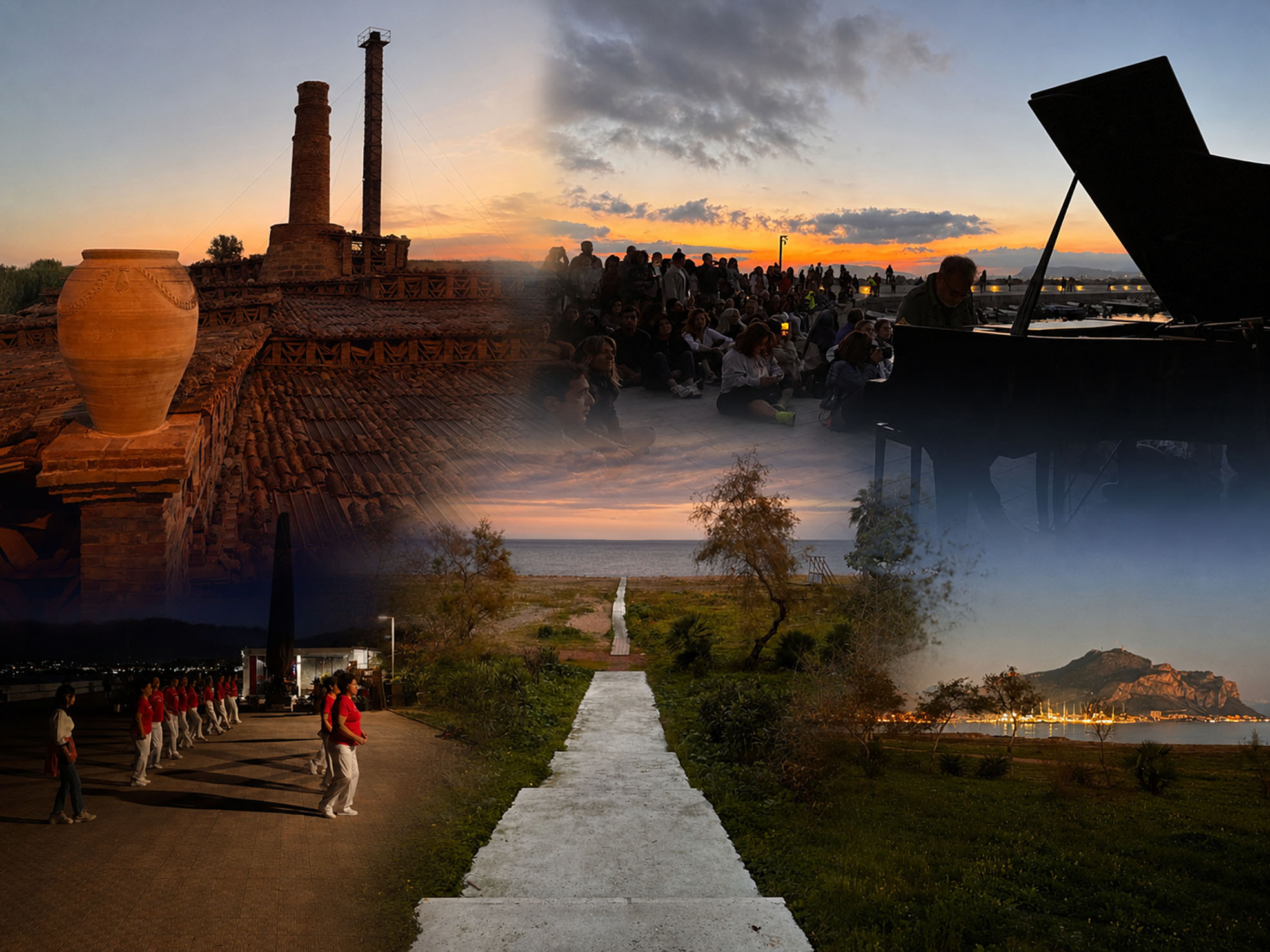
Un ritratto della Costa Sud di Palermo che unisce memoria storica, eventi culturali e riscoperta collettiva del paesaggio litoraneo urbano. (© Maurizio Carta).
A portrait of Palermo’s South Coast that combines historical memory, cultural events, and the collective rediscovery of the urban coastal landscape. (© Maurizio Carta).
IMMAGINE INIZIALE | Un collage fotografico che unisce scorci urbani e paesaggi costieri, architettura storica e dettagli naturalistici per catturare l’essenza di Palermo. (© Maurizio Carta).
HEAD IMAGE | A photographic collage that combines urban views and coastal landscapes, historic architecture, and naturalistic details to capture the essence of Palermo. (© Maurizio Carta).
╝
NOTE
NOTES
[1] Questo contributo nasce dall’intreccio tra attività di ricerca, progettazione e amministrazione pubblica svolte dall’autore negli ultimi vent’anni. Tale posizione privilegiata consente una conoscenza diretta dei processi descritti, pur richiedendo al lettore una valutazione critica che il presente numero monografico, attraverso la pluralità dei contributi raccolti, intende favorire. Per un approfondimento delle questioni descritte si rimanda a tre libri: M. Carta, D. Ronsivalle, The Fluid City Paradigm. Waterfront Regeneration as an Urban Renewal Strategy, Zurich, Springer, 2016; M. Carta, Palermo, un’idea di cui è giunto il tempo, Venezia, Marsilio, 2023; M. Carta, P. La Greca, D. Ronsivalle, B. Lino, Planning Complex Waterfront Interfaces. Reshaping Port City Regeneration for Sustainable Urban Futures, Cham, Springer, 2025.
[2] Il concetto di quarto spazio è stato recentemente elaborato da chi scrive come risposta innovativa al superamento della rigida separazione della città moderna in spazi separati per abitare, lavorare e socializzare. Oggi, le nuove e plurali domande di un abitare urbano più complesso e integrato richiedono un progetto consapevole di luoghi che siano la miscelazione, con diverse dosi e modalità, di tutti e tre gli spazi in modo che possano essere adattati alle diverse domande di vita, invece che costringere i corpi ad adattarsi a un abitare predefinito e preconfezionato. Cfr. M. Carta, La città del quarto spazio, Milano, Mimesis, 2026.
[3] Contro le pratiche di rigenerazione urbana a base immobiliare, tendenzialmente orientata all’incremento della rendita del promotore e dell’investitore, ho proposto una modalità di intervento in grado di garantire maggiore giustizia spaziale che ho definito urbanogenesi incrementale e adattiva per sottolineare innanzitutto la capacità di produrre urbanità prima che valorizzazione urbana e poi la necessità di un processo incrementale e adattivo che interagisca più efficacemente con i territori e le comunità reali, accompagnandone la transizione invece che sedurle con le retoriche immobiliari. Cfr. M. Carta, Sette lezioni di rigenerazione urbana, Siracusa, LetteraVentidue, 2025.
[1] This contribution emerges from the intertwining of research, design and public administration activities carried out by the author over the last twenty years. This privileged position allows for direct knowledge of the processes described, while requiring critical assessment by the reader, which this monographic issue, through the plurality of its contributions, aims to foster. For further discussion of the issues addressed, see: M. Carta and D. Ronsivalle, The Fluid City Paradigm. Waterfront Regeneration as an Urban Renewal Strategy, Zurich, Springer, 2016; M. Carta, Palermo, un’idea di cui è giunto il tempo, Venice, Marsilio, 2023; M. Carta, P. La Greca, D. Ronsivalle and B. Lino, Planning Complex Waterfront Interfaces. Reshaping Port City Regeneration for Sustainable Urban Futures, Cham, Springer, 2025.
[2] The concept of fourth space has recently been developed by the author as an innovative response to the overcoming of the rigid separation of the modern city into distinct spaces for dwelling, working and socializing. Today, the new and plural demands of a more complex and integrated urban dwelling require the conscious design of places that combine, in different degrees and modalities, all three spaces, so that they may adapt to diverse forms of life rather than forcing bodies to adapt to predefined and prepackaged modes of dwelling. See M. Carta, La città del quarto spazio, Milano, Mimesis, 2026.
[3] Against real-estate-driven practices of urban regeneration, generally oriented towards increasing the rent of developers and investors, I have proposed an intervention approach capable of ensuring greater spatial justice, which I have defined as incremental and adaptive urbanogenesis. This notion emphasizes, first, the capacity to produce urbanity before urban valorization and, second, the need for an incremental and adaptive process that interacts more effectively with real territories and communities, accompanying their transition rather than seducing them with real-estate rhetoric. See M. Carta, Sette lezioni di rigenerazione urbana, Siracusa, LetteraVentidue, 2025.
CARTA, Maurizio. “Palermo Fluid City. The Archipelago of Places of the New Waterfront”. PORTUS | Port-City Relationship and Urban Waterfront Redevelopment, 51 (August 2026). RETE Publisher, Venice. ISSN 2282-5789. URL: https://portusonline.org/palermo-fluid-city-the-archipelago-of-places-of-the-new-waterfront/