╔
Negotiating the Waterfront: integrazione porto-città e rigenerazione urbana a Napoli
Introduction
Introduzione
Nel 2025 la città di Napoli celebra i suoi primi 2.500 anni di storia: oltre due millenni di evoluzioni e profonde trasformazioni che dall’antica Neapolis fino all’età contemporanea hanno visto il fronte mare – e in particolare il porto – ricoprire un ruolo da protagonista.
La stratificazione storica dei diversi stadi evolutivi della città testimonia come l’attività portuale sia sempre stata centrale nella vita urbana. Questa centralità è evidente anche dal punto di vista urbanistico, soprattutto alla luce delle recenti scoperte del porto di età romana e delle sue imbarcazioni, emerse durante gli scavi per la metropolitana di Piazza Municipio [1].
Nella sua configurazione attuale il porto di Napoli si presenta come un’infrastruttura relativamente recente, ma la sua storia è segnata da una serie complessa di eventi e trasformazioni che lo hanno reso simbolo di ogni fase critica o rigenerativa della città: “elemento cardine del programma di industrializzazione della città e del territorio nel primo ventennio del Novecento; luogo simbolo dell’emigrazione dal Mezzogiorno; porto dell’Impero; immagine della devastazione bellica; bandiera della possibile ripresa economica e del rilancio cittadino; simbolo delle difficoltà dell’economia locale nel misurarsi con una dimensione competitiva globale” [2].
Il porto conserva molte delle sue strutture storiche, come l’edificio dell’Immacolatella, la darsena militare, il bacino di carenaggio borbonico al Molo San Vincenzo e il Molo stesso, sebbene molte di queste siano inutilizzate e in stato di abbandono [3]. Tra città e porto, gli edifici e gli spazi di interazione hanno una significativa valenza storica, urbanistica ed economica. Se da un lato tale rilevanza rende complesso il loro recupero [4][5], dall’altro rappresenta un potenziale enorme per il rilancio dell’intera città.
A livello funzionale il Porto di Napoli si articola in tre grandi macroaree: quella del Porto storico che si estende dal Molo San Vincenzo fino alla Calata Granili, l’area cantieristica, estesa dal Molo Carmine fino alla Calata Marinella e il Porto commerciale, che si estende dal Pontile Vittorio Emanuele a ovest fino al Molo di Levante a est.
Nonostante questa articolazione funzionale ben definita, la distribuzione degli spazi non risulta altrettanto armoniosa e la mancanza di un progetto organico ha contribuito negli anni a generare un quadro caotico [6][7] che, solo negli ultimi tempi e non senza fatica, si sta lentamente avviando ad una risoluzione concreta.
Partendo da est, la stretta fascia costiera che confina con il Museo di Pietrarsa risulta separata dal tessuto urbano dalla linea ferroviaria Napoli-Salerno. I principali edifici industriali del quartiere, come l’ex Stabilimento Corradini, l’ex Cirio, i Granili e la Società Meridionale di Elettricità, versano in stato di abbandono.
In 2025, the city of Naples celebrates 2,500 years of history: more than two millennia of evolution and profound transformations which, from ancient Neapolis to the contemporary era, have seen the waterfront -and the port in particular- play a pivotal role.
The historical stratification of the city’s various stages of development testifies to the centrality of port activity in urban life. This centrality is also evident from an urban planning perspective, especially considering the recent discoveries of the Roman-era port and its vessels, unearthed during the excavations for the Piazza Municipio metro station [1].
In its current configuration, the Port of Naples appears as a relatively recent infrastructure; however, its history is marked by a complex series of events and transformations that have established it as a symbol of every critical or regenerative phase of the city: “a cornerstone of the program for the industrialization of the city and its territory in the first two decades of the twentieth century; a symbolic place of emigration from Southern Italy; a port of the Empire; an image of wartime devastation; a banner of possible economic recovery and urban revitalization; a symbol of the difficulties faced by the local economy in confronting a globally competitive dimension” [2].
The port still preserves many of its historical structures, such as the Immacolatella building, the military dock, the Bourbon dry dock at Molo San Vincenzo, and the pier itself, although many of these remain unused and in a state of abandonment [3]. Between the city and the port, buildings and spaces of interaction hold significant historical, urban, and economic value. While this importance makes their rehabilitation complex [4][5], it also represents an enormous potential for the revitalization of the entire city.
From a functional standpoint, the Port of Naples is divided into three main macro-areas: the historic port, extending from Molo San Vincenzo to Calata Granili; the shipbuilding area, stretching from Molo Carmine to Calata Marinella; and the commercial port, which extends from Pontile Vittorio Emanuele in the west to Molo di Levante in the east.
Despite this clearly defined functional structure, the spatial distribution is far from harmonious, and the lack of an integrated planning strategy has, over the years, contributed to a state of disorder [6][7] that only recently —and not without difficulty— has begun to move slowly toward a concrete resolution.
Starting from the east, the narrow coastal strip bordering the Pietrarsa Museum is separated from the urban fabric by the Naples–Salerno railway line. The area’s main industrial buildings, such as the former Corradini plant, the former Cirio factory, the Granili complex, and the Società Meridionale di Elettricità, are currently abandoned.
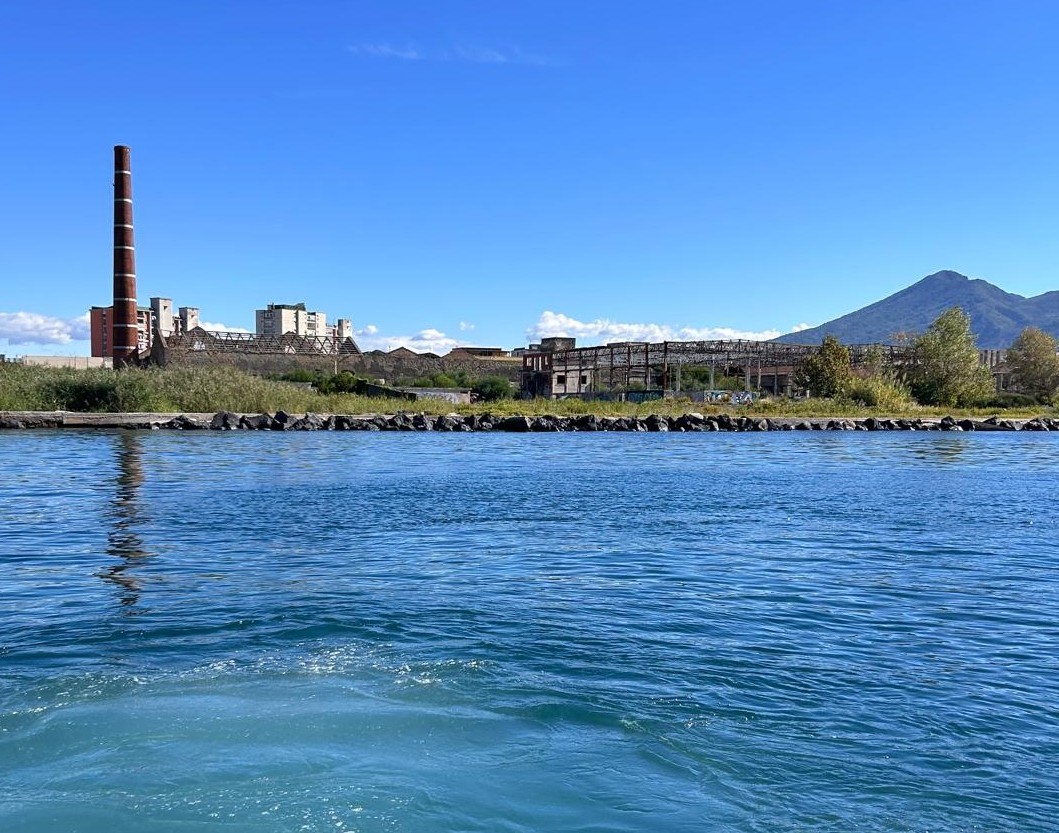
La Costa Est vista dal mare: tra archeologie industriali e abbandono. (© Benedetta Ettorre, 2025).
The East Coast seen from the sea: between industrial archaeology and abandonment. (© Benedetta Ettorre, 2025).
La ferrovia ha contribuito ad isolare queste aree, contribuendo alla formazione di un paesaggio costiero trascurato e accessibile solo in pochi punti. Un esempio è dato dalla strada pedonale ribattezzata come Lungomare di San Giovanni a Teduccio che, assieme alle piccole spiagge urbane adiacenti al vecchio depuratore e alla Corradini, rappresenta uno dei pochi accessi al mare per i cittadini del quartiere.
Nel Porto storico edifici monumentali e strutture logistiche convivono senza un adeguato assetto infrastrutturale. L’assenza di una rete viaria portuale dedicata comporta la compresenza di traffico merci, veicoli privati e flussi pedonali sulle medesime sezioni stradali, aggravando rischi e congestione.
Tuttavia, sebbene gli elementi appena esposti possano far pensare a una situazione complessa e difficile da risolvere, negli ultimi anni sono stati rielaborati e ricollocati numerosi tasselli fondamentali. Vale quindi la pena chiedersi: cosa è cambiato dal 2018, quando nell’articolo “L’interazione porto città a Napoli dal mare alla regione” pubblicato sul vol. 35 di PORTUS da Clemente [8] si leggeva che:
“(…) le criticità della realtà napoletana hanno impedito al porto di crescere e di collegarsi alla città: debolezza politica sia della vecchia Autorità Portuale sia del Comune di Napoli, individualismo diffuso nella società napoletana, frammentazione del sistema economico produttivo, debolezza dell’associazionismo di scopo (…)”?
Oggi alcuni di quei limiti appaiono superati o almeno significativamente ridimensionati, aprendo scenari evolutivi inediti nel rapporto tra porto e città. Alla base di questo cambio di direzione vi è un fattore chiave: l’esplosione di Napoli come meta turistica internazionale che ha reso il porto cittadino il secondo del Paese per traffico passeggeri con numeri che nel 2024 hanno toccato numeri record. Tale dinamica ha imposto un’accelerazione su nodi storicamente rimasti aperti, primo fra tutti la revisione del Piano Regolatore Portuale (PRP), la cui proposta del 2013 era stata respinta dal Consiglio Superiore dei Lavori Pubblici per carenze procedurali e pianificatorie. Nel frattempo, il Documento di Pianificazione Strategica di Sistema (DPSS), strumento fondamentale per la definizione e l’indirizzo delle strategie gestionali dei porti che ricadono nell’ambito di competenza di una Autorità di Sistema Portuale, è stato aggiornato nel 2021, delineando nuove strategie per migliorare l’integrazione tra porto e città. Come previsto dalla L.84/94, all’interno del documento vengono individuate e delimitate le aree portuali e le aree di interazione porto-città che comprendono “gli innesti e gli affacci urbani tra il porto e la città, con un ruolo di rilievo riservato alla riqualificazione di aree di waterfront, di edifici portuali dimessi, agli innesti urbani e alle direttrici di percorso che garantiscono il legame fisico e sociale fra la città e porto”.
Dei numerosi progetti di riqualificazione contenuti nel DPSS e nel POT (Piano Operativo Triennale) alcuni stanno lentamente prendendo forma mentre altri risultano già pienamente funzionanti. Tra questi il collegamento tra il Piazzale della Stazione Marittima e Piazza Municipio, parte del più ampio progetto del Piazzale Angioino, che secondo la classificazione offerta dall’AdSP ricade tra gli ambiti di “penetrazione urbana”. All’interno dell’ambito il collegamento tra città e porto è garantito dal sottopassaggio pedonale tra le due piazze, progettato dagli architetti Alvaro Siza e Eduardo Souto de Moura come parte del progetto della stazione della Metropolitana L1 di Piazza Municipio.
La struttura consente ai viaggiatori e ai crocieristi di spostarsi rapidamente dalla stazione marittima alla città evitando l’attraversamento stradale. Lo snodo di piazza Municipio, così strutturato, completa un sistema integrato di trasporto che collega lo scalo marittimo a tutte le zone della città e a tutti gli hub di trasporto principali, tra cui la stazione ferroviaria di Piazza Garibaldi e nel futuro prossimo l’Aeroporto di Capodichino.
The railway has further isolated these areas, contributing to the formation of a neglected coastal landscape accessible only at a few points. One example is the pedestrian route renamed Lungomare di San Giovanni a Teduccio which, together with the small urban beaches adjacent to the former wastewater treatment plant and the Corradini site, represents one of the few access points to the sea for residents of the district.
In the historic port, monumental buildings and logistical infrastructures coexist without an adequate infrastructural framework. The absence of a dedicated port road network results in the overlap of freight traffic, private vehicles, and pedestrian flows along the same road sections, exacerbating risks and congestion.
Although the elements outlined above might suggest a complex and difficult-to-resolve situation, in recent years many fundamental pieces have been reworked and repositioned. It is therefore pertinent to ask: what has changed since 2018, when in the article “L’interazione porto città a Napoli dal mare alla regione”, published in volume 35 of Portus by Clemente [8], it was stated that:
“(…) the critical issues of the Neapolitan context have prevented the port from growing and from connecting with the city: political weakness of both the former Port Authority and the Municipality of Naples, widespread individualism in Neapolitan society, fragmentation of the productive economic system, and the weakness of purpose-driven associations (…)”?
Today, some of these limitations appear to have been overcome or at least significantly reduced, opening up unprecedented scenarios in the relationship between port and city. At the root of this change lies a key factor: the surge of Naples as an international tourist destination, which has made the city’s port the second in the country for passenger traffic, with figures reaching record highs in 2024. This dynamic has accelerated the resolution of issues that had historically remained unresolved, foremost among them the revision of the Port Master Plan (Piano Regolatore Portuale, PRP), whose 2013 proposal had been rejected by the Superior Council of Public Works due to procedural and planning shortcomings.
Meanwhile, the Strategic System Planning Document (Documento di Pianificazione Strategica di Sistema, DPSS)—a fundamental tool for defining and guiding the management strategies of ports under the jurisdiction of a Port System Authority—was updated in 2021, outlining new strategies to improve integration between the port and the city. As provided for by Law 84/94, the document identifies and delineates port areas and port-city interaction areas, which include “urban connections and interfaces between the port and the city, with a prominent role assigned to the redevelopment of waterfront areas, disused port buildings, urban connections, and route corridors that ensure the physical and social link between the city and the port.”
Among the numerous redevelopment projects included in the DPSS and in the POT (Piano Operativo Triennale), some are slowly taking shape, while others are already fully operational. Notable among these is the connection between the forecourt of the Maritime Station and Piazza Municipio, part of the broader Piazzale Angioino project, which—according to the classification provided by the Port System Authority—falls within the areas of “urban penetration.” Within this context, the link between the city and the port is ensured by the pedestrian underpass connecting the two squares, designed by architects Álvaro Siza and Eduardo Souto de Moura as part of the Line 1 metro station project at Piazza Municipio. This structure allows travelers and cruise passengers to move quickly from the maritime station into the city, avoiding road crossings. The Piazza Municipio hub, as configured, completes an integrated transport system that connects the port terminal to all areas of the city and to all major transport hubs, including the Piazza Garibaldi railway station and, in the near future, Capodichino Airport.
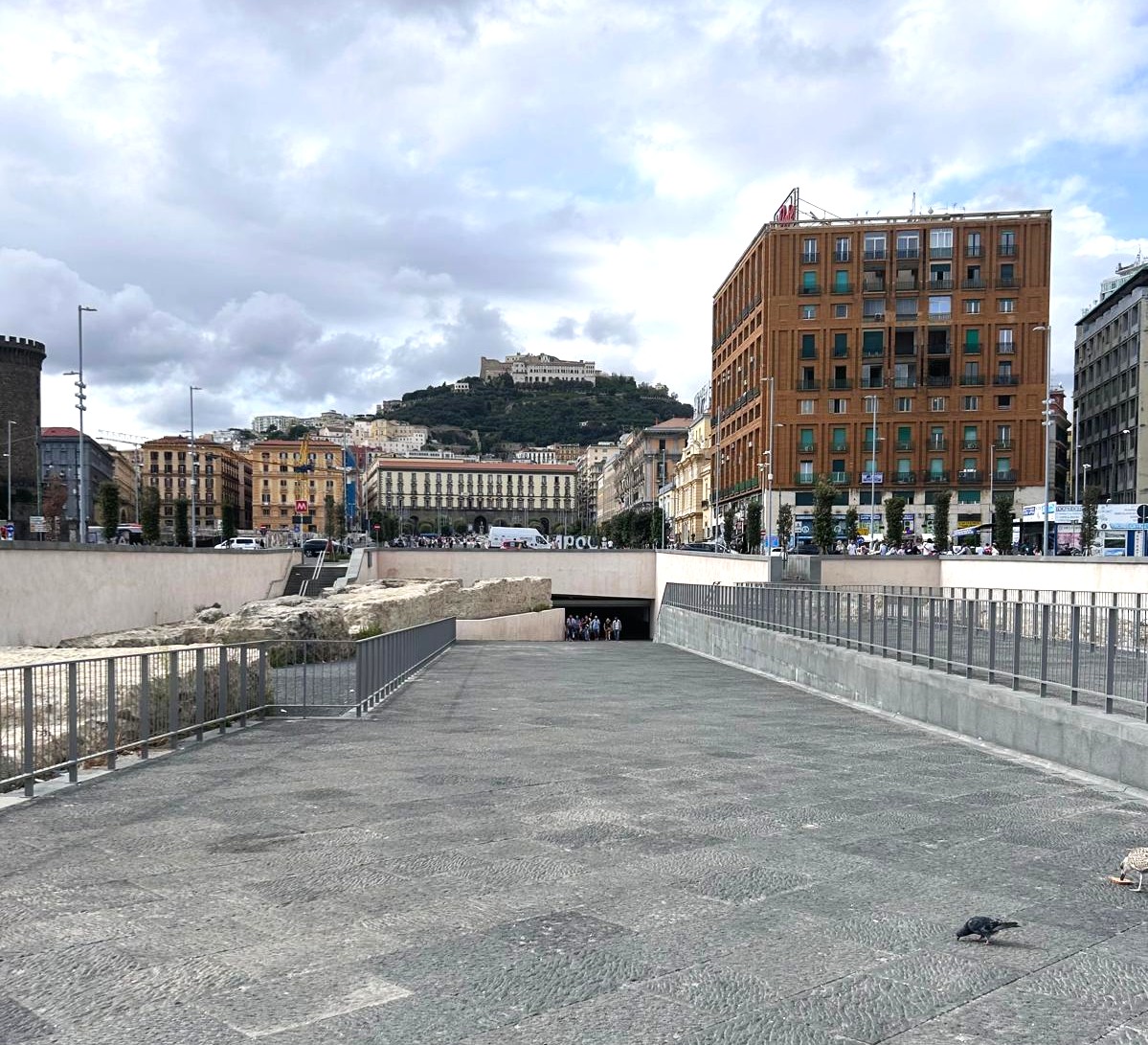
L’attraversamento pedonale Porto-Piazza Municipio. (© Benedetta Ettorre, 2025).
The pedestrian crossing between Porto and Piazza Municipio. (© Benedetta Ettorre, 2025).
Un’altra importante cerniera di connessione tra città e mare è la nuova stazione del Beverello inaugurata a luglio 2024 dopo quasi cinque anni di lavori interrotti più volte per la pandemia di Covid-19. L’opera, che fronteggia la zona monumentale della città di Napoli, fa da perno tra il lungomare occidentale della città, a carattere prettamente paesaggistico, e un waterfront che procedendo da Ovest a Est si fa progressivamente più infrastrutturato.
L’intervento del Molo Beverello, frutto di un concorso internazionale bandito circa vent’anni fa, costituisce una parte significativa del più ampio progetto di “Riqualificazione dell’Area Monumentale del Porto di Napoli” che sviluppa la nozione di filtering line ideata dall’Architetto francese Michel Euvé. La “linea di confine” si poneva come obiettivo quello di restituire alla città di Napoli un waterfront permeabile e funzionale, capace di fare da collante tra le infrastrutture e le architetture portuali da un lato e il denso tessuto urbano dall’altro. Lo scopo primario del progetto è sicuramente quello di migliorare i flussi di traffico e i servizi a terra per i passeggeri ma allo stesso tempo, la realizzazione della copertura come percorso sopraelevato calpestabile contribuisce a rendere l’area pienamente fruibile per i cittadini, garantendo al contempo il pieno utilizzo delle strutture di progetto e delle banchine per le attività portuali. Nonostante ciò, guardando al vecchio progetto della filtering line ci si rende conto che il terminal passeggeri, unico superstite del progetto stesso, risulta avulso dall’auspicata logica di cucitura urbana, rischiando di costituire un diaframma opaco tra città e mare [9].
Another important hinge connecting the city and the sea is the new Beverello terminal, inaugurated in July 2024 after almost five years of works repeatedly interrupted by the Covid-19 pandemic. Facing Naples’ monumental area, the facility acts as a pivot between the western seafront —primarily characterized by its landscape value— and a waterfront that, moving eastward, becomes progressively more infrastructural.
The intervention at Molo Beverello, the outcome of an international design competition launched about twenty years ago, represents a significant component of the broader project entitled “Redevelopment of the Monumental Area of the Port of Naples”, which develops the notion of the filtering line conceived by French architect Michel Euvé. This “boundary line” aimed to return to Naples a permeable and functional waterfront, capable of acting as a connective element between port infrastructures and architecture on one side and the dense urban fabric on the other. The primary objective of the project was the improvement of traffic flows and landside services for passengers; at the same time, however, the construction of the roof as a walkable elevated path contributed to making the area fully accessible to citizens, while ensuring the full operational use of the project’s facilities and quays for port activities. Nevertheless, compared with the original filtering line project, the passenger terminal —now the sole surviving element of that vision— appears detached from the intended logic of urban stitching, risking the creation of an opaque barrier between city and sea [9].
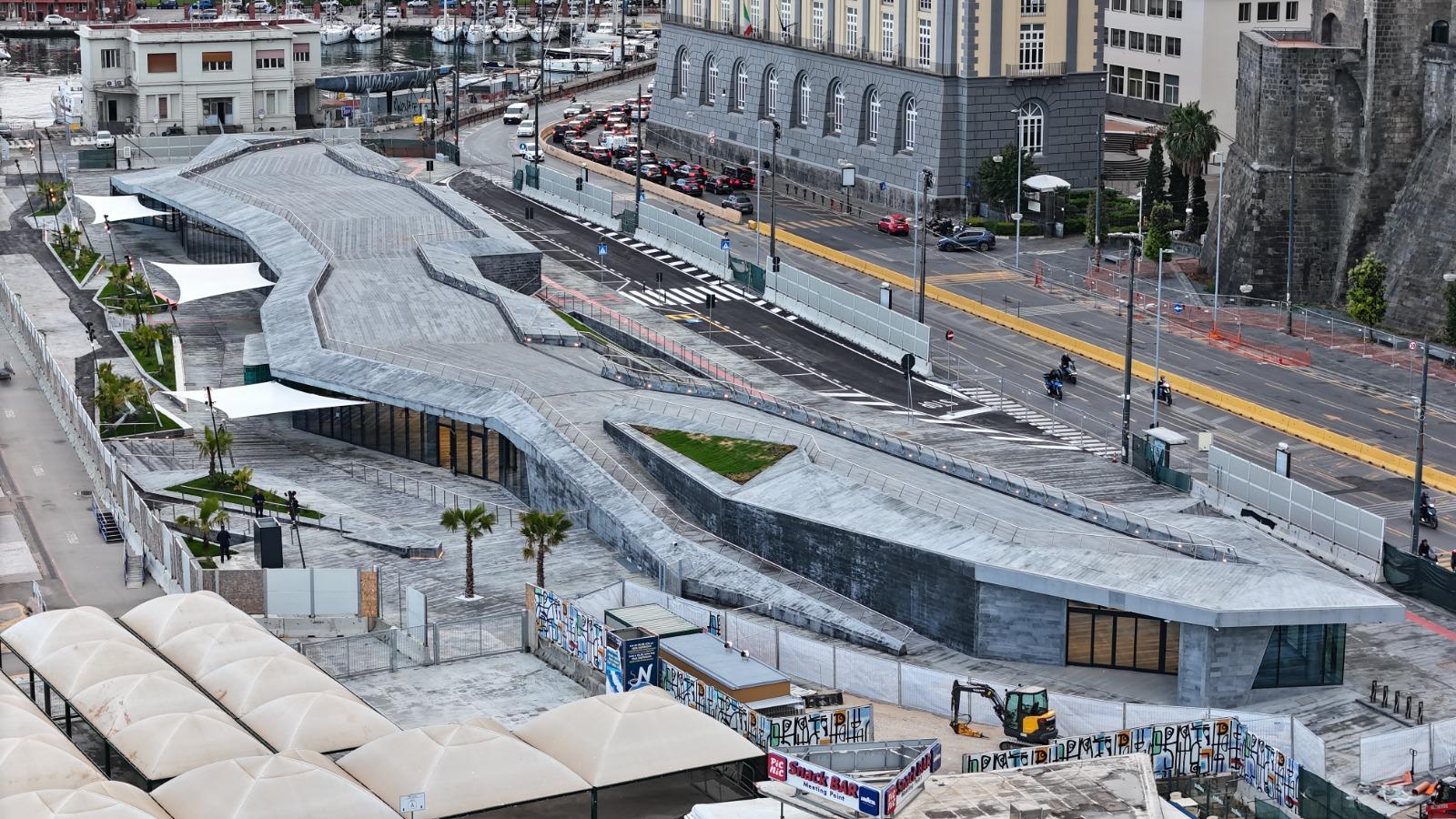
Riqualificazione del Molo Beverello all’interno del Porto Monumentale di Napoli. (Fonte: Tstudio, 2024).
Redevelopment of Molo Beverello within the Monumental Port of Naples. (Source: Tstudio, 2024).
Dal punto di vista amministrativo, invece, nei 20 anni intercorsi tra il concorso e l’effettiva realizzazione del terminal, si sono susseguite diverse vicende che vanno necessariamente menzionate. La progettazione definitiva del waterfront inizia nel 2007 ma l’iter progettuale viene presto sospeso a causa delle divergenze intercorse tra AdSP e Soprintendenza, che in quel periodo aveva apposto un vincolo all’edificio ex Magazzini Generali. Dopo circa due anni di stasi, nel 2010 fu siglato un protocollo e istituito un tavolo di lavoro tecnico a tre, formato da Autorità Portuale, Soprintendenza e Comune di Napoli che in poco tempo riuscì ad approvare un nuovo progetto preliminare, proponendo una soluzione di recupero dell’edificio ex Magazzini Generali. I lavori si fermano di nuovo e solo nel 2013 il progetto del Beverello viene reso autonomo rispetto all’intero progetto del fronte mare, al fine di accelerare i tempi per la costruzione di un servizio ritenuto essenziale per una città in continua crescita turistica. Il processo si blocca nuovamente fino al 2017 e poi ancora fino al 2019, anno in cui finalmente hanno inizio i lavori.
Tra i recenti progetti di riqualificazione degli immobili del Porto storico va inoltre annoverato quello dell’edificio dell’Immacolatella, tra Calata Porta di Massa e gli ex Magazzini Generali di Calata Piliero. Il restauro ha permesso di consolidare le murature settecentesche e di rimuovere gli avancorpi del ‘900, riportando alla luce la configurazione architettonica, i colori e i materiali. Secondo quanto si legge all’interno del DPSS, nell’edificio potranno essere previste, oltre alle destinazioni d’uso legate alle funzioni assegnate al porto storico, anche quelle museali, quali ad esempio il museo dell’emigrazione o della canzone napoletana, così come la possibilità di ospitare la didattica universitaria o il Port center. Dopo quattro anni dalla consegna dei lavori, però, l’edificio è ancora privo di una funzione.
Oltre ai progetti già descritti, un fattore esterno di forte stimolo per l’accelerazione di interventi strategici sul waterfront è rappresentato dall’America’s Cup, evento sportivo di portata internazionale previsto a Napoli per il 2027. La prospettiva di ospitare la competizione ha spinto l’amministrazione comunale, di concerto con l’AdSP, a dare impulso a opere infrastrutturali e di riqualificazione urbana, consolidando il legame tra città e porto e anticipando il completamento di interventi strategici per il waterfront. Se sulla costa di Bagnoli gli interventi previsti sono tesi ad accelerare le operazioni di bonifica ambientale e la rigenerazione urbana del SIN Bagnoli-Coroglio, sul lungomare cittadino si sta procedendo a grandi passi verso la messa a terra di un’altra importante opera di raccordo tra porto e città: la Porta Marittima.
Il progetto, parte del Contratto di Sviluppo Centro Storico, mira a valorizzare l’area che collega Piazza Municipio alla passeggiata pubblica che conduce al Molo San Vincenzo, passando per la Stazione Marittima del Beverello. L’opera, progettata dall’architetto Alvaro Siza, enfatizza la volontà di riunire città e porto creando una relazione tra i due ambiti urbani e un nuovo ordine spaziale della piazza antistante. La Porta, così concepita, punta a diventare un nuovo landmark all’interno del waterfront napoletano, punto di partenza per una passeggiata a mare che dal cuore della città condurrà residenti e turisti verso un altro grande protagonista dell’area: il Molo San Vincenzo, principale diga foranea del porto di Napoli situata alla destra della Stazione Marittima e da anni inaccessibile.
From an administrative perspective, the twenty years that elapsed between the competition and the actual construction of the terminal were marked by a series of events worth mentioning. Detailed design of the waterfront began in 2007, but the process was soon suspended due to disagreements between the Port System Authority (AdSP) and the Superintendency, which at the time had imposed a heritage restriction on the former Magazzini Generali building. After approximately two years of stagnation, in 2010 a protocol was signed and a tripartite technical working group was established, involving the Port Authority, the Superintendency, and the Municipality of Naples. This group rapidly approved a new preliminary project, proposing a recovery solution for the former Magazzini Generali building. Works were halted once again, and only in 2013 was the Beverello project separated from the broader waterfront redevelopment scheme to accelerate the construction of a service considered essential for a city experiencing continuous tourism growth. The process stalled again until 2017, and then once more until 2019, when construction finally began.
Among the recent redevelopment projects in the historic port area is also that of the Immacolatella building, located between Calata Porta di Massa and the former Magazzini Generali of Calata Piliero. The restoration consolidated the eighteenth-century masonry and removed twentieth-century additions, bringing to light the original architectural configuration, colors, and materials. According to the DPSS, in addition to uses related to the functions assigned to the historic port, the building may also accommodate museum functions—such as a museum of emigration or of Neapolitan song—as well as university teaching spaces or a Port Center. However, four years after the completion of the works, the building still lacks an assigned function.
In addition to the projects already described, a powerful external driver accelerating strategic interventions along the waterfront is the America’s Cup, an international sporting event scheduled to take place in Naples in 2027. The prospect of hosting the competition has prompted the municipal administration, in coordination with the Port System Authority, to boost infrastructural works and urban regeneration projects, strengthening the bond between city and port and anticipating the completion of strategic waterfront interventions. While on the Bagnoli coastline the planned works aim to accelerate environmental remediation and the urban regeneration of the Bagnoli-Coroglio Site of National Interest (SIN), along the city waterfront significant progress is being made toward the implementation of another major project linking port and city: the Porta Marittima.
Part of the Centro Storico Development Agreement, the project seeks to enhance the area connecting Piazza Municipio to the public promenade leading to Molo San Vincenzo, passing through the Beverello Maritime Station. Designed by architect Álvaro Siza, the project emphasizes the intention to reunite city and port by establishing a relationship between the two urban realms and creating a new spatial order for the square in front of the station. Conceived in this way, the Porta aims to become a new landmark along the Neapolitan waterfront, serving as the starting point for a seaside promenade that will lead residents and tourists from the heart of the city toward another major protagonist of the area: Molo San Vincenzo, the main breakwater of the Port of Naples, inaccessible for many years.
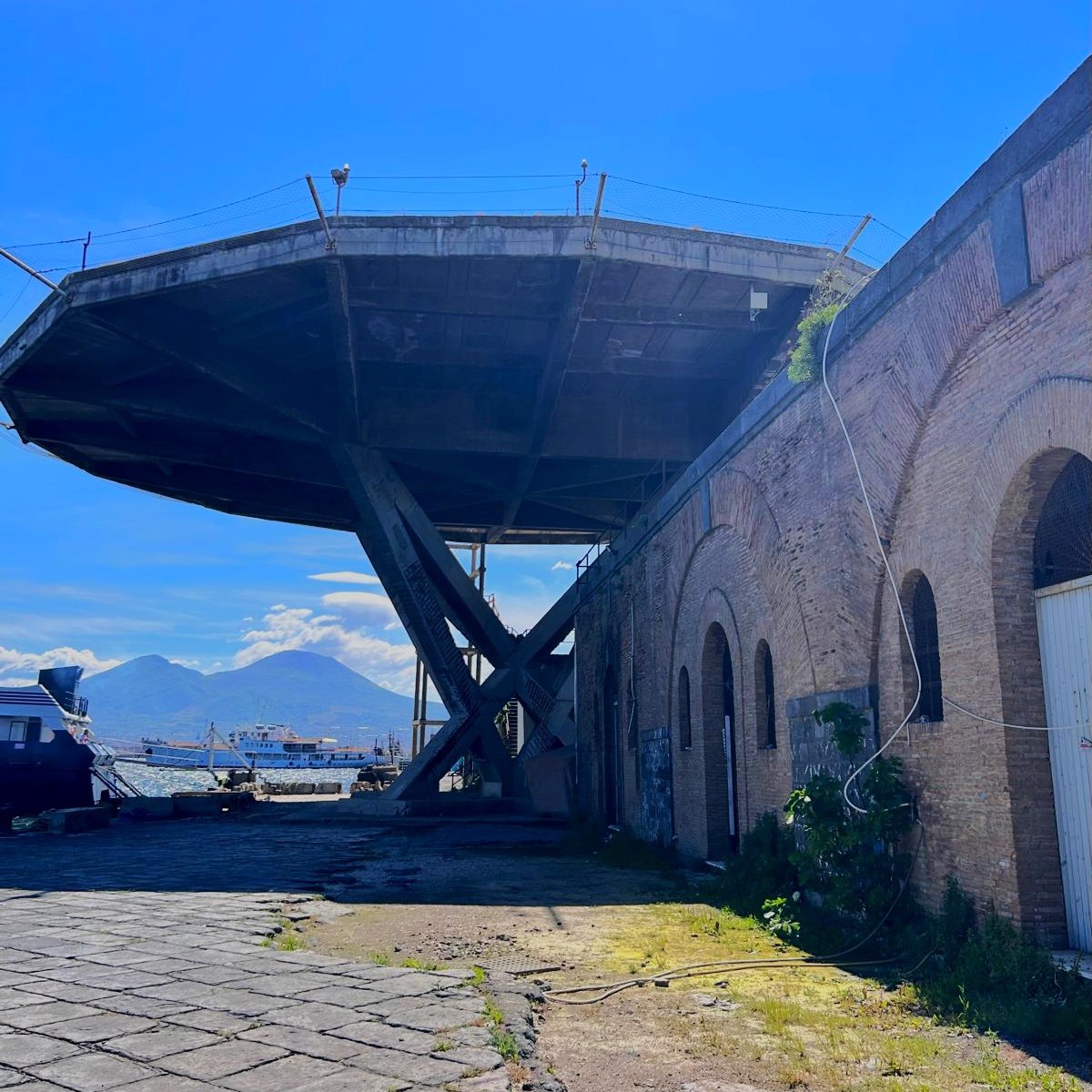
L’eliporto del Molo San Vincenzo. (© Benedetta Ettorre, 2025).
The heliport at Molo San Vincenzo. (© Benedetta Ettorre, 2025).
Dopo più di un decennio di trattative, dialogo e impegno da parte di amministrazioni competenti, Marina Militare e associazioni attive sul tema, tra cui quella dei Friends of Molo San Vincenzo, la struttura sarà finalmente riaperta al pubblico, offrendo una passeggiata che si prolunga per circa 2 km nel mare, offrendo una visuale del tutto nuova della città.
Il percorso pedonale sul Molo avrà inizio in corrispondenza dell’ingresso della Lega Navale, nei pressi dei giardini del Molosiglio. Il camminamento per i visitatori affiancherà la Base Navale e continuerà lungo i fabbricati esistenti fino a raggiungere la zona dedicata alla scuola di vela. Da quest’area si potrà poi accedere al tratto più esteso del molo, dove verrà realizzata una passerella adiacente alla barriera frangiflutti attuale: da qui i visitatori potranno godere di una prospettiva sul mare, fino al punto di confine con l’area gestita dall’AdSP. È previsto inoltre il recupero e l’apertura al pubblico del vecchio eliporto del molo, la cui fruizione sarà garantita da un ascensore panoramico in vetro. La particolare collocazione dell’eliporto garantirà un punto di osservazione a tutto tondo sul Golfo di Napoli e sulla città.
A completare il quadro delle progettualità introdotte di recente vi è il progetto del parcheggio interrato e della risistemazione delle aree circostanti gli ex Magazzini Generali lungo la Calata Piliero. Il progetto, già approvato e in fase di esecuzione, si inserisce in un più ampio programma di riqualificazione della Calata che coinvolge anche il restauro conservativo degli Ex Magazzini Generali e la sistemazione del sistema di accesso all’edificio Immacolatella, entrambi oggetto di altro incarico.
Il progetto si sviluppa su tre livelli: urbano, green e architettonico. La loro sovrapposizione, che prevede un ridisegno urbano che include sia spazi a quota stradale che interrati, mira a restituire alla città un rapporto più diretto e fluido con il mare, trasformando la calata in un’area ponte in grado di collegare i due spazi.
Dopo decenni di rallentamenti e discontinuità, il percorso di ri-connessione tra porto e città a Napoli sembra finalmente avviarsi verso una fase più matura e strutturata. La spinta data dalla crescita turistica e dal rinnovato interesse verso il waterfront ha favorito l’attivazione di strategie e interventi che, sebbene ancora in divenire, stanno già producendo effetti tangibili sullo spazio urbano e sulla percezione collettiva del porto.
I progetti attualmente in corso rappresentano tasselli di una visione più ampia che mira a restituire accessibilità, qualità e funzioni ai luoghi e agli spazi di interazione tra città e mare, nel rispetto delle loro specificità storiche, sociali ed economiche. Tuttavia, la piena riuscita di questo processo dipenderà dalla capacità delle istituzioni e degli attori coinvolti di garantire continuità e coordinamento, evitando nuove frammentazioni e dispersioni di risorse.
Napoli si trova oggi davanti a un’opportunità unica: trasformare la sua storica vocazione marittima in leva per uno sviluppo sostenibile, capace di rafforzare la competitività del porto e, allo stesso tempo, valorizzare il benessere urbano e l’identità collettiva. Se affrontata con visione e continuità, questa sfida, maturata attraverso un ventennio di interventi e strategie sul waterfront, potrà consolidare un rapporto porto-città finalmente riconciliato, celebrando il passato millenario della città e proiettandola con rinnovata ambizione verso il suo futuro sul mare.
After more than a decade of negotiations, dialogue, and commitment by the relevant administrations, the Italian Navy, and associations active on the issue—including the Friends of Molo San Vincenzo—the structure will finally be reopened to the public, offering a walkway extending for approximately 2 km out into the sea and providing an entirely new view of the city.
The pedestrian route along the pier will begin at the entrance of the Lega Navale, near the Molosiglio gardens. The visitors’ walkway will run alongside the Naval Base and continue past the existing buildings until it reaches the area dedicated to the sailing school. From here, access will be granted to the longest stretch of the pier, where a walkway will be built adjacent to the existing breakwater: from this point, visitors will be able to enjoy uninterrupted views of the sea up to the boundary with the area managed by the Port System Authority. The recovery and public opening of the pier’s former helipad is also planned; access will be ensured by a panoramic glass elevator. The helipad’s unique location will provide a 360-degree viewpoint over the Gulf of Naples and the city.
Completing the picture of the recently introduced planning initiatives is the project for an underground parking facility and the redevelopment of the areas surrounding the former Magazzini Generali building along Calata Piliero. Already approved and currently under construction, the project forms part of a broader program for the redevelopment of the Calata, which also includes the conservation restoration of the building and the reorganization of the access system to the Immacolatella building, both entrusted under separate commissions.
The project is articulated on three levels: urban, green, and architectural. Their superimposition, envisaging an urban redesign that incorporates both ground-level and underground spaces, aims to restore a more direct and fluid relationship between the city and the sea, transforming Calata Piliero into a connective area capable of linking the two realms.
After decades of delays and discontinuities, the process of reconnection between port and city in Naples now appears to be entering a more mature and structured phase. The impetus provided by tourism growth and renewed interest in the waterfront has facilitated the activation of strategies and interventions that, although still evolving, are already producing tangible effects on urban space and on the collective perception of the port.
The projects currently underway represent components of a broader vision aimed at restoring accessibility, quality, and functionality to the places and spaces of interaction between the city and the sea, while respecting their historical, social, and economic specificities. Yet the full success of this process will depend on the ability of institutions and stakeholders to ensure continuity and coordination, avoiding new forms of fragmentation and the dispersion of resources.
Today, Naples faces a unique opportunity: to transform its historic maritime vocation into a lever for sustainable development, capable of strengthening the competitiveness of the port while simultaneously enhancing urban well-being and collective identity. If pursued with vision and continuity, this challenge—matured through two decades of interventions and strategies along the waterfront—can consolidate a reconciled port-city relationship, celebrating the city’s millennia-old past while projecting it with renewed ambition toward its future on the sea.
IMMAGINE INIZIALE | Il ritrovato rapporto porto-città a Napoli. (© Benedetta Ettorre, 2024).
HEAD IMAGE | The rediscovered port-city relationship in Naples. (© Benedetta Ettorre, 2024).
╝
RIFERIMENTI
REFERENCES
Castagnaro, A. (2025), “Sulla storia del Molo San Vincenzo”. In Arcidiacono C., Castagnaro A., Clemente M., Giovene di Girasole E., Masucci U., Procentese F. (eds), La lunga rotta per la rigenerazione collaborativa del Molo San Vincenzo nel porto di Napoli, Paparo Editore. ISNB: 979 12 81389 748.
Amirante, R. (2001), Il porto di Napoli. Studi per la redazione del piano regolatore. Liguori.
Ettorre, B., Daldanise, G., Giovene di Girasole, E., & Clemente, M. (2023), “Co-Planning Port–City 2030: The InterACT Approach as a Booster for Port–City Sustainable Development”, in Sustainability,15(21), 15641. https://doi.org/10.3390/su152115641/.
Sacco, S., Cerreta, M. (2022), “A Decision-Making Process for Circular Development of City-Port Ecosystem: The East Naples Case Study”. In Gervasi, O., Murgante, B., Misra, S., Rocha, A.M.A.C., Garau, C. (eds) Computational Science and Its Applications – ICCSA 2022 Workshops. ICCSA 2022. Lecture Notes in Computer Science, vol 13378. Springer, Cham. https://doi.org/10.1007/978-3-031-10562-3_40/.
Strazza, N., Stival, C. A., & Garofolo, I. (2018), “Indirizzi di reversibilità nel recupero di involucri edilizi storici: il caso dei magazzini del Porto Vecchio di Trieste”. In Cuboni F., Desogus G., & Quaquero E. (eds.), Colloqui.AT.e (pp. 138–148), Edicom Edizioni.
Acierno, A., Paglliano, A., Robert, S., & Pistone, I. (2021), “Exploring the Potential of Urban Coastal Interfaces for Socio-Environmental Connections: The Cases of Marseille and Naples” in PORTUS Plus_ the Journal of RETE, vol. 12, Year XI, Special Issue “Re-Designing the City-Port Ecosystem. The Transformative Regeneration Challenge” RETE Publisher, Venice, ISSN: 2039-6422.
Cerreta, M., Giovene di Girasole, E., Poli, G., & Regalbuto, S. (2020), “Operationalizing the Circular City Model for Naples’ City-Port: A Hybrid Development Strategy”, in Sustainability, 12(7), 2927. https://doi.org/10.3390/su12072927/.
Clemente, M. (2018), “L’interazione porto città a Napoli dal mare alla regione” in PORTUS: the online magazine of RETE, vol. 35, Year XVIII, RETE Publisher, Venice, ISSN: 2282-5789. URL: https://portusonline.org/linterazione-porto-citta-a-napoli-dal-mare-alla-regione/.
Russo, M. (2023), “L’architettura bandita dal porto”, La Repubblica. https://napoli.repubblica.it/commenti/2023/02/23/news/larchitettura_bandita_dal_porto-389156745/.