╔
Introduction
To explore the climate‑related challenges affecting waterfront cities and the opportunities that urban design can offer in adapting to these evolving phenomena, we are pleased to host two leading experts, Arnoud Molenaar, Global Director Resilience and Partnerships at Square Floating City, and Richard Coutts, Founder of BACA Architects FRIBA. Their encounter brings together the strategic vision gained through Rotterdam’s urban governance – a quintessential water city and an international model of urban resilience – with the advanced research, design innovation, and technical expertise required to transform the concept of a ‘floating neighbourhood’ into a concrete and scalable reality.
Internationally recognised for his former role as Chief Resilience Officer of the City of Rotterdam, Molenaar led the city’s waterplan, adaptation programmes and resilience strategies for three decades, helping transform it into a global benchmark of climate adaptation. Today, he brings his outstanding public‑sector experience to the private sector’s challenge of climate-adaptive architecture, guiding strategic partnerships to make floating neighbourhoods a scalable and replicable reality for coastal cities around the world.
Among the leading international experts in floating architecture, Richard Coutts heads the London‑based practice BACA Architects, a pioneer in housing solutions that respond dynamically to rising sea levels. From the celebrated Amphibious House on the Thames to complex urban modules such as Square Floating City, his work focuses on integrating advanced research with high‑quality design and technological innovation, thereby redefining the relationship between the built environment and aquatic landscapes.
Conceived as a cross-perspective dialogue structured around key thematic blocks, this dual interview brings together complementary forms of strategic, technical, and design-driven expertise. Through targeted questions, their perspectives stand side by side to provide a clear understanding of the complexity and transformative potential of contemporary waterfronts, offering an integrated reading of the challenges and opportunities associated with living on water, within which the innovative scope of the Square Floating City project takes shape.
INTERVIEWER | Oriana GIOVINAZZI
Director of PORTUS Magazine
INTERVIEWEES | Arnoud MOLENAAR 1 and Richard COUTTS 2
1 Global Director Resilience and Partnerships at Square Floating City
2 Founder of BACA Architects, FRIBA.
Bridging Public Governance and Design Innovation
Oriana GIOVINAZZI |
After more than 30 years in the public sector as Chief Resilience Officer of Rotterdam, what motivated you to join Square Floating City? And in what ways does this new role allow you to accelerate climate adaptation compared to your previous institutional position?
Arnoud MOLENAAR |
In Rotterdam, I initially worked on developing a more integrated urban water-management approach, which later evolved into the Rotterdam Climate Proof programme in 2008, one of the world’s first integrated urban climate resilience programmes. During the past decade, as Chief Resilience Officer, climate adaptation remained a central focus throughout my work.
This unique trajectory allowed me to move beyond strategy and actively implement climate adaptation in practice. At the same time, I increasingly realised the global urgency for cities to accelerate adaptation efforts, particularly in vulnerable coastal and delta regions. Joining Square Floating City, part of the Blue21 group, offered the opportunity to apply this experience internationally and at greater speed. Floating urban development provides cities with a realistic and scalable response to several interconnected challenges: sea-level rise, land scarcity, housing shortages, and the growing need for climate-resilient urban expansion.
Oriana GIOVINAZZI |
How has your professional collaboration with Arnoud evolved now that you have joined forces within the Square Floating City project? How is his hands‑on experience in Rotterdam influencing BACA Architects’ design approach and parameters, particularly in relation to large-scale floating development?
Richard COUTTS |
For over two decades, BACA Architects has pioneered what we define as Aquatecture, moving from single-dwelling prototypes like the Amphibious House on the Thames to macro-scale flood mitigation frameworks, such as our work on Holland’s Room for the River initiative. However, transitioning from defensive flood resilience to creating large-scale, scalable real estate on water requires a fundamental shift in design parameters. Within the specific framework of the Square Floating City project, our collaboration with Arnoud acts as a catalyst. His long-standing institutional experience in Rotterdam allows us to benchmark our architectural parameters against rigorous, real-world public governance and climate adaptation standards. Instead of treating water as a constraint, this specific partnership enables us to refine the ‘Square’ system into a robust, standardised urban grid that perfectly aligns design innovation with the administrative and spatial realities of contemporary waterfront cities.
A New Paradigm for Urban Resilience
Oriana GIOVINAZZI |
Could you expand on the concept of Climate‑resilient Urban Design, outlining its core pillars and the approach that is reshaping contemporary coastal architecture? In what ways does the Square Floating City concept redefine traditional coastal and urban protection, shifting from a passive barrier to an adaptive system?
Richard COUTTS |
Climate-resilient Urban Design is a comprehensive philosophy that integrates management, planning, and the built environment to address the complex challenges cities face today. Urban areas grapple with obsolete infrastructure, slow planning processes, the need to accommodate growing populations with affordable housing and commercial spaces, as well as providing areas for play and recreation, all while confronting rising urban heat and climate impacts.
This approach is holistic and forward-looking, anticipating change and incorporating the flexibility to remediate existing issues, build a new, and adapt to ongoing stresses. A key opportunity lies in the transformation of post-industrial waterfronts, which can drive urban regeneration through climate resilience.
Effective waterfront and coastline regeneration is built upon some interlinked pillars:
- Active public realm
- Adaptable water-based uses
- Resilient flood management strategies
- Functional mixed-use development
- Strong visual and physical engagement with water
The Square Floating City concept exemplifies these principles as both a placemaking initiative and an enabling catalyst, while also being inherently adaptive as its blocks rise and fall with the tides and are designed to withstand long-term sea-level rise.

View of a few connected floating beachblocks. (Credit: Square Floating City).
Oriana GIOVINAZZI |
How does the idea of a ‘floating neighbourhood’ fit within the broader resilience strategy of a water‑based city, and what are the main administrative obstacles that must be overcome?
Arnoud MOLENAAR |
Floating neighbourhoods can contribute both to climate resilience and to social resilience. For rapidly growing coastal cities facing severe housing shortages and limited land availability, waterfront expansion offers a viable and climate-adaptive alternative.
Importantly, floating urban development reduces pressure on valuable ecosystems and discourages construction in flood-prone low-lying areas. Unlike conventional land reclamation, floating urbanism is inherently flexible and reversible: modules can be adapted, relocated, expanded, or reconfigured over time in response to changing urban needs.
Naturally, large-scale floating development also requires new forms of governance and close cooperation between municipalities, residents, infrastructure providers, and water authorities.
In many countries, existing frameworks suffer from a regulatory vacuum: regulations are often caught between maritime law – which treats structures as vessels – and terrestrial building codes, which fail to address dynamic water environments. Key administrative hurdles include securing real estate registry for water plots, obtaining long-term zoning permits, and establishing clear liabilities for underwater public utilities. To overcome this, coastal cities must pioneer adaptive, hybrid planning zones that bridge land and water under a single administrative framework.
The Social Dimension of Living on the Water
Oriana GIOVINAZZI |
The project envisions not only residential units, but fully-fledged urban fabrics equipped with public services and infrastructure. How do you approach the design of public spaces and ‘social life’ on water to ensure that these neighbourhoods become inclusive and vibrant places, avoiding the risk of creating mono-functional settlements or areas lacking a collective identity?
Richard COUTTS |
Designing vibrant, inclusive public spaces on water demands the same disciplined, structured approach as urban design on land, with added attention to the unique challenges of a floating environment. Placemaking on water requires a careful balance between private and publicly accessible spaces, thoughtful consideration of sightlines and active areas, and the seamless integration of essential everyday services, from waste management to emergency access.
Each Square Floating City module is designed to host a diverse mix of complementary uses, mirroring the dynamic balance found in thriving urban neighbourhoods with retail, commercial, residential, and leisure functions. The floating nature of the modules allows for innovative solutions like hiding much of the car parking at or below the waterline, creating pedestrian-friendly environments that prioritise people over vehicles.
Connectivity is enhanced by water taxis and inviting waterside squares, which encourage residents to engage actively with the river and public realm. Additionally, plug-in floating biohabitat modules introduce green spaces and natural habitats at water level, fostering biodiversity and enhancing quality of life. Together, these elements cultivate a rich urban fabric with a strong collective identity, ensuring these neighbourhoods are not mono-functional settlements but inclusive, characterful places where social life can flourish and communities thrive.
Oriana GIOVINAZZI |
Are cities truly ready to adapt their regulations and building codes to accommodate floating neighbourhoods that integrate both public and private functions? What is the greatest challenge in building global partnerships for projects as innovative as this one?
Arnoud MOLENAAR |
We are now entering precisely that transition phase. The growing urgency surrounding climate adaptation and housing shortages is forcing cities to explore new development models.
However, the greatest challenge in building global partnerships lies in overcoming the misalignment of timelines and risk perception between the public and private sectors. Private investors seek certainty on returns and faster deployment, while municipal authorities must prioritise long-term public safety, equity, and environmental accountability.
Rotterdam already provides valuable experience in overcoming these friction points, starting with the pioneering Floating Pavilion developed by Blue21, followed by floating offices and residential projects in dynamic tidal environments. These projects demonstrate that floating urban development can move beyond experimentation and become part of mainstream urban planning.
At the same time, because every city and every coastline is unique, successful implementation will always depend on building a shared vision through tailor-made governance frameworks, adaptive regulations, and deeply collaborative public-private cooperation.

Connections and public spaces between the floating neighborhoods and the mainland. (Credit: Square Floating City).
Challenges and Impacts of Modular Design
Oriana GIOVINAZZI |
What have been the most complex design challenges in large-scale floating urban development?
Richard COUTTS |
One of the most complex design challenges in large-scale floating urban development lies in overcoming perceptions and redefining ambition around what waterfronts can support. Historically, industrialised waterfronts were dominated by massive ocean-going vessels that occupied vast water surfaces, filling the docks with commercial activity, and often blocking the horizon with their sheer scale. In recent decades, many of these areas have been left largely empty, creating a psychological and physical void.
This legacy has shaped expectations: city planners and everyday residents alike have often struggled to envision vibrant, functional urban environments on water. Shifting these perceptions to accept floating developments as viable, valuable urban spaces has been a significant hurdle. However, recent projects featuring small clusters of floating homes, hotels, and conference spaces on water are helping to build confidence in this emerging sector. As these examples demonstrate success, ambition and acceptance are growing, paving the way for larger, more integrated floating urban developments. Still, cultural acceptance and regulatory clarity remain uneven across regions, and this will influence how quickly such developments can scale.

Top view of a floating neighborhood module. (Credit: Square Floating City).
Oriana GIOVINAZZI |
Looking closely at the concept of Square Floating City, the project proposes standardised modular blocks. Can this solution truly convince investors and coastal cities? In particular, how is it more advantageous and safer than traditional land reclamation and regeneration, including in terms of implementation speed and certainty of return on investment?
Arnoud MOLENAAR |
The modular logic of the system significantly improves scalability, flexibility, and implementation speed. Compared to conventional land reclamation projects, floating urban expansion can often be realised much faster and with substantially lower environmental impact. Depending on the project scale, a Square Floating City module could be delivered within approximately two to three years, whereas large land-reclamation projects often require close to a decade before urban development can even begin.
In addition, floating structures automatically adapt to tidal fluctuations and future sea-level rise, whereas reclaimed land requires continuous, expensive upgrading and reinforcement over time.
From an investment perspective, the combination of scalability, phased development, reduced climate risk, and accelerated implementation creates a highly competitive economic outlook for coastal cities and private investors alike.
The standardised modular blocks also create a socially resilient urban environment, comparable to the traditional square courtyards enclosed by surrounding homes, quiet, sheltered spaces that have existed for centuries. In an era marked by population ageing, increasing social isolation, and growing pressure on healthcare systems, these courtyards demonstrate how architecture can naturally foster social interaction, safety, and a sense of community. They create a living environment in which people can maintain their independence while remaining connected to those around them. Today, this approach is often referred to as ‘courtyard urbanism’.
In summary, floating development is not only a faster and more adaptive approach, but can also serve as a means to combine climate resilience, high-quality public space, social inclusivity, and ecological value in an integrated manner.
Scalability and Urban Integration
Oriana GIOVINAZZI |
The ‘Square’ module is not conceived as an isolated element, but as a component within a broader and more complex urban system. How can it be adapted to meet diverse functional needs? More specifically, how can high-end residential districts, social housing, public services, and collective spaces all be integrated within the same modular system, ensuring that this technology remains accessible and sustainable for every intended use?
Arnoud MOLENAAR |
From the perspective of Square Floating City, successful integration is closely linked to both scale and intelligent urban design. Within each city block, we envision a mixed-use environment combining residential functions with shared amenities and public space. As mentioned above, the central courtyard creates a protected and socially cohesive environment that encourages interaction at a human scale.
The design allows approximately 150 to 300 residents per module, which – from a scientific social-resilience perspective – creates a balanced, resilient and manageable community size.
Accessibility to the mainland remains essential and can be facilitated through walking, cycling, or transit connections. The internal floating infrastructure can also accommodate parking and technical facilities beneath the primary living layer, preserving pedestrian-friendly public space above.
As multiple modules become connected, urban diversity can increase further through specialised functions such as sports facilities, hospitality, cultural venues, educational programmes, or even floating data centres that deliver residual heat to surrounding neighbourhoods.
Beyond the urban structure, the project has developed a patented floating beach module that merges public recreational space with integrated wave attenuation.
These floating beach structures serve as dynamic coastal buffers, reducing wave impact while creating attractive public waterfront environments. This marks a shift from viewing coastal protection as a static defensive barrier toward an adaptive, multifunctional urban system that harmonises resilience, ecology, and public space.
Looking ahead, connected chains of floating modules could reinforce vulnerable coastlines and enable cities to expand in a climate-responsive, resilient manner, reshaping contemporary coastal architecture with innovation and sustainability at its core.
Oriana GIOVINAZZI |
‘The ‘Square’ concept relies heavily on modularity. From an architectural and technical perspective, there is a risk that standardising blocks could compromise aesthetic quality and landscape integration. Which design solutions make the system truly scalable and adaptable to different geographic and cultural contexts?
Richard COUTTS |
The ‘Square’ concept functions more like a versatile kit of adaptable parts rather than rigid, standardised blocks. Its shape and proportions can be tailored to fit the specific context of each site – whether that means longer and shallower modules to suit a particular dock or unique waterfront configuration.
From an architectural and technical standpoint, the engineering provides a robust and stable foundation, allowing for site-specific design adaptations. This flexibility enables the integration of local materials, craftsmanship, and detailing, ensuring that the architecture resonates strongly with its geographic and cultural context. In this way, the system remains truly scalable and adaptable without compromising aesthetic quality or landscape integration, fostering unique and contextually meaningful urban environments.
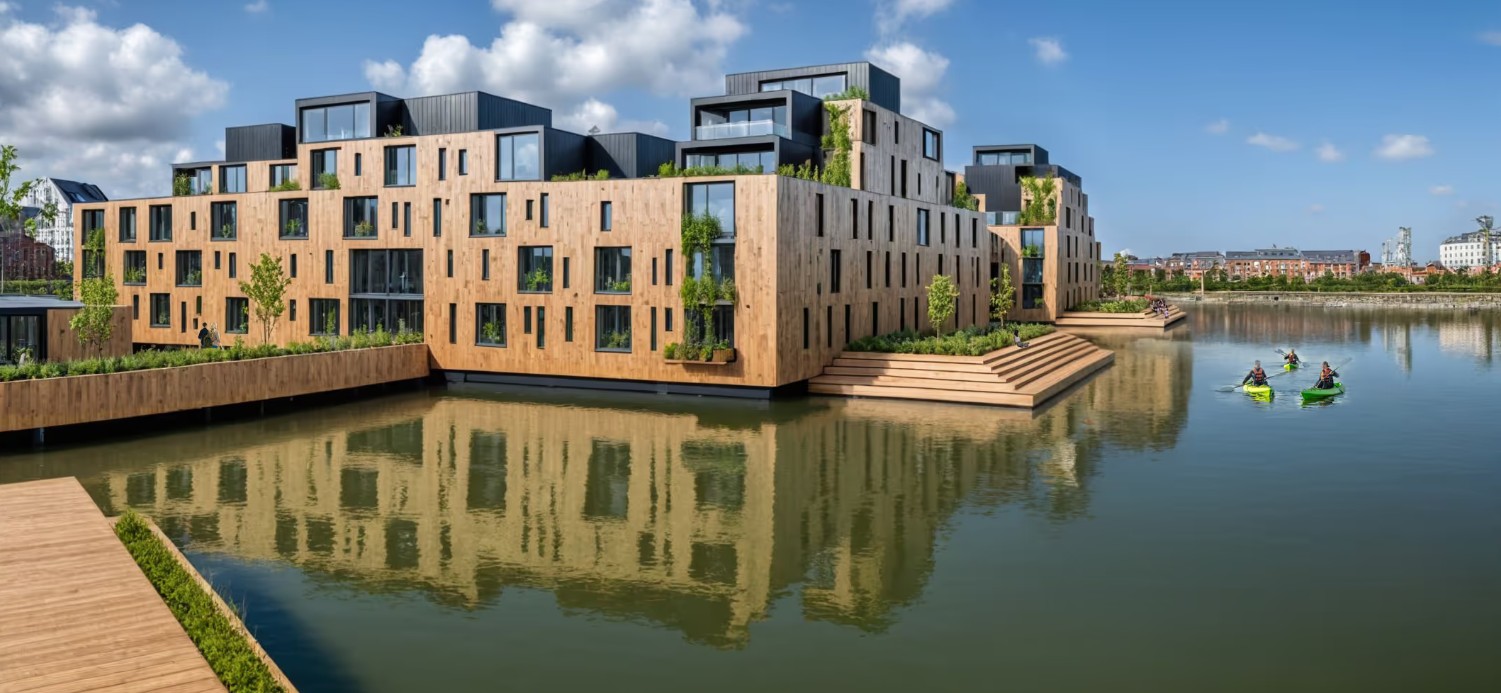
Floating complex with wooden facades. (Credit: BACA Architects; Square Floating City).

River view of a floating neighborhood with wooden facades. (Credit: BACA Architects; Square Floating City).
Oriana GIOVINAZZI |
One of the most common misconceptions is that nearshore architectures tend to create enclaves or isolated ‘islands’, fragmenting the urban landscape. How does the Square Floating City project overcome the waterfront barrier to ensure visual and physical continuity with the existing urban fabric?
Arnoud MOLENAAR and Richard COUTTS |
The project overcomes this risk by designing the floating modules not as isolated destinations, but as direct, organic extensions of the existing street grid and public realm. By carefully aligning sightlines, pedestrian pathways, and public squares between land and water, the waterfront ceases to be a psychological or physical barrier.
This visual continuity is fully supported by an open, multimodal infrastructure. Because the internal layout strictly prioritises pedestrian movement, cycling connections, and water taxis directly linked to the mainland, these neighbourhoods function as fully integrated urban districts. Ultimately, the system is engineered to draw the surrounding land-based community inward, ensuring that the floating fabric remains a shared, inclusive asset for the entire city rather than an isolated and fragmented enclave. Their long-term success will depend on how effectively cities adapt planning tools and regulatory frameworks to these new environments.
Urban Metabolism and Ecosystem Regeneration
Oriana GIOVINAZZI |
Looking at the evolution of your research – from the Amphibious House on the Thames to larger structures, such as the ‘Square’ module – the shift in scale is striking. Which radical innovations, both in material science and in circular urban metabolism systems (energy, water, waste), distinguish this project from your previous experiences?
Richard COUTTS |
Regardless of scale, good design always follows consistent principles: site and context integration, programme development, cultural and community engagement, technical integrity, sustainability, and aesthetic excellence.
This philosophy guided our work on the British Government’s LifE project, focused on zero-carbon communities with integrated flood mitigation through large-scale master plans combining resilient architecture on land and water. Our first major built response was in Nijmegen, Holland, developed alongside colleagues from Delft University’s engineering department, where the foundation for the Square Floating City concept originally took shape. We believe that the accumulation of small built environment wins can create significant impact at scale.
Transitioning to this urban scale, however, required a fundamental evolution in our technical approach. While our early projects relied on lightweight residential structures, the ‘Square’ modules leverage advanced marine engineering, utilising modular concrete platforms and composite materials designed to eliminate saltwater corrosion. Furthermore, from a circular metabolism perspective, the system integrates localised smart grids, water-source heat pumps that exploit the thermal energy of the water, closed-loop water purification systems, and dynamic solar shading. This moves the design parameters away from single-home resilience toward a fully integrated, self-sufficient urban ecosystem.
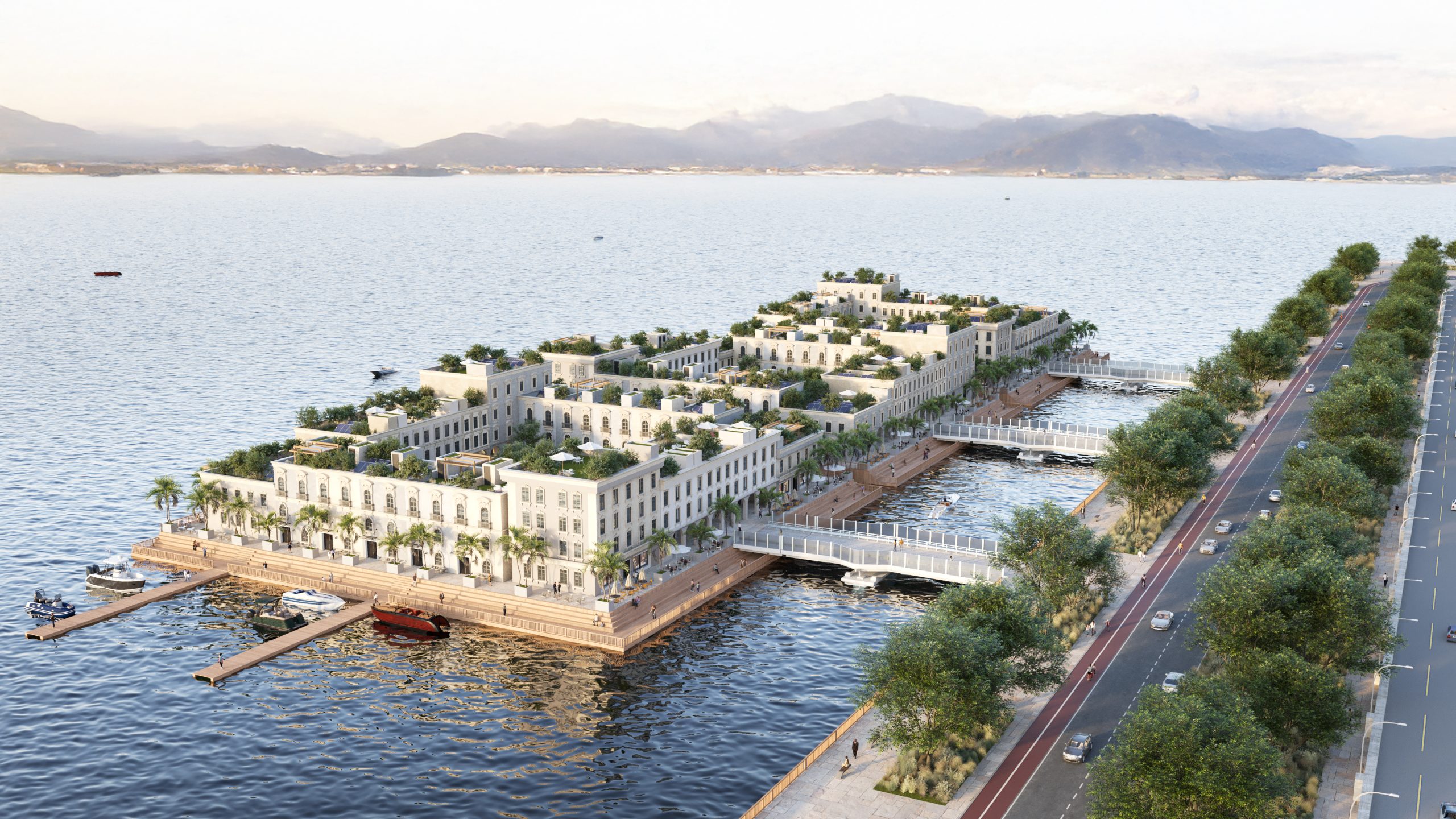
Three connected floating modules. (Credit: Square Floating City).
Oriana GIOVINAZZI |
One of the main concerns surrounding floating urbanism relates to biodiversity protection. From the perspective of governance and environmental regulation, how are you approaching the assessment of long-term ecological impact? Looking beyond neutrality, how can these structures ensure durability in dynamic marine environments and become true ecological catalysts capable of actively contributing to ecosystem regeneration?
Arnoud MOLENAAR |
Biodiversity is one of the most important and frequently discussed themes surrounding floating urban development. The ecological impact always depends on local conditions, including water depth, currents, salinity, and existing ecosystems. To address this, together with our sister company INDYMO, we conducted monitoring research using underwater drones and ecological sensors. The study covered eighteen locations. The results were published in a peer-reviewed publication in the Journal of Water and Climate Change: “Impacts of floating urbanization on water quality and aquatic ecosystems: a study based on in situ data and observations” (2022).
The conclusion is that water quality is not critically affected and that underwater images reveal vibrant ecosystems, including biofouling and filter feeders. Even ecological benefits are possible, but they remain dependent on the specific location and design.

Floating Futures. View of module with ev panels and green rooftops. (Credit: Square Floating City).
Floating structures can create new habitats and increase ecological diversity by introducing sheltered environments for fish, mussels, and aquatic vegetation. Careful spacing between modules is essential, particularly in shallow waters, to ensure sufficient light penetration and ecological continuity. Importantly, floating urban development avoids large-scale land reclamation, thereby preserving seabeds, wetlands, and coral ecosystems that would otherwise be heavily disrupted by conventional coastal expansion.
Furthermore, durability and ecological catalyst behaviour go hand in hand: the floating modules are designed for a lifespan of at least seventy years. To guarantee this lifecycle, maintenance and structural inspections can increasingly be carried out using underwater robotics and monitoring systems already proven within the maritime sector. From a long-term sustainability perspective, our ultimate ambition is to develop highly self-sufficient neighbourhoods integrating renewable energy generation, circular water systems, wastewater treatment, and smart mobility infrastructure, proving that partially off-grid operation is already a technically feasible reality for resilient waterfronts.
The Geography of Resilience and Emerging Markets
Oriana GIOVINAZZI |
Moving from vision to operational practice: in which geographical and institutional contexts is this revolution beginning to take shape? What political and economic drivers make it possible to translate an ambitious concept into an actual construction site?
Arnoud MOLENAAR and Richard COUTTS |
Several major drivers are accelerating interest in floating urban development worldwide. First, climate change is increasing the vulnerability of low-lying coastal cities to flooding, sea-level rise, and heat stress. Second, rapid urbanisation is generating an enormous demand for new housing and infrastructure. Third, the growing scarcity and environmental cost of sand reclamation are making conventional coastal expansion increasingly problematic. As a result, floating development is gradually evolving from an experimental niche into a serious climate-adaptation strategy for waterfront cities.
From a design and construction perspective, these economic and environmental drivers are what finally allow us to move from isolated prototypes to scalable waterfront construction sites. When sand reclamation becomes too expensive or ecologically damaging, the financial sector and city planners suddenly become highly receptive to modular floating solutions as a viable, bankable alternative.
Oriana GIOVINAZZI |
Which specific cities or global regions are showing the strongest interest in your partnership proposals? Does a clear ‘resilience market’ already exist, and in your view, which geographies are likely to drive demand in the coming years?
Arnoud MOLENAAR |
So far, three regions in particular have shown strong interest, albeit for different reasons.
In Europe, many coastal cities are simultaneously facing severe housing shortages and limited spatial capacity, while possessing underutilised waterfronts and former port areas undergoing transition. Floating neighbourhoods can provide flexible urban expansion without increasing pressure on vulnerable land-based areas.
In the Middle East, waterfront megaprojects and artificial-island developments are creating opportunities for alternative floating solutions that are potentially more adaptive and environmentally responsible than traditional reclamation approaches.
Finally, the Caribbean is emerging as an especially relevant context due to its combination of land scarcity, tourism-driven economies, climate vulnerability, and growing housing demand. Several islands within the Kingdom of the Netherlands are actively exploring climate-adaptive waterfront development strategies.
In addition, the Asia-Pacific region – including Singapore, Japan, and South Korea – is likely to emerge as a major market for large-scale waterfront developments in the coming decades. Initial applications will most likely focus on port-related and industrial functions, paving the way for floating infrastructure and, eventually, residential real estate. The progression from working waterfronts to floating urban districts appears less a question of possibility than of timing.
Oriana GIOVINAZZI |
Which pilot projects currently under development – or feasibility studies already underway – best represent the technical, qualitative, and formal evolution of the ‘Square’ module?
Richard COUTTS |
Island nations currently face the most immediate pressure, as they are uniquely at risk from accelerating sea-level rise. We are currently in the advanced stages of undertaking comprehensive feasibility studies across a number of European post-industrial dock settings, focusing on transforming dormant historical basins into vibrant urban sectors. These pilots allow us to test the spatial integration of the ‘Square’ architecture within strictly regulated urban frameworks. We look forward to demonstrating full proof-of-concept for a large-scale square floating city module in the very near future, bridging the gap between innovative marine engineering and actual waterfront regeneration.
A Roadmap to Global Adaptation
Oriana GIOVINAZZI |
As a final forward-looking question and projecting this vision over the next decade, what will be the key indicators of success for Square Floating City? More specifically, what strategic and institutional milestones are needed to transform this model into a widely recognised urban solution?
Arnoud MOLENAAR |
As with many innovations in urban development, the process begins with a launching customer and the successful realisation of a first demonstrator project.
Following rigorous engineering, validation, and testing phases, the next objective is to develop a fully operational and scalable floating neighbourhood concept that can serve as an international reference project. Different product–market combinations are currently being explored to respond to the diverse needs of European, Middle Eastern, and Caribbean cities. In the longer term, scaling toward larger floating districts – and eventually fully integrated floating urban extensions – will become increasingly feasible through industrialised and highly automated production methods.
It is likely only a matter of time before floating urban development becomes part of the standard toolkit for climate-adaptive cities. Cities such as Rotterdam have already demonstrated that floating architecture can move beyond experimentation through singular projects including floating homes, offices, and public pavilions.
The next phase is to scale from individual structures toward interconnected floating neighbourhoods and districts integrated with existing urban fabrics. Initially, these developments will remain closely connected to land-based infrastructure and governance systems.
The transition to large-scale floating urban development may become a reality in the Netherlands sooner than many expect. Representatives of Square Floating City (and BLUE21) have already held discussions with members of parliament and government ministries regarding IJstad, one of the proposed new cities intended to address future housing demand. As a result, the concept of a ‘Floating IJstad’ is now also being considered as a potential development scenario. Should such a vision move forward, the Netherlands could once again set an international benchmark in the field of floating urbanism.

View of three floating neighborhood modules. (Credit: Square Floating City).
Oriana GIOVINAZZI |
In conclusion, do you believe that ‘living on water’ is destined to become a global urban standard for resilient port cities and waterfronts, or will it remain a niche solution? Based on your experience across the built environment, what do you see as the primary hurdles that still need to be cleared to make this vision a truly scalable reality?
Richard COUTTS |
The greatest challenges are no longer purely technical. Cultural acceptance, governance frameworks, financing models, environmental regulations, and long-term public trust will ultimately determine the pace at which floating urban development becomes globally scalable.
To overcome these hurdles, the evolution from single-dwelling prototypes to a true urban standard requires treating nearshore infrastructure not as a rigid block, but as a flexible ‘kit of parts’. At BACA Architects, our experience designing pioneering flood-resilient master plans, such as the floating village in Dordrecht, has taught us that scalability is achieved through incremental growth. Standardised floating city blocks allow post-industrial cities to reclaim underutilised docklands step by step. This matches real-estate demand without requiring massive, risky up-front capital investments. Once planning codes adapt to treat water plots with the same statutory certainty as land, modular floating systems will cease to be high-end exceptions and will become a standard, bankable model for global urban resilience.
HEAD IMAGE | View of one floating neighbourhood module. (Credit: Square Floating City).